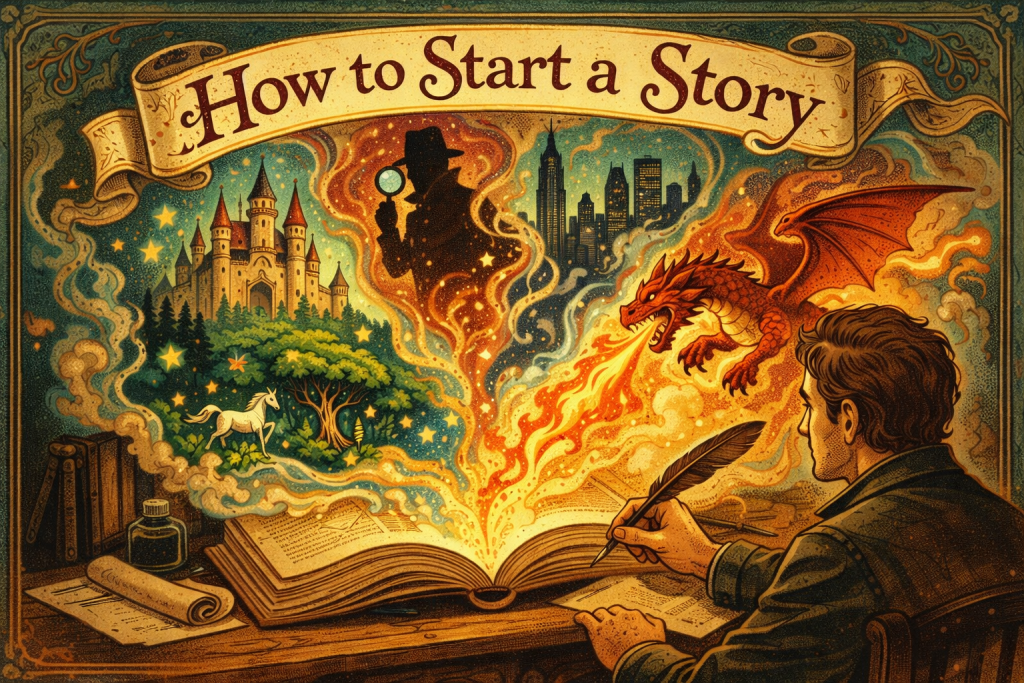
Every writer knows the feeling.
You have an idea — maybe a character, a world, or a fragment of a scene — but when you sit down to start the story, the page stares back at you like an unsolved puzzle.
Where should the story begin?
Do you introduce the world first?
Start with action?
Explain the backstory?
Introduce the characters?
The truth is there isn’t just one correct way to start a story. But there are certain principles that help a beginning feel compelling rather than slow or confusing.
The opening of your story has one main job:
Make the reader curious enough to keep reading.
Let’s explore how great openings achieve that.
Start With Something That Changes
The worst way to begin a story is with a perfectly normal day.
Stories thrive on change.
Something needs to happen that disrupts the ordinary life of your character. It doesn’t need to be an explosion or a dramatic twist — sometimes even a small shift can spark the story.
Examples:
- A letter arrives that shouldn’t exist
- Someone overhears a dangerous secret
- A stranger appears in town
- A simple decision leads to unexpected consequences
When something changes, readers instinctively want to know what happens next.
Conflict and tension early in a story create momentum that pulls the reader forward.
Introduce a Character in Motion
Readers connect with people more than descriptions.
Instead of explaining everything about your protagonist, let us see them doing something.
A character trying to achieve something — even something small — immediately creates interest.
For example:
Instead of:
Sarah was a shy librarian who had always lived in the same town.
Try:
Sarah locked the library door five minutes early and ran. The envelope in her pocket felt heavier with every step.
Now the reader has questions.
Why is she running?
What’s in the envelope?
Why does it matter?
Questions create curiosity — and curiosity keeps readers turning pages.
Choose Your Point of View Carefully
Point of view shapes how the reader experiences the story.
Your choice of perspective influences everything: tone, emotional connection, and how much information the reader receives.
For example:
- First person creates intimacy and personal insight
- Third person offers a broader view of events and multiple characters
Choosing the right perspective early helps establish a clear narrative voice and guides how readers interpret the story.
Drop the Reader Into a World
A strong opening also gives readers a sense of place.
This doesn’t mean writing three pages of description before anything happens. Instead, weave details naturally into the action.
Think about sensory details:
- What does the environment look like?
- What sounds fill the air?
- What smells linger in the space?
- What textures surround the characters?
Atmosphere helps readers feel like they’ve stepped inside the story world.
Use Dialogue or Action to Hook Attention
One of the fastest ways to engage readers is through movement or conversation.
Action creates immediate visual interest. Dialogue reveals character and tension.
For example:
“You shouldn’t have come here,” he said.
I closed the door behind me. “You sent the letter.”
In just two lines, the reader senses conflict, mystery, and character dynamics.
Starting with action or dialogue can make the first page feel alive instead of static.
Give the Reader a Question to Solve
A powerful opening almost always contains a mystery.
Not necessarily a crime — but something unexplained.
It might be:
- a strange event
- a character hiding something
- an unusual setting
- an emotional conflict
Readers instinctively try to solve puzzles. When the story offers one early, it encourages them to continue reading to uncover the answer.
Hint at What’s Coming
Great openings often contain subtle clues about the story ahead.
These hints are called foreshadowing.
Maybe a character notices something strange.
Maybe an object appears that will become important later.
Maybe a line of dialogue carries deeper meaning.
Small hints create a sense that the story has layers waiting to unfold.
Avoid the Common Opening Mistakes
Some beginnings struggle because they fall into predictable traps.
Here are a few pitfalls worth avoiding.
Too much backstory
Readers don’t need to know everything immediately. Let the story reveal information gradually.
A slow start
If nothing happens for several pages, readers may lose interest before the story truly begins.
Too many characters
Introducing too many people in the opening can overwhelm readers. Focus on one or two characters first.
Overexplaining the world
Trust readers to figure things out through context.
The Secret of Great Beginnings
Here’s something many writers don’t realise:
You don’t have to get the beginning perfect the first time.
Most authors rewrite their opening chapters multiple times.
Sometimes the real beginning only becomes clear after the story is finished. Once you understand the full journey of the characters, it becomes easier to see where the story truly starts.
So don’t obsess over perfection on the first draft.
Start somewhere interesting.
You can always refine it later.
Final Thought
The opening of a story is not about explaining everything.
It’s about inviting the reader into a world and giving them a reason to stay.
If your first page introduces a character, hints at conflict, and sparks curiosity, you’re already doing something right.
From there, the story can unfold naturally — one scene, one discovery, and one turning page at a time.
There’s a delicious, tingling moment in every novel-in-progress where the story goes from blank space to spark. It’s the whisper of a character you don’t . . .
Every writer eventually meets them: the villain who should be terrifying… but somehow lands closer to awkward karaoke act than dark overlord. On paper, they’re . . .
Dialogue is one of those slippery beasts in fiction. Get it right and your characters breathe — they walk into a room, speak, and suddenly . . .
There comes a point — usually somewhere between draft number three and “why am I doing this to myself?” — when writing stops feeling like . . .