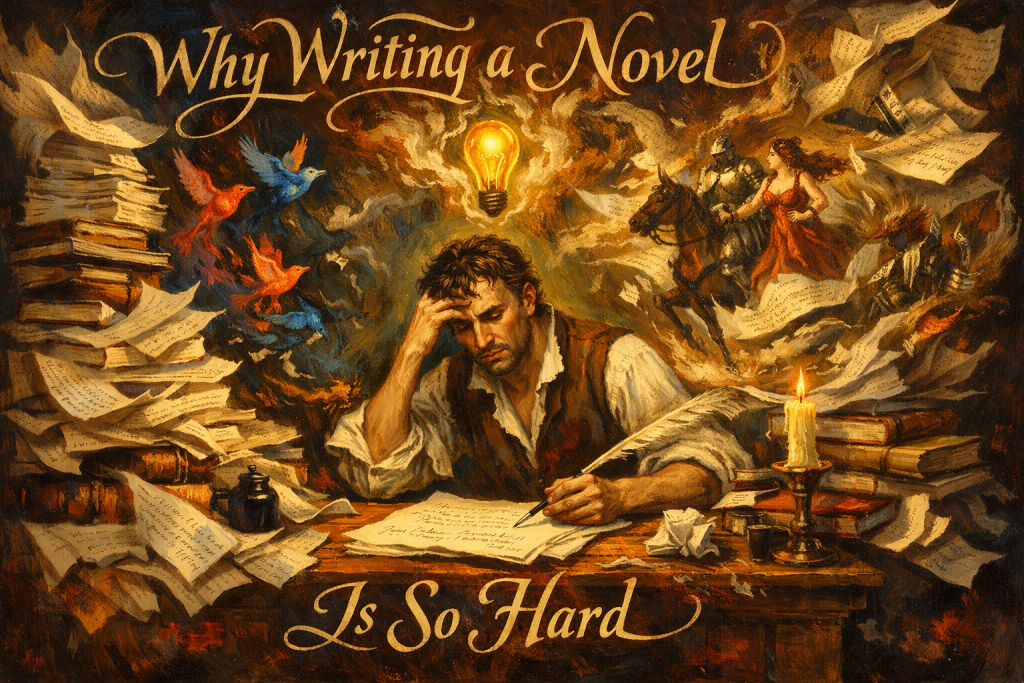
At some point, every writer hits the same wall.
Not a gentle hesitation.
Not a passing doubt.
A wall.
It usually sounds something like this:
“Why is this so hard?”
You had the idea. You felt the excitement. You imagined the finished book sitting in your hands.
And then you tried to write it.
Suddenly, everything slowed down.
The words didn’t come easily.
The plot didn’t behave.
The characters refused to cooperate.
The story that felt vivid in your head turned vague on the page.
So let’s be honest about it:
Writing a novel is hard.
Not because something is wrong with you.
But because of what a novel actually demands.
The Lie We Quietly Believe
Most writers start with a quiet assumption:
“If I have a good idea, writing the book should be fairly straightforward.”
That assumption is the problem.
Because a novel isn’t just an idea.
It’s structure.
It’s pacing.
It’s character psychology.
It’s language.
It’s emotional control.
It’s consistency over tens of thousands of words.
In reality, writing a novel is not one skill.
It’s a dozen different skills stacked on top of each other, pretending to be one thing.
And when one of those skills is underdeveloped, the whole process starts to feel difficult.
The Real Reasons It Feels So Hard
Let’s break this down properly — not in vague motivational terms, but in practical reality.
1. You’re Trying to Turn an Idea Into a Full Story
Ideas are easy.
You can come up with ten in a single afternoon.
But most ideas only contain enough material for:
- a short scene
- a concept
- maybe a few chapters
When you try to stretch that into a full novel, things fall apart.
This is where many writers struggle:
They don’t lack imagination — they lack structure.
You need:
- a clear protagonist
- a central conflict
- meaningful escalation
- a sense of progression
Without those, writing feels like wandering without a map.
2. You Can See It Clearly — But You Can’t Write It Clearly
This is one of the most frustrating parts of writing.
In your head, the story feels:
- vivid
- cinematic
- emotionally powerful
But when you try to put it into words…
It collapses.
Sentences feel flat.
Scenes feel rushed.
Dialogue feels unnatural.
That disconnect makes you question your ability.
But here’s the truth:
Translating imagination into language is a skill — not a talent you either have or don’t.
And like any skill, it improves through repetition.
3. You’re Trying to Be Good Too Early
This is where most writers sabotage themselves.
They sit down to write a first draft… and expect it to be good.
So they:
- rewrite sentences endlessly
- second-guess every word
- delete more than they create
This slows everything down.
And worse — it drains your momentum.
A first draft isn’t supposed to be polished.
It’s supposed to exist.
In fact, many successful writers openly accept that early drafts are messy, rough, even “bad” — because that’s what gives them something to improve later.
You cannot edit a blank page.
4. You’re Overthinking Instead of Writing
There’s a trap writers fall into that feels productive but isn’t.
They spend time:
- planning endlessly
- researching minor details
- watching writing advice videos
- thinking about writing instead of doing it
This creates the illusion of progress.
But it avoids the only thing that actually moves a novel forward:
putting words on the page.
Even small, imperfect progress is more valuable than perfect planning that never becomes writing.
5. You’re Working Against Your Own Process
One of the quiet frustrations of writing is this:
Writers often try to work in ways that don’t suit them.
You might think you should:
- write on a laptop
- outline everything
- write in silence
- draft in order
But what if that doesn’t work for you?
Some writers:
- draft by hand
- write out of sequence
- work in noisy environments
- focus on dialogue first
There’s no universal method.
Writing becomes harder when you force yourself into a process that doesn’t fit your brain.
6. You Underestimated the Scale
A novel is big.
Not just in word count — in mental effort.
You’re holding:
- multiple characters
- overlapping plotlines
- emotional arcs
- pacing decisions
- thematic threads
All at once.
That’s not a small creative task.
It’s closer to building something than simply expressing something.
And like any large project, it can feel overwhelming if you try to carry it all at once.
Why This Difficulty Isn’t a Problem
Now here’s the part most people don’t say clearly enough:
The difficulty is not a flaw. It’s a feature.
If writing a novel were easy:
- everyone would finish one
- most stories would feel identical
- the skill would carry less value
The challenge is what filters out casual effort from committed craft.
And more importantly:
Difficulty is how you improve.
It’s the resistance that builds ability.
How to Make It Feel Easier (Without Expecting It to Be Easy)
You don’t remove the difficulty.
You manage it.
Break the Process Into Smaller Pieces
Don’t think:
“I need to write a novel.”
Think:
- “I’ll write one scene.”
- “I’ll write 500 words.”
- “I’ll fix this paragraph.”
A novel is just a collection of smaller, manageable tasks.
Focus on One Skill at a Time
If everything feels hard, narrow your focus.
Work on:
- dialogue in one session
- description in another
- structure separately
Trying to master everything at once creates unnecessary pressure.
Accept That Progress Is Messy
Some days will feel productive.
Others won’t.
That’s not failure — that’s part of the process.
Writing is not a straight line.
Write More Than You Think
There’s no shortcut here.
Skill improves through volume.
The more you write:
- the clearer your voice becomes
- the faster your ideas translate
- the easier the process feels
The Quiet Truth About Writing a Novel
No one talks about this enough:
Even experienced writers find it difficult.
They just understand the difficulty differently.
They don’t see it as:
“I can’t do this.”
They see it as:
“This is the work.”
Final Thought
Writing a novel feels hard because it is hard.
You’re creating something from nothing.
You’re shaping ideas into structure.
You’re translating thought into language.
You’re building something that didn’t exist before.
That’s not supposed to be easy.
But here’s the part that matters:
Hard doesn’t mean impossible.
It means worthwhile.
Artificial intelligence can now write essays, generate poetry, outline stories, and even produce entire book-length manuscripts in minutes. Because of this, one question keeps appearing . . .
Artificial intelligence is rapidly changing the way people write. Tools can generate outlines, suggest dialogue, correct grammar, and even draft entire chapters in seconds. For . . .
If you spend any time around writing communities today, you’ll eventually encounter a bold claim: “You can write an entire novel with AI.” Some websites . . .
There’s a quiet, persistent fear that creeps into a lot of would-be writers’ minds. It usually arrives disguised as a sensible question, but it carries . . .