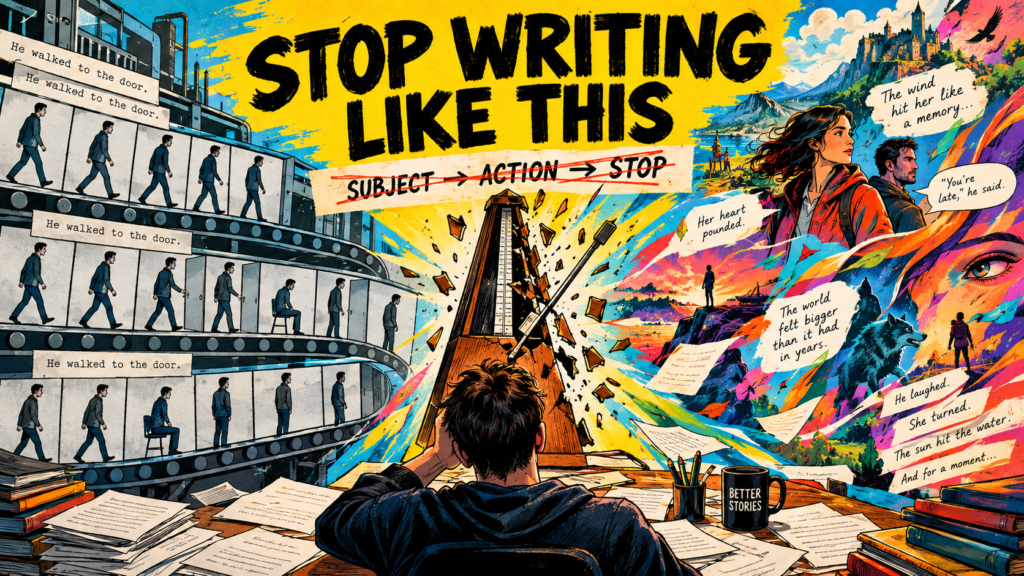
There is a piece of writing advice that sounds sensible, looks sensible and is, in isolation, absolutely sensible:
Keep your writing clear.
Put the character in the sentence. Give them something to do. Move the story forward.
So you write:
Jack opened the door.
He looked outside.
He stepped onto the pavement.
He pulled the door shut.
He walked towards the car.
Nothing is grammatically wrong with any of those sentences.
In fact, the basic construction is perfectly useful. Putting the person or thing performing the action into the subject position and expressing the action clearly in the verb is generally a straightforward way of making prose easy to understand.
The problem starts when you do it all the time.
Because eventually your novel starts reading like a list of instructions.
He did this.
She did that.
He looked.
She turned.
He walked.
She picked it up.
He put it down.
They left.
Nothing is technically wrong.
And yet the writing feels dead.
This is one of those problems that can be surprisingly difficult to spot when you’re too close to your own manuscript.
You aren’t necessarily writing badly.
You’re writing the same way repeatedly.
And repetition of sentence structure can flatten even perfectly good prose.
The Problem Isn’t Subject → Action
Let’s get one thing out of the way first.
I’m not suggesting you stop using simple sentences.
I’m not suggesting every sentence needs to be complicated.
And I’m certainly not suggesting you start throwing commas, semicolons and elaborate descriptions into everything just to prove you can.
A sentence like:
Sarah opened the window.
is perfectly good.
Sometimes Sarah needs to open the window.
The reader needs to know that she opened it.
So tell them.
The problem is what happens when the next sentence is:
Sarah looked outside.
And then:
Sarah closed the window.
And then:
Sarah walked back to the table.
And then:
Sarah picked up her phone.
And then:
Sarah checked the time.
At that point, you’re no longer writing a scene.
You’re reporting choreography.
The reader knows what Sarah physically did, but very little else is happening.
Your Reader Isn’t Watching a Security Camera
This is the simplest way I know to explain the problem.
Imagine your scene is being recorded by a security camera.
What would the camera see?
Sarah enters the room.
Sarah crosses the room.
Sarah opens a cupboard.
Sarah removes a glass.
Sarah fills the glass.
Sarah drinks.
Sarah puts the glass down.
Sarah leaves.
That’s a perfectly accurate record of events.
It is also a terrible novel.
Because fiction isn’t supposed to record everything a character does.
It is supposed to make the reader experience what matters.
There is a huge difference.
Consider this:
Tom walked into the kitchen. He opened the cupboard. He took out a glass. He filled it with water.
Now try:
Tom went into the kitchen for a glass of water, then stopped when he saw the cupboard door hanging open.
Suddenly, the reader has a reason to care.
The physical movement is still there.
But something has changed.
The action now contains information.
And that’s the key.
Action should not merely tell us what the character’s body is doing. It should contribute something to the scene.
Don’t Describe Every Movement
One of the easiest ways to fall into this pattern is believing that readers need to know every physical step a character takes.
They don’t.
If a character walks across a room, opens a drawer and takes out a knife, you probably don’t need:
James stood up.
James walked across the room.
James stopped beside the table.
James opened the drawer.
James reached inside.
James picked up the knife.
Unless the individual movements matter, you’ve just spent five sentences telling us something that could have taken one.
James crossed the room and took the knife from the drawer.
Or:
James opened the drawer.
And perhaps the knife is already in his hand in the next sentence.
The reader is perfectly capable of joining the dots.
In fact, allowing them to do so can make the prose feel more confident.
You don’t have to narrate a character’s entire skeleton.
But Don’t Go Too Far the Other Way
This is where writing advice often becomes ridiculous.
Someone tells you:
“Stop writing simple sentences!”
So you start writing sentences like this:
As James, having finally managed to convince himself that there was really no alternative available to him at this particular moment, reluctantly crossed the room towards the old wooden dresser, which had been standing against the far wall for longer than he could remember, he began to wonder whether perhaps…
No.
You’ve fixed one problem by creating another.
Simple isn’t bad.
Monotonous is bad.
There is an important difference.
A short sentence can be powerful.
A long sentence can be boring.
A complicated sentence can be beautiful.
A simple sentence can be exactly what a scene needs.
The objective isn’t to make every sentence structurally different.
It’s to make the structure serve what is happening.
Sentence Rhythm Is Part of Storytelling
Think about music.
Imagine a song where every note has exactly the same duration, volume and emphasis.
You could listen to it.
But it wouldn’t have much rhythm.
Prose works in much the same way.
Sentence length and structure create rhythm.
Short sentences can accelerate a scene.
Longer sentences can slow it down, allow thoughts to develop or create a sense of observation and immersion.
A sudden short sentence after a long passage can hit hard.
He had spent the entire journey telling himself that the house would be empty, that the lights were probably on a timer, that the broken window was probably nothing more than an accident caused by the storm.
It wasn’t empty.
That final sentence works because the rhythm changes.
Imagine instead:
He drove to the house. He parked outside. He got out. He walked to the door. He saw the broken window. He realised the house wasn’t empty.
Technically clear.
Dramatically flat.
The sentence structure is doing almost nothing to support the tension.
Stop Starting Every Sentence With the Character
This is another common symptom.
Read your manuscript and look at the beginnings of your sentences.
If you see:
He…
He…
He…
He…
He…
or:
Sarah…
Sarah…
Sarah…
Sarah…
you may have a problem.
Not necessarily.
But check it.
There are other ways to begin a sentence.
You can begin with the environment:
Outside, the rain had stopped.
With time:
By midnight, nobody was pretending to be tired.
With a thought:
For the first time, Sarah wondered if she’d made a mistake.
With a reaction:
Behind him came the sound of breaking glass.
With dialogue:
“Don’t touch that.”
With an observation:
The room smelled of smoke.
With a dependent clause:
When the lights went out, everyone stopped talking.
These aren’t tricks to scatter randomly across your manuscript.
They are ways of changing where the reader’s attention begins.
Let the Environment Do Some Work
Another reason action-by-action writing becomes dull is that the character becomes the only thing doing anything.
But your setting is there too.
Suppose your character walks into an abandoned house.
You could write:
David opened the door. He walked inside. He looked around. He saw the furniture. He walked towards the stairs.
Or you could allow the house to become part of the scene:
The door opened onto a room that smelled of damp plaster and old smoke. Dust covered everything except the staircase, where somebody had left a clean trail of footprints.
Now the environment is providing information.
David doesn’t need to walk around pointing at every object.
The setting is doing narrative work for you.
Stop Reporting Reactions
The same problem happens with emotional reactions.
A character hears something shocking.
The writer describes the reaction:
Emma heard the news. She gasped. She covered her mouth. She stepped backwards. She started crying.
Again, nothing is technically wrong.
But it can feel like stage directions.
What if the reaction tells us something about Emma?
Emma read the message twice.
That’s potentially more interesting.
Why twice?
Because she doesn’t believe it.
Or:
Emma read the message, locked her phone and carried on making the coffee.
Now we’re curious.
She’s hiding something.
She’s in denial.
She’s refusing to react.
The action isn’t merely what happened.
It’s revealing character.
Give Actions Consequences
This is probably the most useful test.
After you write an action, ask:
So what?
Not every action needs to change the entire plot.
But it should ideally do something.
He opened the door.
So what?
If nothing changes, perhaps you don’t need the sentence.
But:
He opened the door and found his brother standing on the other side.
Now something happens.
Or:
He opened the door. The smell of smoke reached him before he saw the flames.
Now the action creates information.
Or:
He opened the door, then quietly closed it again.
Now we have a question.
Why?
The best action often creates another problem.
That is how scenes move.
Sometimes You Should Write Subject → Action → Stop
This is important enough to emphasise.
Don’t become afraid of the technique.
If someone is running for their life, simple sentence structures can be brilliant.
He ran.
The door slammed behind him.
Something hit the wall.
He didn’t look back.
The simplicity creates speed.
In an action sequence, excessive internal reflection can actually destroy the tension.
If someone is being chased through a burning building, I don’t necessarily want three paragraphs about the architecture and their childhood memories.
Sometimes:
He ran.
is exactly the sentence you need.
The technique works when the rhythm matches the experience.
That’s the real rule.
Use Repetition Deliberately
There’s another distinction between repetition that happens accidentally and repetition that is deliberately used.
Consider:
She looked at the door.
She looked at the window.
She looked at the clock.
That might be terrible.
Or it might be exactly right.
Perhaps she’s waiting for someone.
Perhaps she’s becoming increasingly anxious.
The repetition could make the reader feel her impatience.
The difference is intention.
If you’re repeating the same construction because you haven’t thought of another way to write the scene, that’s a problem.
If you’re repeating it because the repetition creates the effect you want, that’s craft.
Don’t confuse a rule with a technique.
Read Your Work Aloud
This is one of the best ways to catch repetitive sentence construction.
Your eyes are extremely good at skipping over patterns when you’re editing your own work.
Your ears aren’t quite as forgiving.
Read a page aloud.
Listen.
He walked into the room. He looked at the desk. He opened the drawer. He took out the envelope. He opened the envelope. He read the letter.
You can hear the drumbeat.
It’s not necessarily wrong.
But after a while, it becomes obvious.
Now read:
He walked into the room and went straight to the desk. The drawer was unlocked. Inside, beneath a stack of old receipts, he found the envelope he’d been looking for.
The second version has movement, but the rhythm is more varied.
The prose has room to breathe.
Don’t Edit Every Sentence in Isolation
This is where a lot of writers make another mistake.
They take a sentence and ask:
“Is this sentence good?”
That’s useful.
But you also need to ask:
What are the five sentences around it doing?
A perfectly good sentence becomes bad when surrounded by five sentences built exactly the same way.
Imagine five people playing the same note on five different instruments.
Technically, there’s nothing wrong with any of them.
Together, it gets irritating.
Editing fiction isn’t just about improving individual sentences.
It’s about looking at the pattern created by the sentences working together.
Your Prose Should Have a Pulse
Good fiction has rhythm.
It breathes.
It speeds up.
It slows down.
It pauses.
It sometimes becomes abrupt.
It sometimes wanders because the character’s thoughts wander.
It can be fragmented when somebody is frightened.
It can become deliberate when somebody is thinking carefully.
It can become almost mechanical when a character is emotionally numb.
That is why you shouldn’t blindly follow advice that tells you to write every sentence in the “correct” structure.
There is no universally correct rhythm for fiction.
There is only the rhythm that best serves the moment.
Subject → action → stop is a perfectly good tool.
Just don’t build the entire novel out of it.
The Question to Ask During Your Next Edit
Don’t go through your manuscript trying to eliminate every simple sentence.
That would be pointless.
Instead, take a chapter and look at the first words of your sentences.
Look for repetition.
Then look at the sentence lengths.
Then look at how often you simply describe one physical action after another.
And ask yourself:
Am I showing the reader what matters, or am I documenting what happened?
That’s the distinction.
A character doesn’t need to walk across the room because you believe readers need to know they walked across the room.
They need to walk across the room because something happens when they get there.
They need to open the drawer because what’s inside matters.
They need to look at the door because they’re expecting someone.
They need to pick up the phone because they’re about to make a decision.
And sometimes they need to do absolutely nothing.
That can be even more interesting.
So yes, write clear sentences.
Use strong verbs.
Put your characters where the reader can understand what they’re doing.
But then look beyond the grammar.
Look at the rhythm.
Look at the pattern.
Look at the scene.
Look at what the reader is actually experiencing.
Because your job isn’t to tell us that he walked, she looked, he opened, she picked up and they left.
Your job is to make us care about why they did it.
That’s where the story is.
There is a particular moment in writing a novel that can make you question every decision you’ve made since the first chapter. You’ve been writing . . .

There comes a moment in every writer’s journey where confidence quietly turns into suspicion. You’ve finished your manuscript.You’ve edited it.Maybe you’ve even rewritten large chunks . . .

Every writer eventually faces the same uncomfortable question. If a reader opened your book and read only the first page… would they keep going? It . . .
Every writer knows the feeling. You have an idea — maybe a character, a world, or a fragment of a scene — but when you . . .