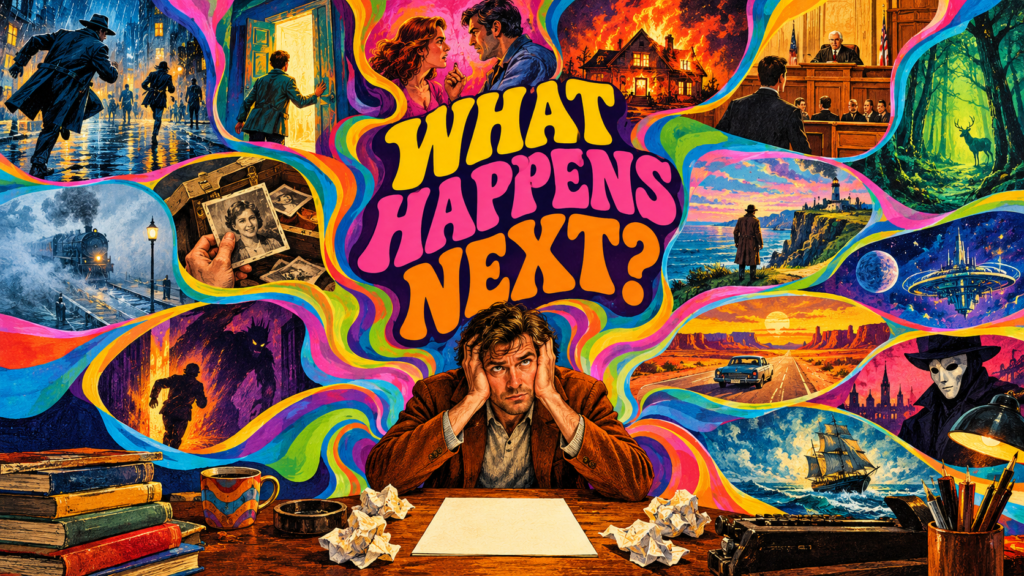
There is a particular moment in writing a novel that can make you question every decision you’ve made since the first chapter.
You’ve been writing happily. The characters are behaving themselves. The plot appears to be moving in roughly the direction you intended.
Then you reach a scene and stop.
You know where the story has been.
You have a vague idea where it needs to go.
But you don’t know what happens next.
So you stare at the screen.
You write something.
It feels wrong.
You delete it.
You try another possibility.
That feels predictable.
You delete that too.
Eventually, you convince yourself that the novel has stopped working.
Maybe the premise isn’t strong enough.
Maybe you don’t understand plotting.
Maybe you should go back and rewrite the first five chapters.
Or perhaps, and this is the one writers really hate admitting, you’re simply stuck.
Fine.
You’re stuck.
That isn’t a disaster.
But I think you’re probably making the problem harder than it needs to be.
The mistake is trying to find the answer.
Instead, you should be generating possibilities.
Lots of them.
And some of them should be bloody awful.
Your First Idea Doesn’t Deserve Your Loyalty
Writers often have an odd relationship with their first idea.
They treat it as though it has been handed down from the heavens.
The character needs to do this.
Then this happens.
Then they discover that.
And that’s the story.
Except it probably isn’t.
Your first solution is usually the most obvious solution available to your brain. That’s not necessarily because you’re a bad writer. It’s because your brain is efficient.
If the detective needs to discover a clue, your brain suggests a clue.
If two characters are arguing, your brain suggests another argument.
If the protagonist needs information, someone conveniently tells them.
It’s logical.
It’s also frequently dull.
The obvious idea is useful because it gives you somewhere to start. It is not automatically the idea you should use.
This is why I like forcing yourself to come up with fifteen possible developments before committing to one.
The number isn’t magical.
The principle is.
Don’t marry the first idea that turns up.
Give Yourself Permission to Write Bad Ideas
This is where the exercise becomes useful.
Take a piece of paper and write:
What could happen next?
Then start listing possibilities.
Don’t judge them.
Don’t polish them.
Don’t worry whether they’re clever.
Just keep going.
The first three or four will probably be obvious.
Good.
Write them anyway.
The next few may be variations on the same thing.
Fine.
Keep going.
Then, eventually, you run out of the ideas you’ve already had.
That’s when things get interesting.
Because now you have to think laterally.
Perhaps the character doesn’t confront the person.
Perhaps they lie.
Perhaps they run away.
Perhaps they discover they’ve misunderstood everything.
Perhaps they get exactly what they wanted.
Perhaps someone else discovers the secret first.
Perhaps the character makes a decision that makes the situation considerably worse.
You aren’t looking for fifteen brilliant ideas.
You’re trying to get beyond the three obvious ones.
That’s a very different exercise.
The Point Isn’t Fifteen. The Point Is Pressure
I’d actually argue against becoming too obsessed with the number.
If you find the answer after seven possibilities, use it.
If you need twenty-three, write twenty-three.
The value is in forcing yourself to explore.
But there’s another question you should be asking while you brainstorm:
Which possibility puts the most pressure on my character?
Because that’s where good story developments tend to live.
Suppose your protagonist has discovered that their best friend has been lying to them.
The obvious next scene is a confrontation.
Fine.
But what happens if the protagonist can’t confront them?
What if doing so would expose a secret of their own?
Now you’ve got a problem.
Perhaps they investigate secretly.
Perhaps they pretend not to know.
Perhaps they use the information against their friend.
Perhaps they discover the lie was protecting somebody else.
Suddenly the story isn’t simply about discovering a lie.
It’s about what the protagonist is prepared to do with the truth.
That’s much more interesting.
Don’t Ask Only What Happens. Ask What It Changes.
This is where a lot of brainstorming exercises fall short.
Writers generate events.
But events aren’t necessarily story.
A man receives a mysterious letter.
Okay.
What changes because he receives it?
A woman discovers somebody has been following her.
Interesting.
What does she do differently because of that discovery?
A character loses their job.
So what?
What decision does that force them to make?
The important part isn’t merely what happens.
It’s the consequence.
You should be able to draw a line between:
Event → Choice → Consequence → New problem
That’s the engine you want.
The event starts something.
The character makes a choice.
That choice creates consequences.
Those consequences create the next problem.
Now you’re no longer desperately inventing things that can happen.
The characters are generating the plot themselves.
Try Making the Situation Worse
When you’re genuinely stuck, this is my favourite question:
How can I make this situation worse?
Not randomly worse.
Meaningfully worse.
If your protagonist has discovered the truth, don’t simply have the villain discover that they’ve discovered it.
That’s mechanical.
Ask what would make the truth more difficult to deal with.
Maybe the protagonist discovers that exposing the truth will destroy someone innocent.
Maybe the person they thought was the victim is actually responsible.
Maybe telling the truth means admitting their own involvement.
Maybe keeping quiet protects somebody they love.
Now there is a choice.
And choices create stories.
Try Making Things Better
This sounds counterproductive.
It isn’t.
Writers are often obsessed with making life increasingly miserable for their characters.
Everything goes wrong.
Then something else goes wrong.
Then something really horrible happens.
Eventually the novel becomes an obstacle course.
Give your character something they desperately want.
Let them have it.
Then ask:
Why is this a problem?
The promotion arrives.
The money arrives.
The missing person comes home.
The relationship is repaired.
The secret is finally revealed.
Wonderful.
Now what?
Success can be far more interesting than failure when it exposes something the character didn’t understand about themselves.
A protagonist who finally gets what they’ve been chasing may discover that achieving it requires them to become somebody they don’t want to be.
That’s story.
Make Your Character Do Something You Didn’t Expect
Here’s another useful variation.
Ask:
What would my character normally do here?
Write it down.
Then ask:
What would they absolutely not do?
That’s where things can get interesting.
Your cautious protagonist normally walks away.
What could make them stay?
Your honest protagonist normally tells the truth.
What could make them lie?
Your selfish protagonist normally protects themselves.
What could make them sacrifice themselves for somebody else?
Don’t force characters to behave stupidly just because you need a plot twist.
That’s not creativity.
That’s cheating.
Instead, find the emotional pressure that could genuinely push them beyond their normal behaviour.
Then you’ve discovered something about the character.
And probably something about the story too.
Don’t Confuse “Unexpected” With “Interesting”
There’s a danger in this exercise.
Once you’ve generated fifteen ideas, you may decide the strangest one must be the best.
Not necessarily.
A random explosion is unexpected.
So is a spaceship landing in the middle of a historical romance.
Neither automatically improves the novel.
You aren’t looking for the idea that makes the reader say:
“I never saw that coming.”
You’re looking for the idea that makes them say:
“Oh God. What are they going to do now?”
That’s different.
Surprise gets attention.
Consequences keep readers reading.
If Everything You Brainstorm Feels Bad, Go Backwards
This is important.
Sometimes you aren’t stuck because you can’t think of what happens next.
You’re stuck because something earlier in the novel is wrong.
Maybe your protagonist made a decision that was too easy.
Maybe you’ve accidentally removed the antagonist’s ability to interfere.
Maybe you’ve solved the central problem halfway through.
Maybe the character has no compelling reason to continue.
Maybe the story simply took a wrong turn.
In those situations, generating fifteen possible next scenes won’t fix anything.
Go backwards.
Ask:
Where was the last point where I genuinely wanted to know what happened next?
Find that point.
Then start brainstorming from there.
This can feel like going backwards.
It isn’t.
Sometimes you have to reverse out of a dead end before you can continue the journey.
Don’t Turn Brainstorming Into Procrastination
There is one other trap.
Brainstorming is fun.
Writing is hard.
That means you can spend an astonishing amount of time generating possibilities without actually choosing one.
Don’t.
You aren’t trying to create an infinite universe of potential novels.
You’re trying to write one.
Once you’ve generated your possibilities, look for the idea that does at least one of these things:
- Creates a difficult choice
- Reveals something about a character
- Raises meaningful stakes
- Changes the direction of the story
- Creates a new problem
- Makes you genuinely curious
Then choose.
You can always change your mind later.
That’s one of the great advantages of writing fiction.
Nothing is carved into stone.
The Best Idea May Be the One You Nearly Dismiss
This is one of the strange things about creativity.
Occasionally you’ll write an idea down and immediately think:
That’s stupid.
Don’t cross it out.
Ask why you thought of it.
Perhaps the exact idea is rubbish.
But maybe there’s something underneath it.
You don’t need to keep the talking dog, the exploding mansion or the mysterious stranger.
Maybe what interested you was the reversal.
Or the betrayal.
Or the character’s reaction.
Or the fact that somebody who seemed trustworthy suddenly wasn’t.
Take the interesting part.
Throw away the rubbish.
Build again.
Ideas don’t arrive fully dressed.
Sometimes you have to strip them down before you can see what they’re actually doing.
Being Stuck Isn’t Always a Bad Sign
I’ve never understood why writers treat getting stuck as evidence that they can’t write.
Sometimes getting stuck means you’ve reached the end of the easy answers.
That’s useful.
You’ve written the obvious scene.
You’ve exhausted the predictable conversation.
You’ve taken the straightforward route as far as it will go.
Now you have to make a choice.
And that’s where the interesting writing often begins.
So when you reach the dreaded blank screen, don’t immediately start questioning the entire novel.
Stop trying to find the perfect next scene.
Get a sheet of paper.
Write down the obvious answer.
Then another.
Then another.
Make the character’s situation worse.
Then better.
Make them lie.
Make them tell the truth.
Give them what they want.
Take it away.
Make them choose between two things they both desperately need.
Then keep going until you’ve run out of safe ideas.
That’s the point.
Because the story you’re looking for may be sitting just beyond the one you already know how to write.
And if you only ever accept the first idea that arrives, you’ll never find it.
There comes a moment in every writer’s journey where confidence quietly turns into suspicion. You’ve finished your manuscript.You’ve edited it.Maybe you’ve even rewritten large chunks . . .
Every writer eventually faces the same uncomfortable question. If a reader opened your book and read only the first page… would they keep going? It . . .
Every writer knows the feeling. You have an idea — maybe a character, a world, or a fragment of a scene — but when you . . .
There’s a delicious, tingling moment in every novel-in-progress where the story goes from blank space to spark. It’s the whisper of a character you don’t . . .