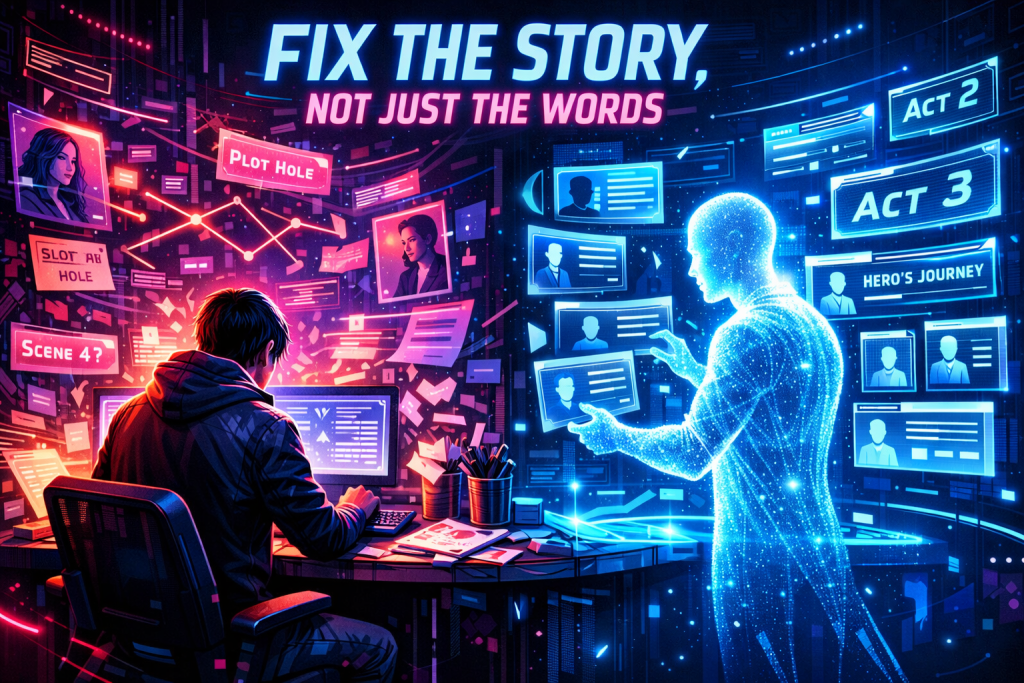
There comes a moment in every writer’s journey where confidence quietly turns into suspicion.
You’ve finished your manuscript.
You’ve edited it.
Maybe you’ve even rewritten large chunks of it.
And yet something still feels… off.
You can’t quite name it.
But you can feel it.
The pacing drags in places.
The characters don’t hit as hard as they should.
The story works — but it doesn’t grip.
This is the point where most writers make a critical mistake.
They keep polishing sentences.
When the real problem isn’t the sentence.
It’s the story underneath it.
What Developmental Editing Actually Is (And What It Isn’t)
Let’s cut through the confusion.
Developmental editing is not about:
- fixing grammar
- correcting spelling
- tightening individual sentences
It’s about something much bigger.
It’s about whether your story works as a whole.
A proper developmental edit looks at:
- plot structure
- character arcs
- pacing
- emotional impact
- point of view
- scene effectiveness
It asks the uncomfortable question:
“Does this book actually deliver what it promises?”
And more importantly:
“If not — why?”
Developmental editing is a high-level, structural process that focuses on the foundations of your book, not the surface polish.
Why Most Writers Avoid It
Let’s be honest.
It’s not just about cost.
It’s about fear.
Because a developmental edit doesn’t say:
“This sentence could be better.”
It says:
“This entire section isn’t working.”
Or worse:
“Your main character isn’t compelling enough.”
That’s not easy to hear.
So instead, writers stay in the safe zone:
- tweaking wording
- adjusting dialogue
- fixing commas
It feels productive.
But it’s like repainting a house with a cracked foundation.
What a Good Developmental Editor Actually Does
A proper developmental editor isn’t just pointing out problems.
They’re mapping your story.
They read your manuscript multiple times, looking for patterns, inconsistencies, and deeper structural issues that aren’t obvious on a single pass.
They might provide:
- a detailed editorial report
- margin comments throughout your manuscript
- a structural breakdown of your story (often called a “book map”)
- suggestions for improving scenes, pacing, and character development
This isn’t light feedback.
It’s a full dissection of your story.
And yes — it can take weeks.
Because understanding a story at that level takes time.
The Hard Truth: Your First Draft Isn’t the Problem
Here’s where a lot of writers go wrong.
They assume the issue is that their writing isn’t “good enough.”
But more often than not, the real issue is:
- unclear structure
- weak stakes
- inconsistent character motivation
- pacing that doesn’t match the story
These are not sentence-level problems.
They are story-level problems.
And no amount of line editing will fix them.
A Simple Example (And Why It Matters)
Let’s say your story has a strong premise:
A detective hunting a killer who always stays one step ahead.
On the surface, that works.
But a developmental editor might ask:
- Why does this case matter personally to the detective?
- What changes about them by the end?
- Does each clue escalate tension — or just fill space?
- Is the killer actually interesting, or just functional?
These questions don’t fix your sentences.
They fix your story.
Developmental Editing vs. “I’ll Just Figure It Out”
Some writers push back on this.
They say:
“I’ll just revise it myself.”
And yes — you should.
But here’s the problem:
You’re too close to your own work.
You know what you meant.
You know what the scene is supposed to do.
You fill in gaps the reader never will.
A developmental editor doesn’t have that bias.
They see:
- where you lost clarity
- where tension drops
- where the story stops engaging
That outside perspective is the difference between:
a story that makes sense to you
and
a story that works for readers
When You Actually Need Developmental Editing
Not every manuscript needs it immediately.
But you probably do if:
- you’ve rewritten multiple times and something still feels off
- beta readers give vague feedback like “it’s good, but…”
- your pacing feels inconsistent
- your characters aren’t landing emotionally
- you’re stuck and don’t know how to fix it
It’s especially valuable for indie authors, where you don’t have a traditional publishing team guiding the process.
The Cost (And Why It Feels Expensive)
Let’s address the obvious issue.
Developmental editing isn’t cheap.
And there’s a reason for that.
It requires:
- multiple full reads
- detailed analysis
- written feedback
- often weeks of focused work
You’re not paying for a quick correction.
You’re paying for someone to:
understand your story deeply enough to improve it
That’s not a small task.
But Here’s the Part Writers Don’t Want to Hear
You don’t need a developmental editor.
You can write a book without one.
Plenty of writers do.
But…
If your goal is to write something that genuinely connects with readers — something that holds together structurally and emotionally — then ignoring big-picture feedback is a gamble.
And usually, it shows.
A Better Way to Think About It
Don’t think of developmental editing as:
“Someone fixing my book.”
Think of it as:
“Someone showing me how to fix my book.”
A good editor doesn’t rewrite your story.
They reveal:
- what’s working
- what isn’t
- why it isn’t
- how you might improve it
The decisions are still yours.
If You Can’t Afford It (Let’s Be Real)
Not everyone can invest in professional editing.
So here’s what you can do instead:
1. Get brutally honest beta readers
Not friends who say “it’s great.”
People who will tell you where they got bored.
2. Step away from your manuscript
Distance helps you see flaws more clearly.
3. Analyse your own structure
Break your story down scene by scene.
Ask: What is this scene doing?
4. Read like a writer
Study books in your genre and ask why they work.
It’s not the same as a professional edit.
But it’s far better than guessing.
Final Thought
Most writers spend too long trying to perfect sentences…
When the real work is fixing the story underneath.
Developmental editing forces you to confront that truth.
It’s uncomfortable.
It’s sometimes brutal.
It will almost certainly highlight things you didn’t want to see.
But it does something else too.
It shows you how to turn:
a draft that almost works
into
a story that actually does
Every writer eventually faces the same uncomfortable question. If a reader opened your book and read only the first page… would they keep going? It . . .
Every writer knows the feeling. You have an idea — maybe a character, a world, or a fragment of a scene — but when you . . .
There’s a delicious, tingling moment in every novel-in-progress where the story goes from blank space to spark. It’s the whisper of a character you don’t . . .
Every writer eventually meets them: the villain who should be terrifying… but somehow lands closer to awkward karaoke act than dark overlord. On paper, they’re . . .