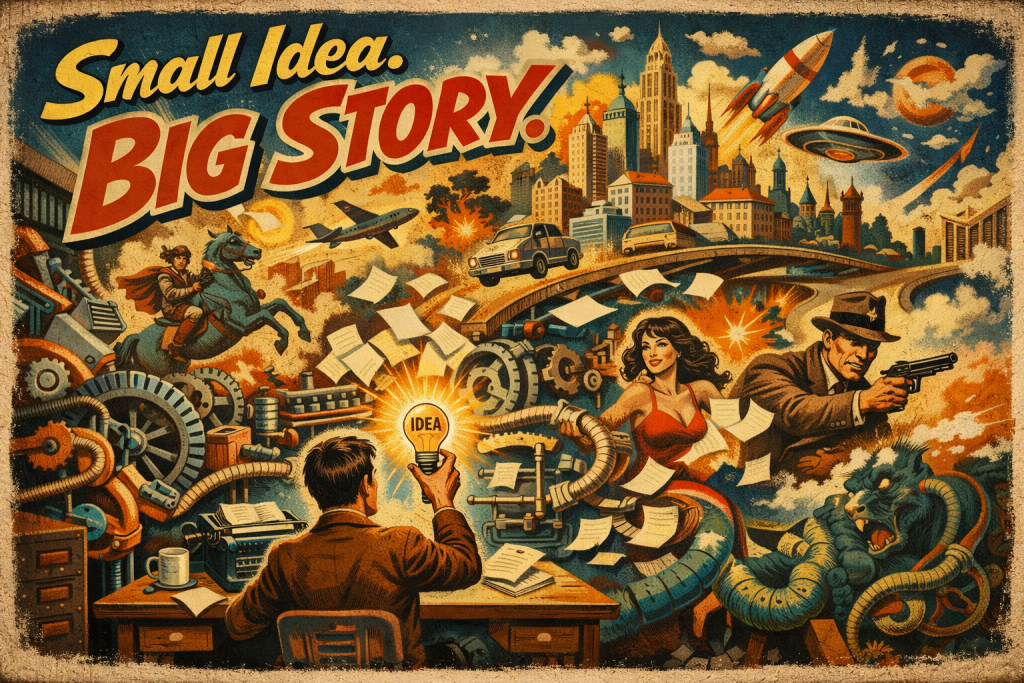
“I’ve got a good idea… but I don’t think it’s big enough for a novel.”
That sentence has quietly killed more books than lack of talent ever has.
Here’s the blunt truth: most ideas aren’t big enough—at least not in the form you first think of them.
But that doesn’t mean they’re useless. It means you’re looking at them wrong.
A novel isn’t built from a “big idea.” It’s built from a developed one.
And development is work most writers try to skip.
The Myth of the “Big Enough” Idea
New writers love the idea of scale.
They think novels come from:
- Epic plots
- High-concept hooks
- World-shattering stakes
And yes—those can work. But they’re not what makes a story sustain itself over 80,000 words.
What actually matters is depth.
You don’t need a massive idea. You need an idea that can:
- Change
- Complicate
- Escalate
- Reveal something over time
A man stuck in a room? That’s not a big idea.
A man stuck in a room who slowly realises he chose to be there? That’s a story.
Same premise. Completely different potential.
Most “Small Ideas” Are Just Undeveloped
When someone says their idea is too small, what they usually mean is:
“I only have the interesting bit.”
You’ve got:
- A moment
- A character
- A twist
- A setting
- A piece of dialogue
That’s not a story. That’s a fragment.
And fragments don’t become novels on their own.
You have to start asking uncomfortable questions:
- What happens before this moment?
- What happens after it?
- Why does it matter?
- Who is affected?
- What changes because of it?
If you can’t answer those, the idea isn’t too small—you’ve just stopped digging too early.
The Expansion Process (This Is Where Most People Quit)
Turning a small idea into a novel isn’t about adding filler. It’s about adding pressure.
Here’s how you actually expand something without ruining it.
1. Find the Core Tension
Every idea has a hidden conflict buried inside it.
Your job is to drag it out into the open.
Example:
A woman finds a letter meant for someone else.
That’s not a story.
But ask:
- What if the letter reveals something dangerous?
- What if she knows the person it’s meant for?
- What if delivering it causes harm—and keeping it does too?
Now you’ve got tension.
And tension is expandable.
2. Build Consequences, Not Events
This is where most writers go wrong—they add more things happening instead of more meaning.
A weak expansion looks like:
- Event → Event → Event → Event
A strong one looks like:
- Action → Consequence → Complication → Escalation
If your idea doesn’t create consequences, it won’t sustain a novel.
Every decision your character makes should make things worse, messier, or more complicated.
If things stay simple, your story stays small.
3. Make It Personal (Or It Won’t Matter)
You can’t stretch an idea if it doesn’t matter deeply to the character.
Surface-level stakes don’t hold attention.
Ask yourself:
- Why this character?
- Why does this situation hit them harder than anyone else?
- What are they afraid of losing?
If the answer is vague, your story will be too.
Small ideas grow when they become personally unavoidable.
4. Add Resistance
Here’s a hard rule:
If your character can solve the problem quickly, you don’t have a novel—you have a short story.
Resistance creates length.
Not artificial obstacles. Not random complications.
Meaningful resistance:
- Internal (fear, denial, guilt)
- External (other people, systems, consequences)
- Situational (time pressure, lack of information)
The more layered the resistance, the more space your story has to breathe.
The Real Question: Is It Worth Expanding?
Now let’s challenge your original doubt.
You asked if you should just forget the idea.
Sometimes? Yes.
Not every idea deserves 300 pages.
But here’s how you actually decide.
Keep It If:
- It nags at you repeatedly
- You keep returning to it without forcing it
- It raises questions you want to answer
- It has emotional weight—not just cleverness
Drop It If:
- You only like the twist, not the journey
- You can’t find meaningful conflict
- It relies on gimmicks instead of depth
- You’re trying to convince yourself it’s good
Be honest here.
Writers waste months on ideas they don’t actually care about.
Stop Trying to Inflate — Start Digging
A common mistake is trying to “scale up” an idea artificially.
Writers think:
“I need to add subplots, more characters, bigger stakes…”
No. You need to go deeper, not wider.
A shallow idea with more pieces is still shallow.
Instead:
- Interrogate the character’s choices
- Complicate their motivations
- Expose contradictions
- Force them into worse decisions
That’s where length comes from.
Not expansion. Intensification.
A Practical Example (So You Can’t Dodge the Work)
Let’s take a genuinely small idea:
A man receives a phone call from his younger self.
That’s interesting—but it’s not a novel yet.
Now watch what happens when we build it properly.
Step 1: Define the conflict
The younger self wants something changed. The older self knows the cost.
Step 2: Add stakes
Changing the past could erase relationships, achievements, or even the present identity.
Step 3: Layer consequences
Each attempt to “fix” something creates new problems.
Step 4: Personalise it
What regret is driving this? What mistake won’t let go?
Step 5: Escalate
Eventually, the older self must choose between a better past… or accepting a flawed present.
Now you’ve got:
- Theme (regret vs acceptance)
- Character arc
- Emotional stakes
- Narrative progression
Same idea. Completely different scale.
The Brutal Truth: You’re Probably Quitting Too Early
Most writers don’t struggle with ideas.
They struggle with staying with them long enough to develop them.
The moment it gets difficult—when the idea stops being shiny and starts requiring structure—they assume it’s not good enough.
That’s not insight. That’s impatience.
Writing a novel isn’t about having a brilliant idea.
It’s about committing to one long enough to make it work.
What You Should Actually Do Next
Don’t sit there wondering if your idea is big enough.
Test it.
Do this:
- Write down your core idea in one sentence
- Identify the central conflict
- List 5 possible consequences
- Define what your character stands to lose
- Sketch how things get worse over time
If you can do that, you don’t have a small idea.
You have the beginning of a novel.
If you can’t?
Then yes—maybe it’s not ready.
But don’t confuse “not ready” with “not worth it.”
Final Thought: Small Ideas Are Where the Best Stories Start
Big ideas are often empty.
Small ideas, when handled properly, become precise, personal, and powerful.
And those are the stories people actually remember.
So no—you shouldn’t forget your idea.
But you also shouldn’t protect it from being challenged, stretched, and reshaped.
That’s the difference between an idea you like…
…and a story that actually works.
There’s a particular kind of misery that writers know well. You sit down, you open the document, and you stare at the cursor blinking back . . .
There’s a lie that gets repeated so often it’s practically tradition. Someone finds out you’re a writer, and within thirty seconds, they’ve said it: “Oh, . . .
There’s a quiet lie that creeps into most writers early on. It sounds sensible. Strategic, even. “Write what people want.” On the surface, that’s not . . .
There’s a very specific kind of optimism that comes with a brand-new notebook. Clean pages.Sharp corners.That quiet promise of this is where it all begins. . . .