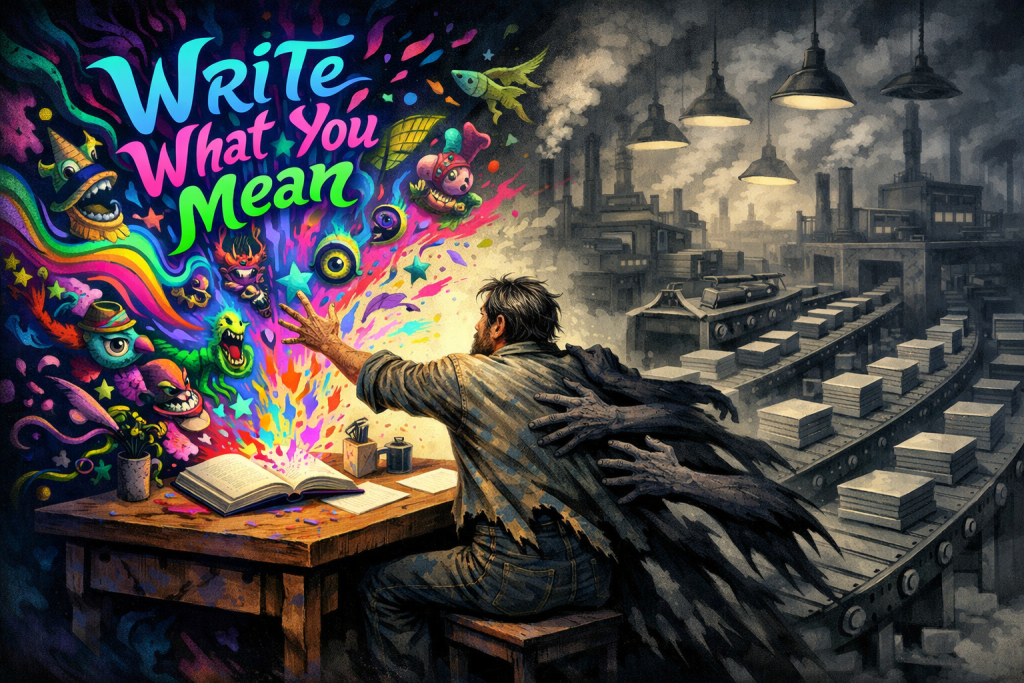
There’s a quiet lie that creeps into most writers early on.
It sounds sensible. Strategic, even.
“Write what people want.”
On the surface, that’s not terrible advice. If you’re publishing commercially, audience matters. Market awareness matters. But here’s where it goes wrong: too many writers take that idea and twist it into something paralysing.
They stop writing what excites them… and start guessing what might impress someone else.
That’s when the work dies.
Not dramatically. Not all at once. But slowly—sentence by sentence—until what’s left is technically fine and creatively hollow.
Let’s talk about why telling your story—not a fabricated, focus-grouped version of it—isn’t just important. It’s the only approach that actually leads anywhere worth going.
The Moment You Start Guessing, You Start Diluting
The fastest way to ruin a good idea is to second-guess it into something “safer.”
You begin with a sharp, slightly strange concept—something that has a bit of edge to it. Then the internal editor kicks in:
- “Maybe that’s too weird.”
- “Would readers get this?”
- “Should I make the character more likeable?”
- “Maybe I should follow what’s trending…”
And just like that, you’ve sanded down everything that made the idea yours.
What you’re left with isn’t better. It’s just more familiar.
And familiar is overcrowded.
Readers don’t remember books because they followed expectations well. They remember them because they felt like something specific—something deliberate, something authored rather than assembled.
If your work could have been written by anyone trying to please everyone, it won’t matter.
Your Style Isn’t Optional — It’s the Whole Point
A lot of writers treat style like decoration.
Something you add later. Something you “develop over time.” Something separate from the actual writing.
That’s backwards.
Your style is your writing.
It’s in:
- The way your sentences move
- The kinds of details you choose
- What you focus on—and what you ignore
- The rhythm of your dialogue
- The emotional tone you default to
When you try to write for an imagined audience, you suppress those instincts. You start mimicking instead of expressing. You flatten your voice to fit a shape you think is acceptable.
And here’s the uncomfortable truth: readers can tell.
They might not articulate it clearly, but they feel it. There’s a difference between confidence and imitation. Between a voice that knows what it’s doing and one that’s asking permission.
If you don’t show your style, you’re not protecting your work—you’re removing the very thing that makes it distinct.
Feedback Is Useful — But It’s Not Authority
Let’s address the second half of your point, because this is where a lot of writers get it badly wrong.
You said:
“Feedback and ideas are welcome, but if you don’t like it or you didn’t think about it… is it really a good idea?”
That’s a dangerous question if you answer it lazily.
Because there are two equally bad extremes:
- Ignoring all feedback because it challenges you
- Accepting all feedback because you assume others know better
Both will wreck your work—just in different ways.
Here’s the reality:
Feedback is a tool. Not a verdict.
Someone might suggest:
- Changing a character’s motivation
- Removing a subplot
- Altering the tone
- Simplifying the prose
That doesn’t automatically make it a good idea.
But dismissing it purely because you didn’t think of it? That’s just ego in disguise.
You don’t have to agree with feedback—but you do have to interrogate it.
Ask:
- What problem is this person actually reacting to?
- Are they responding to confusion, pacing, tone, or clarity?
- Does their suggestion fix the root issue—or just mask it?
Often, the suggestion itself is wrong… but the problem behind it is real.
Good writers learn to separate the two.
The “I Don’t Like It” Trap
This is where things get a bit uncomfortable.
You said: if you don’t like it… is it really a good idea?
Sometimes, no. Trusting your instinct matters.
But sometimes? You don’t like it because it forces you to confront something you’ve avoided.
- A weaker character arc than you realised
- A pacing issue you’ve grown blind to
- Dialogue that sounds clever in your head but flat on the page
- A theme you haven’t fully committed to
Writers often reject feedback not because it’s wrong—but because it’s inconvenient.
And that’s a problem.
You need to develop a brutal kind of self-awareness here. Not self-doubt—but self-honesty.
If multiple readers point to the same issue, that’s not coincidence. That’s a signal.
You don’t have to take their solution—but you’d be foolish to ignore the pattern.
Chasing Trends Is a Losing Game
Let’s be blunt: writing what you think people want is usually just writing what’s already popular.
And by the time you finish your book?
You’re late.
Trends move fast. Publishing moves slowly. That gap kills most “strategic” writing attempts.
But there’s a bigger issue.
When you chase trends, you’re not leading—you’re following. And followers don’t define anything. They blend in.
The irony is this:
The books that succeed commercially are often the ones that don’t feel like they were designed to succeed.
They feel specific. Confident. Uncompromised.
That doesn’t mean they ignore audience—it means they don’t pander to it.
There’s a difference.
Creative Risk Is Not Optional
If you’re always comfortable with what you’re writing, you’re probably playing it too safe.
Your best ideas should make you hesitate slightly.
Not because they’re bad—but because they’re honest.
Maybe it’s:
- A character decision that feels morally messy
- A narrative choice that breaks convention
- A tone that leans darker, stranger, or more personal than expected
Those are the moments where your writing stops being generic.
And yes—some readers won’t like it.
Good.
You’re not trying to be universally liked. You’re trying to be distinct.
If everyone agrees with your work, you’ve probably said nothing worth arguing with.
The Real Job: Clarity of Intent
Writing “your story” doesn’t mean writing whatever you feel like with no structure or discipline.
That’s just self-indulgence.
The real task is clarity.
You need to know:
- What kind of story you’re telling
- Why it matters to you
- What emotional effect you’re aiming for
- What you’re willing to keep—and what you’re willing to cut
When you have that clarity, feedback becomes easier to handle.
Because you’re not asking:
“Do they like it?”
You’re asking:
“Does this help me achieve what I’m trying to do?”
That’s a completely different mindset—and a far more useful one.
Common Mistakes Writers Make Here
Let’s call a few out directly.
1. Writing for approval instead of impact
If your primary goal is to be liked, your work will be forgettable.
2. Confusing accessibility with compromise
Making your work clear is good. Diluting it to avoid risk is not.
3. Treating feedback as a checklist
You don’t need to implement every note. You need to understand it.
4. Mistaking discomfort for failure
If something feels challenging to write, that’s often a sign you’re onto something real.
5. Hiding behind “style” as an excuse
Your voice isn’t a shield for weak structure or sloppy execution. You still need craft.
So… Is It a Good Idea If You Didn’t Think of It?
Let’s answer your original question properly.
No—an idea isn’t automatically good just because someone else suggested it.
But dismissing it for that reason alone is short-sighted.
A better approach:
- If it strengthens your vision → consider it seriously
- If it solves a real problem → investigate it
- If it clashes with your intent → reject it confidently
- If you’re resisting it emotionally → examine why
Your job isn’t to protect your ego.
It’s to protect the integrity of the story.
Final Thought: Own the Work or Don’t Bother
If you’re constantly writing with one eye on what others might think, you’re not really writing—you’re negotiating.
And negotiated stories are rarely powerful.
At some point, you have to decide:
Are you trying to create something that feels like yours?
Or something that feels like it might pass?
Because those are not the same goal.
And trying to do both at once usually leads to something that achieves neither.
Write the story you mean.
Then refine it with intelligence, not insecurity.
That’s where the real work begins.
There’s a particular kind of misery that writers know well. You sit down, you open the document, and you stare at the cursor blinking back . . .
There’s a lie that gets repeated so often it’s practically tradition. Someone finds out you’re a writer, and within thirty seconds, they’ve said it: “Oh, . . .
“I’ve got a good idea… but I don’t think it’s big enough for a novel.” That sentence has quietly killed more books than lack of . . .
There’s a very specific kind of optimism that comes with a brand-new notebook. Clean pages.Sharp corners.That quiet promise of this is where it all begins. . . .