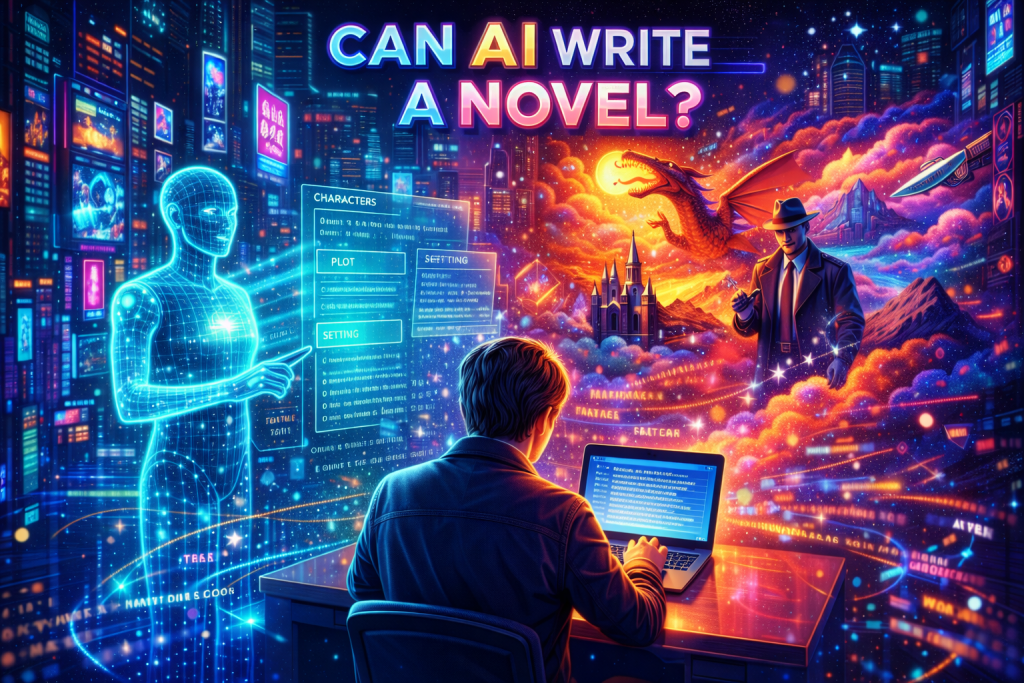
Artificial intelligence can now write essays, generate poetry, outline stories, and even produce entire book-length manuscripts in minutes. Because of this, one question keeps appearing in writing communities:
Can AI actually write a good novel?
The answer isn’t as simple as yes or no. AI can certainly produce a novel, but whether that novel is good depends on what you think makes a story worth reading.
AI Can Generate a Complete Story
Technically speaking, AI is capable of writing a full novel.
Give it a prompt, and it can create:
- A basic plot structure
- Character descriptions
- Dialogue between characters
- Scene-by-scene narratives
- Even a complete ending
In terms of volume and speed, AI can outperform human writers easily. What might take a person months to draft can be generated in minutes.
But writing quickly is not the same thing as writing well.
The Problem With Depth
A good novel doesn’t just tell a sequence of events. It creates depth.
Readers expect:
- Characters with believable motivations
- Emotional consequences to decisions
- Themes that reflect something meaningful about life
- Subtle development over hundreds of pages
AI struggles with this kind of complexity because it doesn’t truly understand the world it’s writing about. Instead, it predicts what words are most likely to come next based on patterns in existing text.
This can produce writing that looks polished but often feels surface-level when read closely.
Characters Often Feel Artificial
One of the biggest weaknesses of AI-generated fiction is character development.
Human writers build characters from observation and empathy. They understand contradictions in people: bravery mixed with fear, kindness mixed with selfishness, confidence hiding insecurity.
AI characters tend to be more predictable. They often follow familiar tropes without the messy emotional nuance that real people have.
Readers might enjoy a story at first, but if characters don’t feel real, the illusion eventually breaks.
Originality Is Another Challenge
Many stories follow familiar structures—heroes, villains, conflicts, and transformations. That’s normal.
The difference lies in how those elements are presented.
AI learns from enormous collections of existing writing. Because of this, its storytelling often resembles a blend of what already exists. It may combine tropes and ideas effectively, but it rarely produces something that feels genuinely new.
Human writers, on the other hand, bring unique perspectives shaped by their personal lives, culture, humour, fears, and beliefs.
That individuality is difficult for AI to replicate.
Where AI Can Be Useful
While AI might struggle to produce a great novel on its own, it can still be extremely useful for writers.
Many authors use AI tools to help with:
- Brainstorming plot ideas
- Generating writing prompts
- Exploring alternative story directions
- Breaking through writer’s block
- Editing and improving sentence clarity
In this role, AI becomes more like a creative assistant than a storyteller.
The writer remains the one making creative decisions.
Collaboration Might Be the Real Future
Instead of replacing writers, AI may change how novels are created.
A writer might:
- Use AI to generate several plot possibilities
- Select the most interesting ideas
- Rewrite and expand them with deeper emotion and meaning
- Shape the final narrative through their own voice
This combination can speed up the creative process while still preserving the human element that makes stories powerful.
So… Can AI Write a Good Novel?
AI can absolutely produce a readable novel.
It might even produce an entertaining one.
But the stories readers remember—the ones that stay with them for years—usually come from something deeper than pattern recognition. They come from lived experiences, emotional understanding, and personal perspective.
Those things belong to human writers.
AI can assist the creative process, but the best novels still come from human imagination.
There’s a particular kind of misery that writers know well. You sit down, you open the document, and you stare at the cursor blinking back . . .
There’s a lie that gets repeated so often it’s practically tradition. Someone finds out you’re a writer, and within thirty seconds, they’ve said it: “Oh, . . .
“I’ve got a good idea… but I don’t think it’s big enough for a novel.” That sentence has quietly killed more books than lack of . . .
There’s a quiet lie that creeps into most writers early on. It sounds sensible. Strategic, even. “Write what people want.” On the surface, that’s not . . .