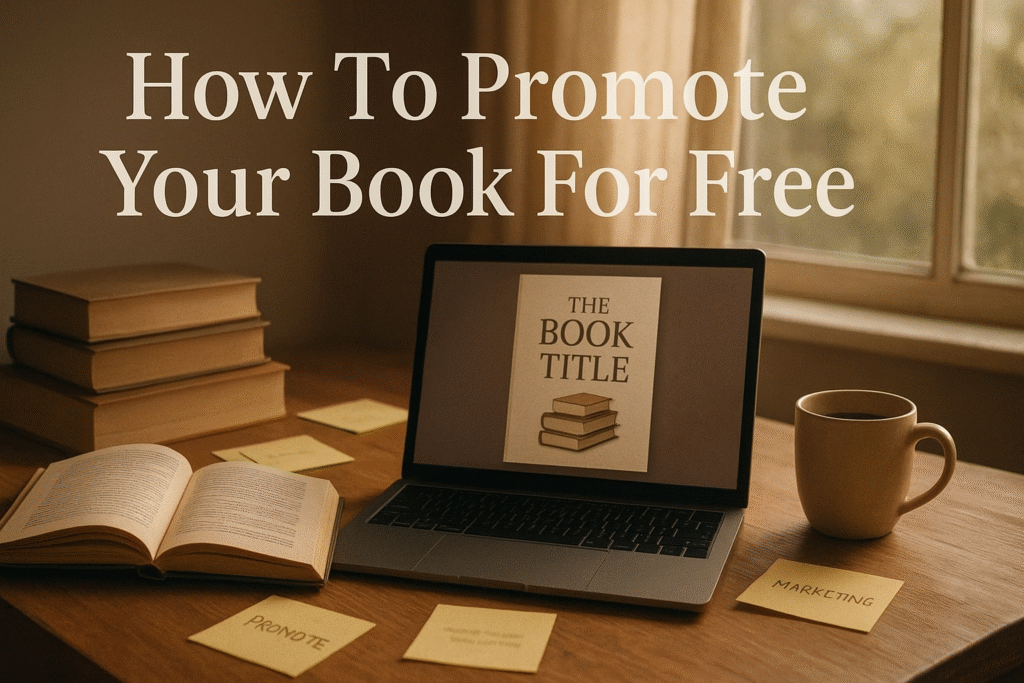
Every writer dreams of typing those two sacred words — The End. But few realise what comes next. Somewhere between closing your laptop and staring lovingly at your finished manuscript, a thought creeps in:
How on earth do I get people to read this?
Here’s the truth no one wants to admit: writing a book is difficult, but promoting a book — especially on a zero-pound budget — is an entirely different beast. It’s part creativity, part strategy, part mild existential crisis.
But it is possible. And not only possible — it can be surprisingly fun if you approach it with curiosity instead of dread. Free promotion doesn’t mean low-value promotion. It means leveraging what you have: your voice, your story, your community, and your willingness to experiment.
This article will walk you through the most powerful free promotional strategies available right now — grounded in experience, dipped in humour, and designed to help you grow your audience without draining your bank account.
1. Start with Your Story — Because Readers Don’t Buy Books, They Buy Authors
If you’ve ever followed an author online, you know it’s rarely their book description that hooks you — it’s them.
Readers are curious creatures. They want to know:
- Who wrote this?
- What kind of mind created this world?
- Why did they choose this story?
- And most importantly… do I feel connected to them?
Your personal story is your strongest free marketing tool. Use it.
How to do it:
- Share the moment the idea for your book arrived — even if it was during a bad haircut or in the shower.
- Talk about the scenes that nearly broke you (every book has at least one).
- Explain your “why.” Not the polished, PR-ready version. The real one.
Human connection sells books. Authenticity doesn’t cost a penny.
2. Build a Home for Your Writing — A Website or Blog
You do not need a fancy website. You do not need animations, scroll-triggered effects, or a homepage that looks like a sci-fi UI dashboard.
You need one simple thing:
A place where readers can find you, learn about your work, and stay connected.
A blog lets you:
- Share your writing journey
- Post behind-the-scenes content
- Offer free short stories or chapters
- Build authority in your genre
- Give readers a reason to return
When people Google your name (and they will), you want something to appear — preferably something you wrote, not your old Bebo profile.
Your website is your digital home. It doesn’t have to be big. It doesn’t have to be fancy. It just needs to be yours.
3. Harness Social Media (Without Becoming a Dancing Influencer)
Social media is free. That’s its biggest selling point — and its biggest trap.
Used badly, it can feel like standing in a crowded stadium shouting, “Please buy my book!”
Used well, it’s a conversation.
Choose one or two platforms — not all of them.
The key to not burning out is this:
Pick the platform you actually enjoy.
If you love visuals → Instagram
If you love discussions → Facebook
If you love chaos → Twitter / X
If you love short bites of value → TikTok
If you love yelling into a digital canyon → also Twitter / X
What to share (and what to avoid):
Great free promo content:
- Snippets from your book
- Funny or emotional writing struggles
- Worldbuilding extras
- Character art (AI or sketched — no judgement)
- Your writing setup
- Small pieces of wisdom from your journey
Avoid:
- Begging for sales
- Spammy “Buy my book!” posts
- Posting only when you want something
- Arguing with reviewers (never do this — seriously)
Free promotion thrives on consistency, not desperation.
4. Use Email — The Most Powerful Free Tool You Probably Aren’t Using
Social media comes and goes. Algorithms change on a whim. But an email list is yours forever.
Start an email list now — even if you only have five subscribers to begin with. Those five people are more valuable than 5,000 random Twitter followers because they chose you.
What to send them:
- A monthly update
- Early access to short stories
- Behind-the-scenes process notes
- Cover reveal excitement
- Personal reflections
Email builds loyalty — and loyalty builds book sales.
5. Join Reader Groups, But Don’t Be That Person
Online communities can be goldmines — if you treat them like communities, not free billboards.
Facebook groups, Reddit threads, writing forums, genre-specific spaces… all of these are full of readers actively looking for new books.
But here’s the rule:
Add value before you ask for attention.
Comment on posts.
Answer questions.
Celebrate other writers.
Recommend books you didn’t write.
If people get to know you, they’ll want to read you.
6. Offer Free Content — Strategically, Not Desperately
Free content is not about devaluing your work. It’s about giving readers a safe entry point.
Examples of strategic free content:
- The first chapter of your book
- A short prequel story
- A bonus scene
- A character dossier
- A map, piece of art, or mini essay about your world
This works particularly well if you’re growing an email list — “Sign up for the first chapter free” is simple, effective, and still entirely cost-free.
7. Appear on Podcasts, Blogs, and Online Interviews — All Free
You’d be surprised how many podcasts and blogs are looking for guests. Bookish sites, niche communities, writing shows, genre-specific hosts — they’re all out there.
You don’t need fame to get booked. You need:
- A story
- A perspective
- A willingness to talk about your process
How to pitch:
A short email:
- Who you are
- What your book is
- Why you’d be a helpful guest
- What topics you can speak about
People love behind-the-scenes stories. Give them yours.
8. Make Friends with Other Writers
This isn’t networking. Networking is awkward.
This is building a tribe.
Writers support writers. We cheer for book launches, share posts, swap early drafts, and celebrate each other’s victories.
And here’s the magic:
When writers become your friends, they become your amplifiers.
They share your posts.
They recommend your book.
They tag you in opportunities.
Community is the free engine behind most successful authors.
9. Use Goodreads Wisely
Goodreads can be a strange place — a mix of enthusiastic readers, brutally honest reviewers, and people who think one-star ratings are a hobby.
But it’s valuable. It’s free. And it has millions of passionate readers.
You can:
- Create an author profile
- Join book discussions
- Host Q&As
- Share updates
- Add your book to relevant lists
It helps readers discover you — and more importantly, it helps them see you as a real author.
10. Run Free Launch Events — Digital or Local
A launch doesn’t have to cost money. It also doesn’t have to be a huge affair.
Free launch ideas:
- A Facebook Live reading
- An Instagram Q&A
- A local library reading
- A Zoom session with interested readers
- A small giveaway (ebook or bonus chapter)
Readers love hearing from the author directly. It makes the book feel personal — which increases the likelihood they’ll share it.
11. Make Your Book Easy to Share
The easier you make it for readers to share your book, the more they will.
Create shareable assets:
- Quote graphics
- Character teasers
- Aesthetic moodboards
- Short reading clips
- Your favourite line from the book
These cost nothing to create — but they make your book infinitely more visible.
12. The Rule No One Wants to Hear: Your Best Free Promotion Is… Writing the Next Book
A single book can gain an audience.
A second book builds it.
A third begins your career.
Free promotion takes time — but it works exponentially faster when readers have more than one doorway into your world.
Write the next book.
And the next.
And the next.
Every new story is a louder megaphone.
Conclusion: Promotion Isn’t Shouting — It’s Sharing
Free book promotion isn’t about becoming a salesperson. It’s about becoming visible. Becoming reachable. Becoming human.
You don’t need a marketing budget.
You don’t need a PR agent.
You don’t need billboards, banners, or ads.
You need:
- Your story
- Your voice
- Your willingness to connect
Promote your book by promoting yourself — your passion, your process, your purpose. When you show up authentically, readers show up naturally.
And remember: you aren’t bothering people by sharing your book. You’re giving them the chance to discover something that might just change their week — or their life.
There comes a moment in every writer’s journey where confidence quietly turns into suspicion. You’ve finished your manuscript.You’ve edited it.Maybe you’ve even rewritten large chunks . . .
Every writer eventually faces the same uncomfortable question. If a reader opened your book and read only the first page… would they keep going? It . . .
Every writer knows the feeling. You have an idea — maybe a character, a world, or a fragment of a scene — but when you . . .
There’s a delicious, tingling moment in every novel-in-progress where the story goes from blank space to spark. It’s the whisper of a character you don’t . . .