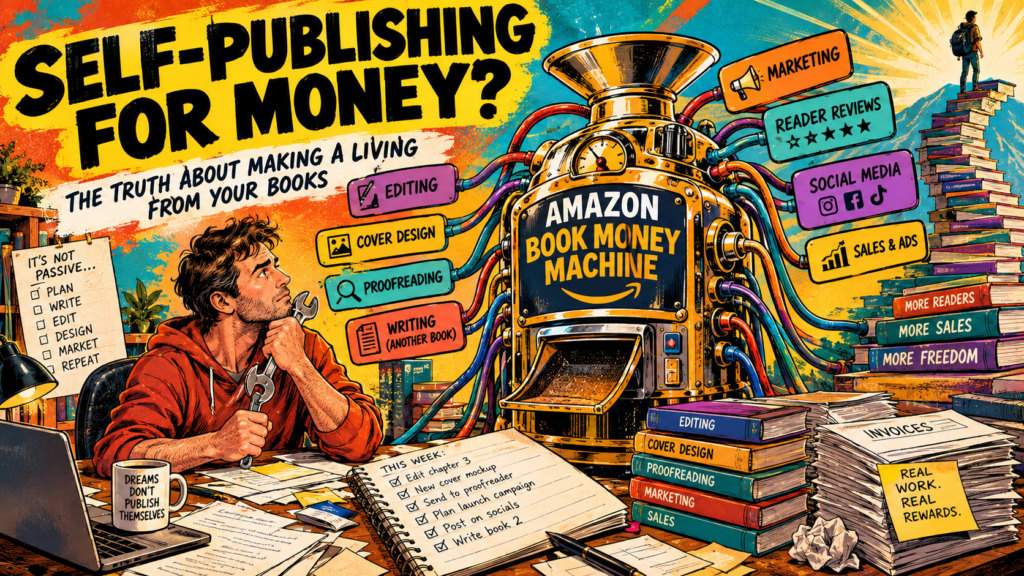
There is a very attractive idea floating around the internet.
Write a book.
Publish it on Amazon.
People buy it while you sleep.
Then write another one.
Repeat the process until you’ve built yourself a nice little passive-income machine.
It sounds wonderful.
It also leaves out rather a lot.
Self-publishing can absolutely make money. There are authors who earn substantial incomes from independently published books. But there is a world of difference between “books can generate income” and “writing books is an easy way to make passive income.”
If you’re thinking about self-publishing, you need to understand that difference before you spend months writing a book based on the expectation that Amazon is going to magically turn it into a business.
Because Amazon doesn’t want you to become a successful author.
Amazon wants to sell books.
Your job is to give readers a reason to buy yours.
That distinction matters.
The First Question Shouldn’t Be “How Much Can I Make?”
It should be:
Why am I writing this book?
That might sound like a strange question when we’re talking about making money.
It isn’t.
If you’re writing fiction, perhaps you have a story you desperately want to tell.
Perhaps you have wanted to write a novel for twenty years.
Perhaps you’ve already written three books and are trying to turn writing into a career.
Perhaps you write romance, crime, fantasy, science fiction or thrillers because that’s what you genuinely love.
Those are good reasons.
But if your entire motivation is:
“I heard people make money publishing books on Amazon,”
you should stop and think.
Writing a book is a terrible way to make quick money.
It takes time.
It requires skill.
It requires editing.
It requires presentation.
It requires marketing.
And even after you’ve done all of that, there is no guarantee anyone will buy the bloody thing.
The internet loves success stories.
It doesn’t spend nearly as much time showing you the thousands of books sitting quietly on digital shelves selling very little.
Self-Publishing Is a Business, Not a Button
One of the biggest misconceptions about self-publishing is that the difficult bit is getting the book onto Amazon.
It isn’t.
Uploading a book is relatively straightforward.
The difficult bit is producing something people want to buy and then getting it in front of those people.
Think about what you’re actually creating.
You need a manuscript.
You need editing.
You need proofreading.
You need a cover.
You need formatting.
You need a title.
You need a description.
You need appropriate categories and keywords.
You need pricing decisions.
You need an author profile.
You need some form of marketing.
And if you want to build a long-term career, you need another book.
And another.
And another.
Self-publishing removes the traditional publisher from the middle of that process.
It doesn’t remove the work.
It moves the work to you.
That’s both the great advantage and the great responsibility of independent publishing.
Don’t Choose a Book Because You Think It’s Profitable
This is particularly dangerous for fiction writers.
You see that romance sells.
So you decide to write romance.
You notice that thrillers are popular.
So suddenly you’re writing a thriller.
You discover that a particular fantasy subgenre is doing well.
So you convince yourself that you have always secretly wanted to write exactly that.
Perhaps you can do it.
But there’s a problem.
Readers can usually tell when an author doesn’t really care about the story.
Writing to market isn’t inherently wrong. Understanding your genre and knowing what readers expect can be extremely useful.
But there is a difference between understanding a market and chasing a trend.
If you don’t enjoy the genre, you’re making your own job miserable.
And if you don’t understand the readers, knowing that a genre sells isn’t going to help much.
The better question is:
What do I enjoy writing, what am I capable of writing well, and is there an audience for it?
Find the overlap.
That’s where the opportunity is.
Your Book Still Has to Be Good
This should be obvious.
It apparently isn’t.
There is an extraordinary amount of advice online about keywords, algorithms, pricing, categories and advertising.
All of those things can matter.
None of them can turn a terrible book into a great one.
You can have the perfect Amazon description.
You can have an impressive cover.
You can select carefully researched categories.
You can run advertisements.
You can get people to click on your book.
And then they can read the first few pages and decide they don’t want it.
Marketing gets somebody to the door.
The book has to convince them to stay.
This is why writing ability remains the foundation of the whole business.
Don’t spend six months learning how to advertise a book you haven’t learned how to write.
Editing Isn’t an Optional Luxury
There’s another trap in the “passive income” version of self-publishing.
The assumption that you can write the book quickly, upload it cheaply and start collecting money.
If you’re serious about building a readership, don’t do that.
Your first draft isn’t your finished book.
It is the material from which you make the finished book.
You need to revise.
You need to question scenes.
You need to remove unnecessary material.
You need to fix structural problems.
You need to check character motivation.
You need to deal with awkward prose.
And you need someone else to look at it.
Preferably someone who isn’t your mum.
Your mum may genuinely love your book.
That is lovely.
She may also be completely incapable of telling you that chapter seven doesn’t work.
A professional editor isn’t there to tell you that your book is rubbish.
They’re there to help you find the rubbish before your readers do.
Your Cover Is Part of the Sales Pitch
You can complain about readers judging books by their covers.
It won’t change anything.
They do.
The cover is one of the first things a potential reader sees.
That doesn’t mean your cover has to be expensive.
It means it has to be appropriate.
If you’re writing a psychological thriller, your cover needs to communicate something about the experience the reader is going to get.
If you’re writing a light-hearted romantic comedy, the visual language will be different.
If you’re writing literary fiction, different again.
The cover doesn’t need to explain the entire story.
It needs to make the right reader stop scrolling.
That’s its job.
Amazon Doesn’t Owe You Readers
This is perhaps the most important thing to understand about self-publishing.
You publish your book.
Amazon makes it available.
That doesn’t mean Amazon owes you an audience.
There are countless books competing for attention.
Your book isn’t automatically special because you spent three years writing it.
That’s harsh.
It’s also liberating.
Because once you accept it, you can stop waiting for somebody else to make things happen.
You can build an audience.
You can talk about your writing.
You can create a website.
You can develop an email list.
You can use social media.
You can write articles.
You can appear on podcasts.
You can contact relevant reviewers.
You can collaborate with other authors.
You can experiment.
You can learn.
You have options.
Marketing Doesn’t Mean Begging People to Buy Your Book
Some writers hear the word marketing and immediately imagine themselves shouting:
BUY MY BOOK!
every day on Facebook.
Please don’t.
Marketing can be much more interesting than that.
Talk about the subject of your book.
Talk about your characters.
Discuss the ideas that inspired it.
Share something you’ve learned while writing.
Tell people about the setting.
Show them the cover.
Share a short extract.
Talk about the research.
Tell the story behind the story.
Give readers something interesting before asking them to spend money.
You are not trying to convince everybody to buy your book.
You’re trying to find the people who are already likely to enjoy it.
That’s a much easier job.
Don’t Put Everything on One Book
This is where the idea of passive income becomes particularly misleading.
One book might earn money.
It might earn very little.
It might suddenly take off.
It might find readers six months after publication.
You don’t know.
But relying entirely on one title is risky.
A writing career becomes more interesting when you have a catalogue.
If someone discovers your first novel and enjoys it, what else can they read?
That’s a much better question than:
“How do I make my first book sell 10,000 copies?”
If you have five good books available, a reader who discovers one has somewhere else to go.
If you have ten, there is even more opportunity.
Your books can support one another.
Your readership can grow with you.
Your back catalogue becomes an asset.
That’s the real long-term potential of self-publishing.
Quantity Matters — But Not More Than Quality
There is a piece of advice that gets repeated endlessly:
Write more books.
It’s good advice.
Until it becomes:
Write books as quickly as possible.
That’s different.
If you produce six terrible books in a year, you haven’t necessarily built a successful publishing business.
You’ve produced six terrible books.
Writing faster can be useful.
Learning to finish projects is useful.
Developing a sustainable writing routine is useful.
But speed should not become an excuse for lowering your standards.
The goal is not to manufacture books.
The goal is to build a catalogue of books readers want to read.
The Money Comes From Understanding the Numbers
If you’re approaching self-publishing as a business, you need to understand what you’re actually earning.
A sale isn’t the same thing as profit.
You have costs.
Editing.
Proofreading.
Cover design.
Formatting.
Advertising.
Software.
Possibly professional services.
Your time.
Print books have production costs.
Different formats have different economics.
Promotional pricing changes the calculation.
Advertising can consume revenue.
So don’t look at a £4.99 book and think:
“I make £4.99 every time someone buys it.”
You don’t.
Understand your royalties.
Understand your costs.
Understand your advertising spend.
Understand your tax obligations.
Understand what your actual profit looks like.
You’re not just an author.
If you’re trying to make money from publishing, you’re also running a small business.
“Passive Income” Is Usually the Wrong Mental Model
This is where I’d disagree most strongly with the way self-publishing is often sold online.
A book can become a relatively low-maintenance source of income.
That’s true.
But low maintenance is not the same as passive.
You still need to write the book.
You may need to update it.
You may need to promote it.
You may need to respond to readers.
You may want to improve the cover.
You may want to adjust the description.
You may want to experiment with advertising.
You will almost certainly need to write another book if you want to grow.
A better description might be:
front-loaded work that can continue producing income.
That’s much less sexy.
It’s also much closer to reality.
Your First Book Is Also Research
Here’s a healthier way to think about your first self-published book.
It isn’t just a product.
It’s an education.
You’ll learn how long it actually takes you to write.
You’ll learn what editing costs.
You’ll discover what readers respond to.
You’ll learn how Amazon’s publishing system works.
You’ll discover whether you enjoy marketing.
You’ll see what sells.
You’ll learn what doesn’t.
You’ll probably make mistakes.
That’s fine.
Your first book doesn’t need to prove that you’ve become a publishing millionaire.
It needs to teach you enough that the second book is better.
And the third is better again.
Build an Author Career, Not a One-Book Lottery Ticket
This is the fundamental shift I would recommend.
Don’t think:
“How can I make money from this book?”
Think:
“How can I build a sustainable career around writing books people want to read?”
Those sound similar.
They aren’t.
The first encourages shortcuts.
The second encourages investment.
The first makes you obsess over immediate sales.
The second makes you think about readers.
The first makes you chase trends.
The second makes you develop a body of work.
The first makes one disappointing launch feel like failure.
The second treats it as information.
That difference in mindset matters.
So, Can You Make Money Self-Publishing?
Yes.
But don’t confuse possibility with probability.
There are authors making serious money from self-publishing.
There are also enormous numbers of authors making very little.
The existence of successful authors proves that success is possible.
It does not prove that success is easy.
And that’s actually good news.
Because you don’t need another article promising that anyone can write three books over a weekend and earn passive income while lying on a beach.
You need the truth.
Self-publishing gives you an opportunity.
It doesn’t give you an audience.
It doesn’t give you sales.
It doesn’t give you a career.
It gives you control.
What you do with that control is up to you.
Write the best book you can.
Learn your market without becoming a slave to it.
Get the book professionally presented.
Understand the business side.
Learn how to reach readers.
Build a catalogue.
Keep improving.
And keep writing.
Because the most valuable thing you can build as a self-published author isn’t one successful Amazon listing.
It’s a body of work that makes a reader finish one book and immediately ask:
“What else have you written?”
That’s the business.
And that’s considerably more interesting than pretending you can make money while you sleep.
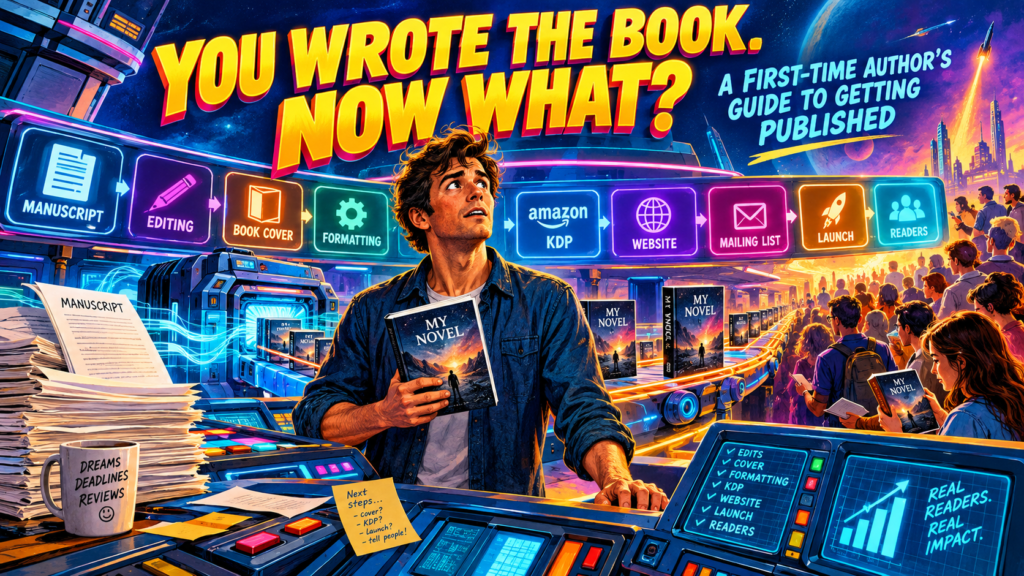
There is a particular moment every writer dreams about. You type the final sentence. You write THE END. You sit back, perhaps with a cup . . .
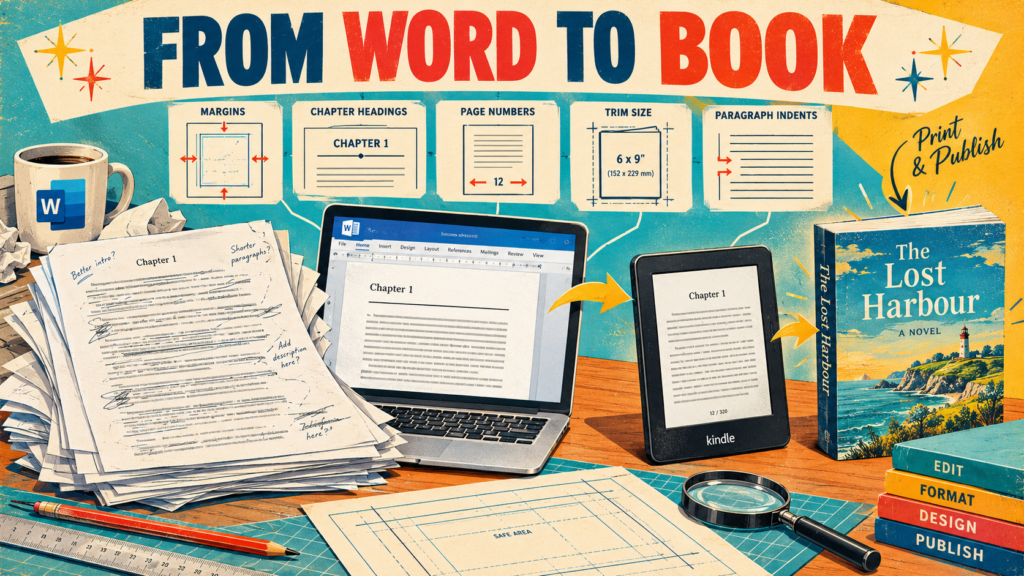
Finishing the novel is the hard part. Or at least, that’s what you tell yourself. Then you open Microsoft Word and discover that you now . . .
There’s a particular kind of misery that writers know well. You sit down, you open the document, and you stare at the cursor blinking back . . .
There’s a lie that gets repeated so often it’s practically tradition. Someone finds out you’re a writer, and within thirty seconds, they’ve said it: “Oh, . . .