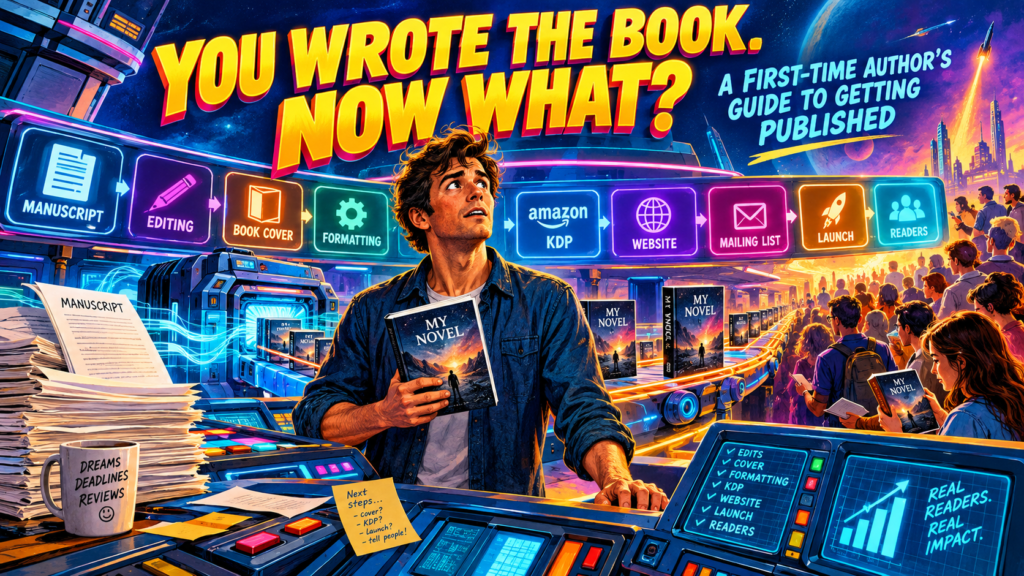
There is a particular moment every writer dreams about.
You type the final sentence.
You write THE END.
You sit back, perhaps with a cup of coffee, perhaps with something stronger, and think:
I’ve done it. I’ve written a book.
And you have.
But if this is your first book, there is something nobody tells you clearly enough.
You are not finished.
You have finished writing the manuscript. That is a huge achievement. But publishing is another job entirely.
And if you are planning to self-publish, you are not simply handing your manuscript to somebody else and waiting for a book to appear. You are suddenly dealing with editing, formatting, cover design, metadata, pricing, distribution, author profiles, websites, mailing lists, promotion and a whole collection of decisions you probably never thought about when you were halfway through chapter twelve.
This is where a lot of new authors discover an uncomfortable truth.
Writing a novel and publishing a novel are two different skills.
You need both.
Finishing the Manuscript Is the Beginning
Let’s start by killing one particularly persistent fantasy.
You finish your manuscript.
You upload it.
Amazon puts it on sale.
People discover it.
People buy it.
People leave wonderful reviews.
Your sales climb.
You become a successful author.
Lovely.
Also, possibly, complete nonsense.
Uploading a book to Amazon does not create an audience for it.
It creates a product.
There is an important difference.
A book sitting on a retailer’s website is not automatically going to find readers. There are an enormous number of books available, and your novel has to compete for attention before anyone gets as far as reading the first page.
That doesn’t mean you need a huge social-media following.
It doesn’t mean you need to become some sort of full-time internet personality.
It does mean you need to think beyond the manuscript.
Your book needs to be finished, presented professionally, discoverable and available to buy.
And you need to give potential readers a reason to notice it.
First: Make Sure the Book Is Actually Finished
This sounds obvious.
It isn’t.
Many first-time authors confuse finishing a draft with finishing a book.
They are completely different things.
A first draft might contain brilliant scenes, weak scenes, unnecessary characters, inconsistent motivations, plot holes, repetition and dialogue that seemed wonderful at midnight but makes you cringe three months later.
Do not rush to publish simply because you have reached the final chapter.
Let the manuscript breathe.
Then revise it.
Then revise it again.
Get other people to read it.
Pay attention to recurring criticism.
Proofread it.
And, ideally, get professional editing help if you can afford it.
There is nothing wrong with publishing independently.
There is something wrong with treating independence as an excuse to skip professional standards.
Self-publishing means you control the process.
It does not mean you should do everything badly yourself.
Decide What You Are Actually Publishing
Before you get anywhere near the publishing button, decide what your book actually needs.
Are you publishing an ebook?
A paperback?
A hardcover?
Several formats?
The practical requirements are not identical.
A manuscript designed for an ebook is not necessarily formatted correctly for a print edition. A paperback introduces decisions about trim size, margins, page layout, bleed and cover dimensions.
This is one reason it is dangerous to think:
“I’ll just upload my Word document.”
A manuscript is not automatically a book simply because it contains the right words.
The finished product needs to look like a book.
That means proper chapter headings, consistent typography, sensible spacing, page layout and all the other details readers notice without necessarily knowing why something feels wrong.
Readers may not compliment your margins.
They will notice when they are terrible.
Your Cover Is Not Decoration
This is another uncomfortable subject.
Authors sometimes become emotionally attached to their covers.
That is understandable.
You have spent months or years writing the book. The cover feels like the visual representation of everything you’ve created.
But your cover isn’t primarily for you.
It is for the reader.
It needs to communicate what sort of book this is quickly.
A thriller should not look like a romantic comedy.
A literary novel should not look like a children’s adventure.
A fantasy novel shouldn’t look like a business manual.
And your favourite photograph isn’t automatically a good book cover.
Think about the books sitting beside yours.
Would your cover look like it belongs in the same category?
Would someone understand the genre from a tiny thumbnail?
Would they be curious enough to click?
If the answer is no, redesign it.
Sentimentality is expensive.
Then There Is the Amazon Page
Once the physical and digital product are ready, you have another job: presenting the book properly.
Your title matters.
Your subtitle, where appropriate, matters.
Your description matters.
Your categories matter.
Your keywords matter.
Your author name matters.
All of these pieces contribute to how the book is presented and discovered.
The mistake is treating this section of the process like administration.
It isn’t.
It is marketing.
Your book description isn’t a summary you wrote because Amazon asked for one.
It is sales copy.
That doesn’t mean it should sound like an advert screaming at the reader.
It means it should make the reader want to know what happens next.
Don’t explain the entire plot.
Don’t tell them your book is “an unforgettable masterpiece”.
Don’t fill it with vague claims about an emotional journey.
Give them the problem.
Give them the stakes.
Give them the hook.
Then make them want the answer.
Don’t Guess at the Metadata
One of the least glamorous parts of publishing can have a surprisingly important effect on discoverability.
Metadata.
Keywords and categories need thought.
What would an actual reader type when looking for a book like yours?
What genre does your book genuinely belong to?
Who is the reader?
What books would they already be reading?
Don’t choose categories simply because they sound impressive.
Don’t stuff keywords with things that have nothing to do with your story because you think they might attract more people.
You are not trying to trick the system into showing your book to everybody.
You are trying to help the right readers find it.
That is a much more useful objective.
Build Your Author Home Before Launch Day
Here’s another mistake I see constantly.
The author thinks about marketing after the book is published.
That is backwards.
You should have somewhere for interested readers to go before you need them to go there.
That could be a simple author website.
It doesn’t need animations.
It doesn’t need seventeen pages.
It doesn’t need to win a design award.
It needs to answer basic questions.
Who are you?
What do you write?
What is your book?
Where can I buy it?
How can I contact you?
What else have you written?
If someone discovers you through social media and wants to investigate further, don’t make them hunt for information.
Give them somewhere obvious to go.
Your website is your permanent home.
Social media is rented space.
Platforms change. Algorithms change. Accounts disappear. Trends die.
Your website is the place you control.
Start Building an Audience Before You Need One
You don’t need 50,000 followers to sell a book.
You do, however, need people who care enough to pay attention.
This is why an email list can be useful.
Social media gives you access to an audience when the platform decides to show them your post.
An email list gives you a direct way to communicate with people who have deliberately chosen to hear from you.
And you don’t have to turn into a spam machine.
You can send occasional updates.
Talk about your writing.
Share progress.
Offer something useful.
Tell people about your launch.
Give subscribers something worth opening.
The important thing is to start before launch day.
Trying to build an audience when your book is already available is considerably harder than building curiosity while the book is coming.
Your Launch Is Not One Post
This deserves to be shouted.
One social-media post saying “My book is out!” is not a marketing campaign.
It’s an announcement.
There is nothing wrong with making the announcement.
But if you post it once on Tuesday morning and disappear by Tuesday afternoon, most people will never see it.
And even those who do see it may not be ready to buy immediately.
People need time.
They need reminders.
They need opportunities to become interested.
You can talk about the cover.
You can introduce characters.
You can share a short extract.
You can discuss the inspiration behind the story.
You can share behind-the-scenes material.
You can talk about the writing process.
You can announce the release date.
You can remind people when the book is available.
You can share genuine reader reactions.
You can talk about what you’re writing next.
None of this means endlessly shouting:
BUY MY BOOK.
In fact, don’t do that.
Give people reasons to become interested in the person and the story behind the book.
Think About the Launch Before You Press Publish
A release date shouldn’t be a random day you choose because the manuscript happens to be ready.
Give yourself some breathing room.
You may need time to finish the cover.
You may discover a formatting problem.
You may need another proof copy.
You may want to prepare social posts.
You may want to contact early readers.
You may want to organise promotional material.
You may want to build your mailing list.
You may simply need time to stop panicking.
That last one is perfectly legitimate.
A little planning can turn launch week from chaos into something manageable.
Always Preview and Proof the Book
There is one step that should never be treated as optional.
Look at the actual finished product.
Don’t assume the file is correct because it looked fine on your computer.
Preview the ebook.
Check the print layout.
Look at chapter breaks.
Check headers and page numbers.
Look for strange spacing.
Check the contents page.
Look for missing text.
Check the cover.
And if you’re producing a physical book, order a proof copy when appropriate.
There is a world of difference between looking at a PDF on your screen and holding the actual book in your hands.
You may discover that something you thought looked fine absolutely doesn’t.
Good.
That’s what the proof is for.
Find the problem before your reader does.
Publishing Is Not the Finish Line
This is probably the biggest lesson of the entire process.
Publishing your first book is an achievement.
But it isn’t the end of your author journey.
If anything, it changes the nature of the job.
Before publication, your main responsibility is to create the book.
After publication, you have two jobs:
write the next book and help readers discover the previous one.
That can feel frustrating.
You’ve spent months or years writing.
Surely you deserve to sit down now.
You do.
Take a moment.
Celebrate.
Have the drink.
Take the photograph holding your book.
Tell your friends.
Enjoy the fact that you actually did something that most people who say “I’ve always wanted to write a novel” never manage to do.
Then get back to work.
Because one book is not a career.
It is the beginning of one.
The First-Time Author Checklist
Before you launch, ask yourself:
- Is the manuscript properly edited?
- Has someone else read it critically?
- Is the proofreading finished?
- Is the interior professionally formatted?
- Does the cover look like a genuine book in its genre?
- Is the title clear and appropriate?
- Is the book description doing its job?
- Have you researched your keywords and categories?
- Have you decided which formats you are publishing?
- Have you checked the final ebook and print files?
- Have you ordered a proof where appropriate?
- Is your author website ready?
- Is your author profile complete?
- Do your social-media bios tell people what you write?
- Is there somewhere readers can join your mailing list?
- Do you have a launch plan?
- Have you prepared more than one promotional post?
- Do you know where readers can buy the book?
- Have you allowed enough time between finishing the book and launching it?
If several of those answers are “no”, you probably aren’t ready to publish.
And that’s fine.
Being ready matters more than being impatient.
You Don’t Need to Become a Marketing Guru
There is a temptation, particularly when you’re new to publishing, to believe you now need to master everything.
SEO.
TikTok.
Instagram.
Facebook.
Newsletters.
Advertising.
Book bloggers.
Launch teams.
Promotional graphics.
Giveaways.
Podcasts.
Interviews.
The list goes on.
You don’t need to do everything.
You need to find a manageable system that you can actually maintain.
If you hate making videos, don’t build your entire author strategy around making videos.
If you enjoy writing articles, write articles.
If you enjoy talking to readers, talk to readers.
If you prefer email, build an email list.
If you enjoy social media, use it.
The objective isn’t to become brilliant at marketing.
The objective is to make your books easier for interested readers to discover.
And Then You Write Another Book
Eventually, the excitement of the launch fades.
The posts stop.
The orders become less exciting.
You start checking sales figures less often.
Good.
That’s when the real career starts to become interesting.
Because now you have a decision.
Are you going to spend the next two years trying to make your first book perfect?
Or are you going to write the second?
You can improve the first book.
You can learn from its mistakes.
You can improve your marketing.
You can improve your covers.
You can understand your readers better.
But the most useful thing you can do as an author is keep producing better work.
Your first book doesn’t need to be the final statement on your ability as a writer.
It is your first statement.
There will be others.
The Book Is the Product. You Are the Author.
There is a useful distinction here.
Your book is something you sell.
Being an author is something you build.
That means creating a body of work.
It means developing an identifiable voice.
It means learning how publishing works.
It means understanding your readers.
It means building relationships rather than chasing one-off sales.
It means becoming better at every part of the process.
Self-publishing gives you enormous control.
But control comes with responsibility.
Nobody is coming along to organise your launch.
Nobody is automatically building your readership.
Nobody is going to fix your terrible cover because you spent two years writing a brilliant novel.
That can sound frightening.
It should also be liberating.
Because it means you have more control over what happens next.
You wrote the book.
Now learn how to publish it properly.
Then learn how to get it into readers’ hands.
Then write the next one.
That’s the job.
And if you approach it that way, finishing your manuscript stops being the moment when everything ends.
It becomes the moment when everything starts.
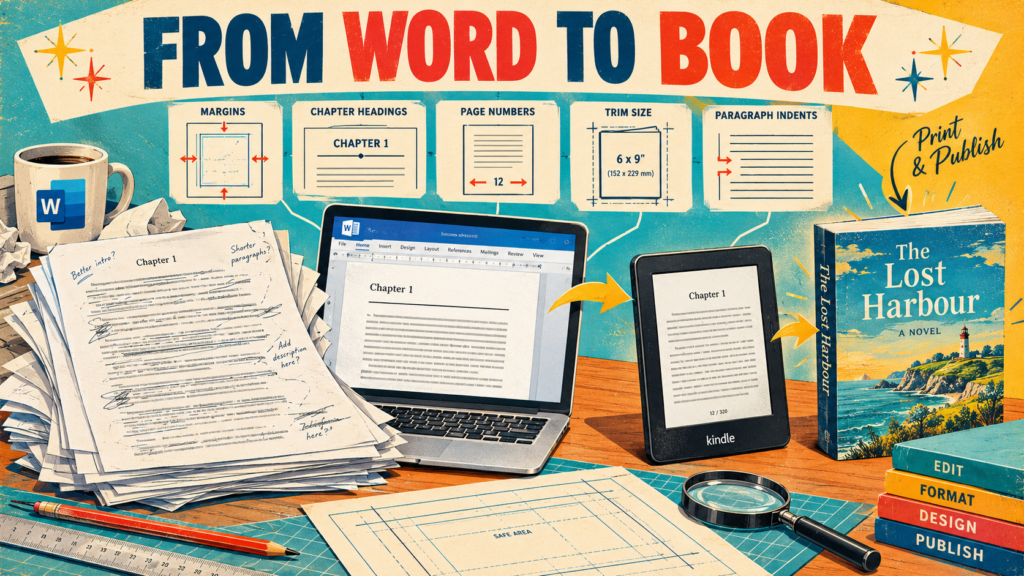
Finishing the novel is the hard part. Or at least, that’s what you tell yourself. Then you open Microsoft Word and discover that you now . . .
There’s a particular kind of misery that writers know well. You sit down, you open the document, and you stare at the cursor blinking back . . .
There’s a lie that gets repeated so often it’s practically tradition. Someone finds out you’re a writer, and within thirty seconds, they’ve said it: “Oh, . . .
“I’ve got a good idea… but I don’t think it’s big enough for a novel.” That sentence has quietly killed more books than lack of . . .