
Too often, people believe they need to pass some invisible exam before calling themselves a writer: a published book, a degree, the perfect idea, or the “right moment.” But here’s a truth I learned in 20 years of writing: the only requirement for being a writer is putting words on a page.
Writing isn’t about waiting for inspiration to hit. It isn’t about needing perfect sentences, flawless grammar, or a fancy concept. It’s about showing up — even when your thoughts feel muddled, even when your sentences come out awkward, even when you’re sure your first draft is rubbish. That’s when real writing begins.
So if you’ve ever thought “I’d love to write… one day”, this post is a wake-up call. Tomorrow can be your “day one.”
Why So Many Talented People Don’t Write — And How to Break That Chain
Over the years I’ve met so many people who want to write, yet never do. Here are the psychological traps I see most often — and how to escape them.
🔒 Trap: “I’m not good enough”
They think: I don’t have a degree, or I’m not published, so I’m not a real writer. But truth is — writing isn’t a club you get admitted to. It’s a muscle you build. The first draft will almost always be messy, clumsy and half-formed. But that draft doesn’t define you. What defines you is that you dared to write it.
🕰️ Trap: “I don’t have time / I’m too busy”
Life moves fast. Jobs, chores, kids, responsibilities — they all pile up. Many treat writing like a luxury, waiting for “free time.” But that’s backward. If writing matters to you, treat it like an appointment: a daily ritual. Even five minutes a day, done consistently, can slowly add up.
🧠 Trap: “What if it’s rubbish?”
That voice inside your head — the critic — is loud. It whispers, “This is trash. People will laugh. You’ll look silly.” The thing is: that voice rarely shuts off. If you wait until you quiet it, you’ll never write. Instead: write now, polish later. Accept the rough, unfinished first draft. Let it be ugly. That’s where the magic begins.
The Foundation: Build Habits, Not Expectations
If writing is a lifestyle more than a project, then what you need first is structure — a set of small, repeatable habits that lead you forward even when motivation vanishes.
Here are the habits that have kept me writing for two decades.
1. Write Something — Anything — Everyday
Yes, every day. Even if it’s a sentence. Even if it’s a scribble on a scrap of paper. The goal isn’t perfection or publishable prose. The goal is movement. A daily writing habit trains your brain to expect writing, to recognise the chair-at-the-desk as sacred time. WTD+1
Some days you’ll pour out pages of story. Some days you’ll just jot “I can’t think of anything.” And that’s fine. It’s all practice.
2. Use Short, Playful Exercises — Without Pressure
Think of writing like physical exercise. You wouldn’t start training for a marathon by running 26 miles on day one. You’d warm up. Stretch. Build gradually. The same goes for writing.
- Try a free-writing sprint — set a timer for 10–15 minutes, write continuously. Don’t worry about grammar, sense, or style. Let the thoughts flow. Wikipedia+1
- Write a random scene: two characters arguing over something silly. Or a description of a room you know well. Or what you see when you look out of a window. Use small prompts, small ideas — but treat them as writing drills.
This keeps your creativity limber. It reminds you writing doesn’t have to be serious or perfect. It just has to be.
3. Accept the Ugly First Draft — Then Revisit
Too many writers stall because they hear the inner critic’s voice. “You’re not good enough,” it says. “This sucks.” So they stop. Or they over-edit, rewriting the first paragraph a hundred times. That paralyzes momentum.
Instead: write the draft — however ugly — then set it aside. Come back later with fresh eyes. Revise. Polish. Clean up. It’s the difference between a sketch and a painting. One is messy and rough; the other is refined and alive.
4. Give Yourself Permission to Fail — Consistently
Failure isn’t an endpoint. It’s part of the journey.
If you miss a day? No guilt. Just start again.
If the last paragraph you wrote stinks? That’s fine — rewrite later.
If you get distracted — life happens — just return when you can.
The real crime isn’t imperfection. It’s giving up.
A 30-Day “Starter Challenge” for You
If you’re ready, here’s a simple challenge — designed to kick-start your writing life. Think of it as planting seeds. What grows depends on the care you give them.
| Day | Task |
|---|---|
| 1 | Free-write for 10 minutes: “What’s on my mind right now?” |
| 2 | Describe a room you know intimately — every smell, every sound, every object. |
| 3 | Write a short dialogue (3–4 lines) between two characters arguing over nothing important. |
| 4 | Write a letter to yourself ten years ago. What advice would you give? |
| 5 | Free-write: “I’m afraid…” Let the fear spill onto the page. No censoring. |
| 6 | Write a scene that begins with “It was raining, and then…” |
| 7 | Write a memory — not what happened, but what you felt. Focus on emotion, not facts. |
| 8 | Describe a stranger you saw today — just from memory. Invent their thoughts. |
| 9 | Write a paragraph starting with “If I died tomorrow…” What would you want recorded? |
| 10 | Create a character sketch: name, age, fears, loves, a secret. |
| 11 | Write a scene from that character’s life — 200 words. |
| 12 | Write a sensory list: tastes, sounds, smells, textures — from a recent moment. |
| 13 | Write a short monologue — as that character — angry, joyful or lost. |
| 14 | Free-write: “What does ‘home’ mean to me?” |
| 15 | Write a scene set 50 years in the future. |
| 16 | Describe a dream you remember — or invent one. Make it vivid. |
| 17 | Write a scene with no dialogue — just description and internal thoughts. |
| 18 | Translate a real conversation you had into fictional characters. |
| 19 | Write a comedic scene — something absurd or silly. |
| 20 | Write a scene from a child’s point of view. |
| 21 | Write a scene beginning with “They never expected to find…” |
| 22–30 | Revisit any of the above. Expand, polish, cut, refine. |
This isn’t about producing a polished story yet. It’s about building muscle memory. Building confidence. Building momentum.
If you complete these 30 days — even haphazardly — you will have:
- dozens of short scenes, exercises, ideas
- a sense of rhythm: you showed up, day after day
- a lowered fear of the blank page
- a growing voice — even if it’s rough around the edges
And most importantly — you will have proven to yourself that you can write.
When Structure Helps — Framing Your Writing Habit
Writing becomes easier when it embeds into your life — when it isn’t a chore, but a ritual. Over the years I’ve found that the most reliable writers use structure to shield themselves from the fluctuations of emotion, mood, and distraction.
Here’s a simple structure that works — whether you’re writing a novel, journaling, scripting, or experimenting.
- Fixed slot in the day: Early morning. Late evening. Lunch break. Find a time and show up whether you feel like writing or not. Like brushing your teeth.
- Word-count or time target: 300 words. 15 minutes. 1 page. Don’t aim for perfection — aim for minimum. Once you begin, sometimes the flow will carry you further. Author Learning Center+1
- Warm-up rituals: Free-writing, a walk, a cup of tea, music, a glance out the window — whatever helps you shift into writing mode.
- “Brain-dump” first pass: Write first, edit later. Dump ideas, fragments, half-formed thoughts. Leave them messy. That’s where creativity hides.
- Review only after a buffer zone: Give yourself time between writing and editing. Let your unconscious mind settle. Then revisit, refine, shape.
This way, writing ceases to be a rare event — it becomes an ongoing conversation between you and the page.
What This Practice Gives You — Beyond Just Words
If you follow this path — habit, repetition, writing without pressure — you’ll notice changes that go beyond “I wrote a story.”
🧠 Your inner voice gets clearer
When you write consistently, you begin to hear your true voice. Not the polished, market-ready voice. But the raw, honest one. That voice is gold: awkward, unrefined, but real. It’s the voice readers connect with because it sounds human.
📚 You build a subconscious bank of ideas
All those quick scenes, random descriptions, dream-fragments, dialogues — they’re not waste. They’re idea shards. Later, when you draft a novel or a story, you’ll realise you already have a repository of characters, moods, moments waiting to be reworked.
🧩 You learn the mechanics of storytelling — without pressure
Through small exercises you’ll test pacing, voice, character, viewpoint, tone. You’ll make mistakes — weird endings, bad dialogue, clunky description. Good. Those mistakes teach you more than polished success ever could.
🎯 You build confidence — not by perfection, but by persistence
Each day you write — even poorly — you prove to yourself: I can do this. The fear fades. The blank page becomes less threatening. Over time, writing becomes as natural as walking, breathing — part of your daily rhythm.
Common Objections — And How to Answer Them
“But I don’t know what to write.”
Then write what you do know: your feelings, your memories, your fears, your morning coffee. Use small prompts. Write a description. Write a list. Write nonsense. The point is to stay in motion; clarity will come later.
“I don’t have time.”
You don’t need hours. Five minutes counts. Ten minutes counts. Even a sentence counts. What counts is that you build routine.
“I’m afraid of producing bad work.”
Good. That fear shows you care. But the only way to improve is to produce bad work — then rewrite, learn, refine. Every famous writer has laboured over multiple drafts; most of what they first created was flawed.
“It feels like I’m wasting time.”
Only if you define “success” as publication or praise. If you define success as growth — confidence, voice, habit — then every scribble counts.
Final Truth: Writing Is Less About Talent — More About Showing Up
I’ve seen it many times: people with “talent” never become writers because they wait for inspiration. Others, with no special gift, become published authors — because they showed up, every day, even when nothing flowed, even when life got messy, even when the words felt like gravel.
Talent helps. Inspiration helps. But the most dependable thing in writing is habit. Persistence. Courage to write ugly first drafts.
If you want to write — start now. Write a line today. Write a page tomorrow. Keep going. Build the habit. Over time, you’ll accumulate not just words, but stories, strength, style, and a writer’s life.
You don’t need permission. You just need to write.
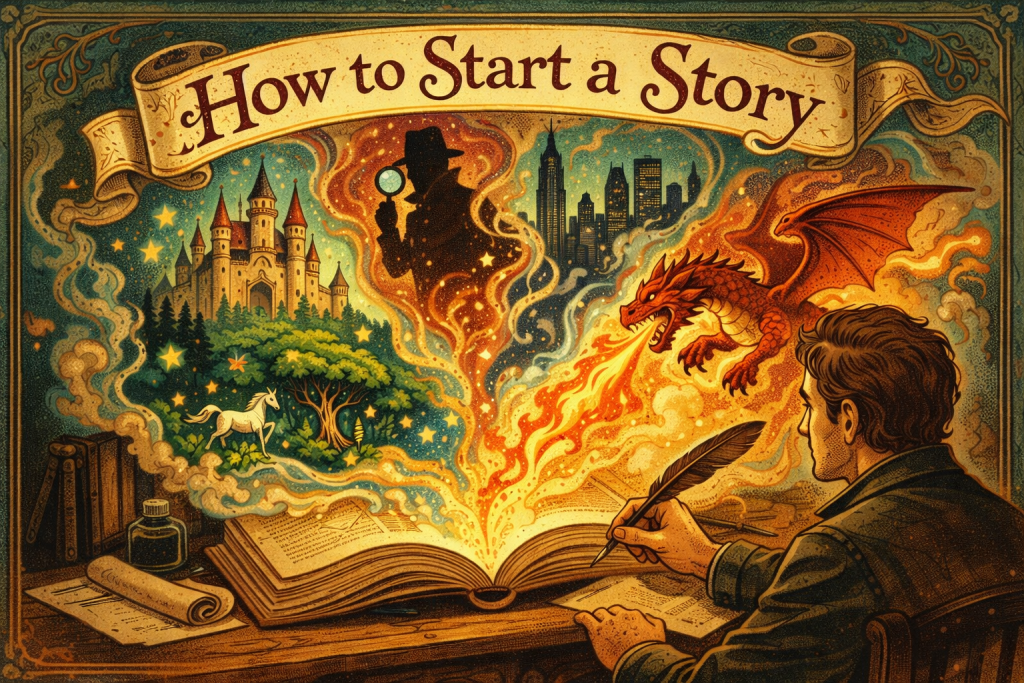
Every writer knows the feeling. You have an idea — maybe a character, a world, or a fragment of a scene — but when you . . .

There’s a delicious, tingling moment in every novel-in-progress where the story goes from blank space to spark. It’s the whisper of a character you don’t . . .

Every writer eventually meets them: the villain who should be terrifying… but somehow lands closer to awkward karaoke act than dark overlord. On paper, they’re . . .

Dialogue is one of those slippery beasts in fiction. Get it right and your characters breathe — they walk into a room, speak, and suddenly . . .