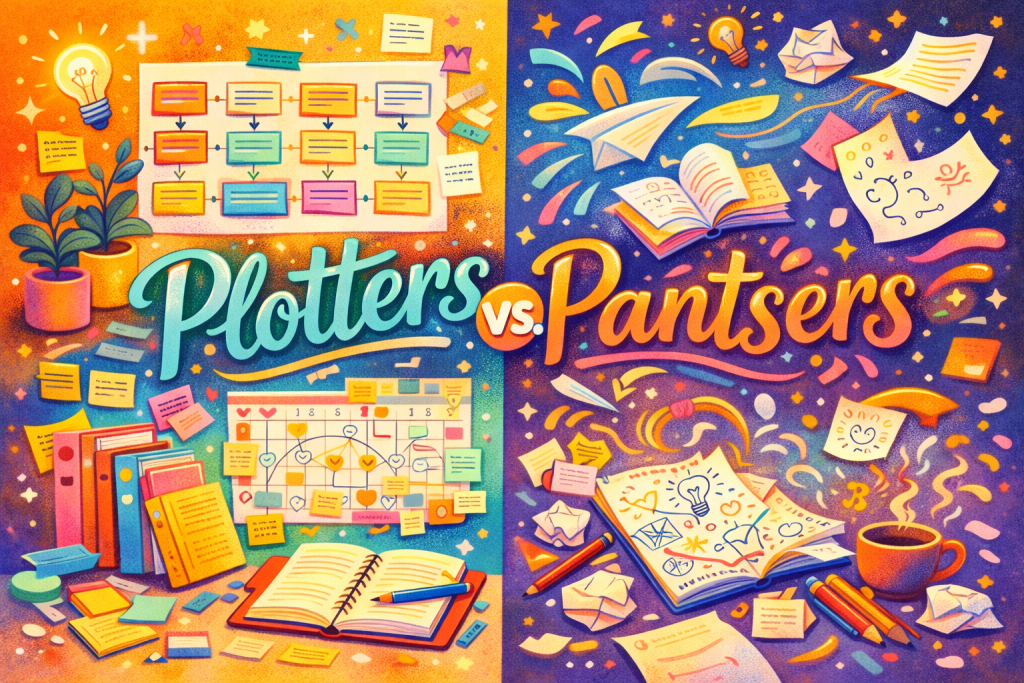
There are two kinds of writers in the world.
(Or at least, that’s what the writing internet has decided.)
On one side, we have the Plotters — the writers with colour-coded spreadsheets, sticky notes spreading across walls like determined vines, and a clear map from “Chapter One” to “The End.” On the other side lurk the Pantsers — the brave souls who open a blank page, take a deep breath, and leap head-first into a story without a plan beyond let’s see what happens next.
Both sides swear their way is the only sane way to write. Both sides have masterpieces and abandoned drafts to their names. And both sides — whether they like it or not — are driven by the same desire:
To tell a story that lives, breathes, and matters.
So… which approach really makes better stories?
Let’s talk honestly — writer to writer.
What Exactly Is a Plotter?
A Plotter is someone who plans the story before writing it.
This might mean:
- A chapter-by-chapter outline
- A detailed beat sheet
- Character arcs mapped like story geometry
- Or a full-blown novel blueprint that looks suspiciously like a building plan for a cathedral
Plotters want to understand the shape of the book before laying down the first line. They like structure. They trust story frameworks. They want to know where they’re going so they can focus on the how rather than the what next?
Why Plotting Works So Well
Plotting gives writers:
✔ A clear roadmap — less wandering, fewer dead ends
✔ Confidence that the story has a beginning, middle, and end
✔ Awareness of pacing and emotional turning points
✔ A sense of control over theme and meaning
And crucially — plotting can make revision easier. If you’ve already explored the “what ifs” in outline form, you may save yourself months (or years) of painful structural rewrites later.
Plotting is like travelling with sat-nav. You still have to do the driving, but you’re less likely to end up crying on the hard shoulder because you somehow took a wrong turn and ended up emotionally attached to a side character who has derailed the entire story.
The Shadow Side of Plotting
Of course, nothing in writing comes free.
Plotting can also:
✘ Feel rigid — Some writers feel trapped by their plan
✘ Kill the magic — If you already know every twist, you may lose the excitement
✘ Encourage perfectionism — Endless planning can become highly productive procrastination
✘ Create fear of deviation — Even when the story wants to evolve
I’ve seen writers outline a novel three times over… and never actually write it. The plan becomes a warm cocoon — safe, predictable, and ultimately stagnant.
Sometimes, your story needs room to surprise you.
And What About Pantsers?
A Pantser (from “by the seat of your pants”) writes to discover the story.
No outline. No roadmap. No safety net.
They start with:
- A character voice whispering in the dark
- A question they don’t know the answer to
- A single image, mood, or line of dialogue
- Or a scrap of a situation that refuses to leave them alone
Then they write — letting instinct, curiosity, and caffeine do the heavy lifting.
Why Pantsing Can Be Magic
Pantsing often results in:
✔ Raw energy and authenticity — The writer discovers the story at the same time as the reader
✔ Characters who feel startlingly alive — Because they aren’t forced to behave
✔ Unexpected twists — That weren’t engineered but evolved
✔ A sense of creative play — Writing becomes an adventure
When pantsing works, it really works. You end up with a story that feels organic, emotionally honest, and full of surprising life.
It’s like getting in a car with no destination and realising you’ve stumbled upon the best hidden café in the country.
But Pantsing Has Its Monsters Too
The downside?
✘ You may write yourself into corners
✘ Structural revision can be brutal
✘ Some drafts collapse under their own chaos
✘ You may lose track of subplots, pacing, or theme
And the big one:
✘ You might never finish.
Many pantsers have hard drives full of beautiful beginnings and abandoned middles. The story spark is intoxicating. The stamina? Less so.
So… Who Writes the Better Stories?
Here’s the truth I’ve learned after twenty years of doing this:
Neither method automatically makes a better writer — or a better book.
Great plotters write breathtaking, layered novels.
Great pantsers write novels that thrum with life.
But bad plotters produce sterile stories that read like instruction manuals.
And bad pantsers write emotional labyrinths that never quite become books.
The method only matters in service to the story.
A story doesn’t care how it was born. It only cares whether it works.
The Real Question: How Do You Think?
Your best method will match your brain’s natural habits.
You Might Be a Plotter If…
- You like lists, calendars, or plans
- You feel calmer when you know what’s ahead
- You enjoy analysing story structure
- You hate waste and inefficiency
- Blank pages feel intimidating without direction
You Might Be a Pantser If…
- You get bored easily
- You discover your characters by writing them
- You love surprises and emotional instinct
- You value discovery over certainty
- Planning drains your creative energy
Neither list is morally superior.
Some writers need control.
Some writers need chaos.
Most of us need a bit of both.
The Hybrid Writer (AKA: The Secret Third Door)
There is a middle path. I’d argue most working writers walk it.
You can:
✨ Sketch a loose outline… then allow yourself to deviate.
✨ Write freely for a while… then pause and organise what you’ve discovered.
✨ Plan the big turning points… but let the journey be fluid.
Think of it like planning a road trip:
You know you’re heading north.
You’ve booked a place to sleep most nights.
But if you see an interesting detour sign and a suspiciously excellent bakery… you’re absolutely allowed to pull over.
This hybrid method keeps structure and spontaneity in conversation rather than competition.
Practical Tips for Plotters
If you’re a plotter at heart, here’s how to avoid suffocating your story:
1. Treat your outline as a living document.
If your characters want to do something new — listen. Update your plan instead of forcing obedience.
2. Leave some blank spaces.
Don’t outline every emotional beat. Give yourself mystery to explore.
3. Write the book, not the plan.
At some point, stop perfecting your spreadsheet and open the draft.
4. Re-discover the story in revision.
Ask: Now that I’ve written it — what is the book really about?
Practical Tips for Pantsers
And if you’re a pantser?
1. Keep a story journal.
Jot down emerging threads so you don’t lose them.
2. Pause at the halfway mark.
Take stock. What promises have you made to the reader? Where is this really going?
3. Learn story structure — not to obey, but to diagnose.
Structure becomes your editing friend, not your creative jailer.
4. Finish messy. Fix later.
Perfection is not your drafting friend. Momentum is.
The Only Metric That Matters
Writers sometimes treat “plotter vs pantser” like Hogwarts houses. We pick a side. We defend it passionately. We buy the scarf.
But here’s the thing:
The only useful question is this:
Does your current process help you finish the best story you can write… without destroying your love for writing in the process?
If the answer is yes?
Congratulations. You’re doing it right.
If the answer is no?
You are allowed — encouraged, even — to change.
A lifelong plotter can loosen their grip.
A forever-pantser can try a roadmap.
We are not trees. We’re writers. We move. We grow. We experiment.
And the story — always — deserves the process that serves it best.
A Final, Gentle Thought
Readers don’t sit down with a novel and say:
“Ah yes, this was clearly written by a plotter.”
They say:
“I couldn’t put it down.”
“This broke my heart.”
“I’ll be thinking about this for weeks.”
They care about the impact — not the method.
So whether you’re outlining your next chapter with the enthusiasm of a Victorian cartographer, or hurtling into your story with nothing but instinct and a mug of tea…
Keep writing.
Keep experimenting.
And remember: the only wrong way to write a book… is the way that stops you finishing it.
There’s a quiet, persistent fear that creeps into a lot of would-be writers’ minds. It usually arrives disguised as a sensible question, but it carries . . .
Ask a room full of writers whether originality still matters, and you’ll witness an immediate and passionate divide. Half will insist that nothing truly original . . .
There’s a myth that has lodged itself firmly into the modern writer’s brain: to be a writer, you must have the latest laptop, a spotless . . .

The question of whether writers should use AI tools to help them write has become one of the most divisive debates in modern creative circles. . . .