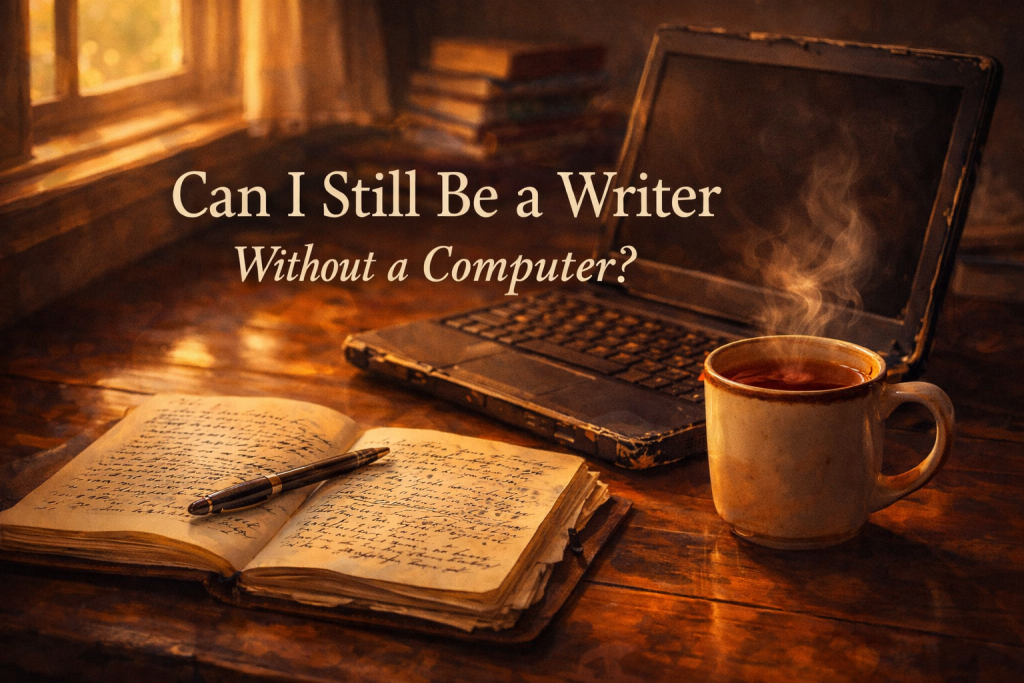
There’s a myth that has lodged itself firmly into the modern writer’s brain: to be a writer, you must have the latest laptop, a spotless desk, and a productivity app for every hour of the day. Preferably with coffee shop ambience and a minimalist aesthetic thrown in.
If that’s true, then most of history’s great writers were in deep trouble.
Because here’s the truth — a truth I’ve learned over twenty years of writing fiction, watching other writers grow, and occasionally losing half my work to a crashed hard drive:
Writers aren’t made by the equipment they own. Writers are made by the words they return to, again and again.
And yes — you can do that without a shiny MacBook or an AI-powered note system.
So if your tech situation looks… less than glamorous — maybe you don’t own a computer at all, or you’re coaxing life out of a wheezing machine that sounds like it might take flight — this article is for you.
Let’s talk honestly about what you do need, what you don’t, and how to build a sustainable writing life with whatever tools you already have.
Writing Didn’t Start With Computers
It helps to remind ourselves: computers arrived late to the party. For centuries, writers worked with quills, ink that smudged, typewriters that jammed, and pages that vanished in fires, wars, and careless attics.
Jane Austen edited by hand. Dickens wrote longhand, then rewrote. Ray Bradbury rented a typewriter by the hour in a library basement. Those stories aren’t romantic nostalgia — they’re reminders of something important:
The act of writing is shockingly low-tech.
All it asks is this:
- your mind
- your voice
- a way to record words
Everything else is convenience — beautiful convenience, yes — but not essential.
So let’s explore the options.
Option 1 — You Don’t Have a Computer at All
If you have no computer, your first thought might be: Well that’s it then. I’m locked out of writing forever.
Not even close.
✍️ You Can Write Longhand
Paper is patient. Pens are cheap. And your brain works differently when your hand moves across a page. Writing longhand slows you down — but slowing down isn’t always the enemy. It can make your sentences deliberate, your descriptions intentional, your characters more fully formed before they rush into chaos.
Here’s what works well handwritten:
- brainstorming story ideas
- planning scenes
- character backstories
- early drafts
- journalling in your character’s voice
- problem solving stuck plot points
Whole novels have started in battered notebooks. Yours can too.
📱 You Can Use a Mobile Phone
If you have a smartphone — even an older one — you already have a portable writing studio in your pocket.
Notes apps. Email drafts. Free word processors. Cloud storage. Voice-to-text if your thumbs mutiny.
I’ve written scenes on trains, in hospital waiting rooms, standing in the wind outside a rehearsal studio — all on my phone. It’s not comfortable, but it’s surprisingly powerful.
The trick is lowering your expectations of the experience while raising your commitment to show up.
You don’t need a mahogany desk to write a paragraph.
You need 10 minutes.
Option 2 — You Have a Computer, But It’s Older Than Your Houseplant
Ah yes. The reluctant machine.
It hums like a jet engine. It boots up slower than a Victorian carriage horse. You click something and stare into the void wondering whether fate will ever return from spinning-wheel limbo.
I’ve owned these computers. I’ve sworn at these computers.
And yet — they still wrote books.
💻 What Really Matters Is Stability, Not Speed
Ask yourself:
- Can it open a simple document?
- Does it save your work?
- Will it run free word-processing software?
If the answer is yes, then you are not blocked. You are merely writing with a slightly grumpy tool.
Turn off everything you don’t need. Disable startup clutter. Use lightweight programs. Avoid dozens of tabs (your computer — and your brain — will thank you).
Perfection is not required. Function is.
But What About Publishing?
This is the part where anxiety whispers:
“Sure, I can write. But how do I ever share my work without proper tech?”
Two things.
1️⃣ Writing Comes First — Always
Publishing without writing is like worrying about what colour icing you’ll use on a cake that doesn’t exist yet.
Give your story the dignity of existing before you panic about distribution.
2️⃣ Access Doesn’t Have to Be Fancy
Libraries often offer:
- free computer use
- internet access
- quiet spaces
- printers
- sometimes workshops or writing groups
A USB stick and a library card are powerful tools.
You can also type handwritten drafts later — slowly, steadily. Plenty of writers do this. Typing your draft becomes your first editing pass.
That’s not a disadvantage. That’s efficiency disguised as inconvenience.
The Real Question Behind the Question
“I don’t have a computer… can I still be a writer?” rarely means exactly what the words say.
Usually, it means something softer, more fearful:
- “Do I belong here?”
- “Am I already behind?”
- “Do real writers look like me?”
- “Is the door already closed?”
Let me answer directly:
Yes, you belong here.
Real writers come from every possible background, circumstance, income bracket, health condition, and technological setup. Writing has never been an exclusive club. Anyone who says otherwise is selling something — usually the illusion of control.
You don’t need permission to write.
You just need time, patience, and the willingness to keep going when the page doesn’t love you back right away.
Building a Writing Practice With Whatever You Have
Let’s make this practical. Here’s a framework you can use whether you’re writing in a notebook, on a creaking PC, or on your phone in the five minutes between life happening.
🧭 1. Decide What “Writing” Means For You
Writing isn’t only “adding new words to a draft.” It also includes:
- thinking through a scene
- outlining
- revising
- learning your craft
- journalling through a character problem
If you can capture thoughts in ink or pixels, you are writing.
🕰 2. Choose Repeatable Time, Not Massive Time
You don’t need three uninterrupted hours.
You need consistency.
Ten minutes a day will do more for you than heroic, twice-a-month marathons that leave you exhausted and guilty.
Promise yourself small wins. Keep them.
📘 3. Use Simple Storage
If you’re writing on paper:
- Number your notebooks.
- Date your entries.
- Keep a contents page at the front.
If you’re writing digitally:
- Back up to a USB stick.
- Email important drafts to yourself.
- Name files clearly so future-you doesn’t hunt through “final_final_REAL_final.docx” at midnight.
Low-tech doesn’t mean disorganised.
🧠 4. Separate Craft From Tools
Your writing ability is not measured by your device specs.
Learn story structure. Character motivation. Dialogue rhythm. Pacing. Subtext. Point of view.
Those skills live in you, not your machine.
When the tech changes — and it always does — your craft remains.
What You Do Need To Be a Writer
Let’s clear the noise. Here’s the true essentials list.
You need:
- curiosity
- a willingness to fail on the page
- discipline… in gentle doses
- time (even tiny scraps of it)
- a way to capture words
Everything else is optional — even comfort.
And yes, that last bit is important. Writing isn’t always comfortable. It asks you to face yourself. It asks you to sit in silence when the world shouts. It asks you to keep going when the first draft looks like it has been assembled from spare parts of seven strange sentences found wandering in the night.
You don’t need a glowing screen to do that.
You need heart.
The Unexpected Advantage of Low-Tech Writing
There’s a quiet superpower in limited tools:
Focus.
When you don’t have a glittering internet waiting to swallow you whole, you’re left alone with your story. No distractions. No endless scrolling disguised as “research.” No tabs. No notifications.
Just you and the work.
Many writers — myself included — sometimes intentionally go low-tech to reconnect with the story’s heartbeat.
You’re not behind.
In some ways, you’re ahead.
And When You’re Ready to Upgrade?
You may reach a point where better tech becomes helpful — not because it defines you, but because it supports you.
If and when that day comes:
- buy second-hand if you need to
- start with simple software
- treat the upgrade as a tool, not a transformation
You were already a writer before the box arrived.
A Final Word — From One Writer to Another
If you’ve read this far, there’s a reason.
Something in you wants to write.
Not “one day when life is tidier.”
Not “when you can afford the fancy setup.”
Not “when you finally feel like a proper writer.”
Now.
With whatever you have.
So here’s my invitation — not a challenge, not a demand, just a gentle nudge:
Start today.
Open a notebook.
Borrow a library computer.
Dictate into your phone while you walk.
Write badly. Then write again.
Watch what happens when you stop waiting for the perfect tools and start trusting your imperfect voice.
Because in the end, the device you write on will be forgotten.
The story won’t.
There’s a quiet, persistent fear that creeps into a lot of would-be writers’ minds. It usually arrives disguised as a sensible question, but it carries . . .

Ask a room full of writers whether originality still matters, and you’ll witness an immediate and passionate divide. Half will insist that nothing truly original . . .
There are two kinds of writers in the world. (Or at least, that’s what the writing internet has decided.) On one side, we have the . . .

The question of whether writers should use AI tools to help them write has become one of the most divisive debates in modern creative circles. . . .