If you spend any time around writing communities today, you’ll eventually encounter a bold claim:
“You can write an entire novel with AI.”
Some websites promise you can generate a book in minutes. Others claim AI will solve writer’s block forever. A few even suggest traditional writing might soon be obsolete.
Naturally, this leaves many writers wondering:
Should I be using AI to write my novel?
The honest answer is more nuanced than the hype suggests. AI tools can be genuinely useful for writers — but not in the way many advertisements suggest.
Let’s look at what AI novel-writing software really does, how writers actually use it, and where its limitations still lie.
What AI Novel Writing Software Actually Is
AI novel-writing software is essentially a writing assistant powered by machine learning.
Instead of writing a complete novel on its own, these tools typically help with:
- brainstorming story ideas
- generating outlines
- suggesting plot developments
- rewriting sentences
- expanding scenes
- overcoming writer’s block
Some tools also track characters, world-building details, and long story arcs to keep novels consistent over many chapters.
In other words, they act more like a brainstorming partner than an automatic novelist.
Examples of AI Novel Writing Tools
Several platforms have appeared specifically for fiction writers.
Sudowrite
A popular tool designed to help with brainstorming, rewriting, and scene development. It’s often recommended for new writers looking for creative inspiration while drafting.
NovelCrafter
This software focuses more on organization. It helps track characters, world-building, and plot details across long manuscripts, making it useful for writers working on series or complex stories.
NovelAI
A subscription-based AI story generator launched in 2021 that allows writers to generate text and even create illustrations to accompany stories.
Some platforms even attempt to generate entire novels, though results vary widely in quality and coherence.
The Big Promise: “Write a Novel in Minutes”
Many AI tools advertise that they can generate complete novels quickly.
Technically, this is true.
Some platforms can produce long drafts almost instantly. For example, AI tools can generate story text, titles, or opening chapters based on a prompt describing the plot or genre.
But there’s an important distinction between generating text and writing a novel.
A novel isn’t just word count. It requires:
- consistent character motivations
- meaningful story arcs
- emotional depth
- thematic cohesion
And that’s where AI still struggles.
Where AI Still Struggles With Long Stories
AI can produce convincing passages of text, but maintaining narrative structure over an entire novel is difficult.
General-purpose AI tools often lose track of story details after several chapters, causing plot inconsistencies or characters behaving unpredictably.
For example:
- characters forgetting earlier events
- plot threads disappearing
- tone shifting randomly
These issues make fully automated novels difficult without human editing.
In short, AI can generate pages, but it still needs a writer to shape the story.
How Writers Are Actually Using AI
Most experienced writers who experiment with AI use it as a creative assistant rather than an author.
Common uses include:
1. Brainstorming ideas
AI can generate multiple story concepts quickly, helping writers explore different directions.
2. Outlining plots
Writers often use AI to sketch possible story structures before developing them themselves.
3. Overcoming writer’s block
When a scene feels stuck, AI suggestions can spark new ideas.
4. Expanding scenes
AI can sometimes help flesh out descriptions or dialogue that writers later refine.
5. Editing and rewriting
Some tools suggest alternative wording or improve clarity.
This workflow treats AI as a drafting partner rather than a replacement for creativity.
AI in Publishing: A Real Example
AI-assisted books are already appearing in publishing.
For example, the children’s book Alice and Sparkle was created using AI tools to generate both text and illustrations.
The book sparked debate about creativity, copyright, and the role of AI in art.
These conversations are still evolving as the technology develops.
The Real Advantage of AI for Writers
Despite the controversy, AI can genuinely help writers in several ways.
The biggest advantages are:
Speed
AI can generate ideas or text quickly, allowing writers to experiment more.
Momentum
Sometimes seeing something on the page helps overcome creative paralysis.
Exploration
Writers can test multiple variations of a scene or idea without starting from scratch.
Used well, AI can act like a brainstorming engine that accelerates creative thinking.
The Risk of Over-Reliance
There is also a downside.
If writers depend too heavily on AI-generated prose, their work can start to feel:
- generic
- repetitive
- emotionally flat
Readers tend to notice when stories lack a distinct human voice.
Writing is not just about producing text — it’s about communicating experience, perspective, and emotion.
That part still belongs firmly to human authors.
A Balanced Approach to AI Writing
The healthiest way to use AI in fiction writing is somewhere in the middle.
Instead of asking:
“Can AI write my novel?”
Ask:
“How can AI help me write a better one?”
Use it for brainstorming, outlining, or experimentation — but keep the creative decisions in your own hands.
Because the truth is simple:
AI can generate words.
But meaning still comes from the writer.
Final Thought
Every new technology in writing has sparked fear at some point.
Typewriters did.
Word processors did.
Spellcheck did.
AI may become another tool in the writer’s toolbox.
But tools don’t tell stories.
People do.
Artificial intelligence is rapidly changing the way people write. Tools can generate outlines, suggest dialogue, correct grammar, and even draft entire chapters in seconds. For . . .
There’s a quiet, persistent fear that creeps into a lot of would-be writers’ minds. It usually arrives disguised as a sensible question, but it carries . . .
Ask a room full of writers whether originality still matters, and you’ll witness an immediate and passionate divide. Half will insist that nothing truly original . . .
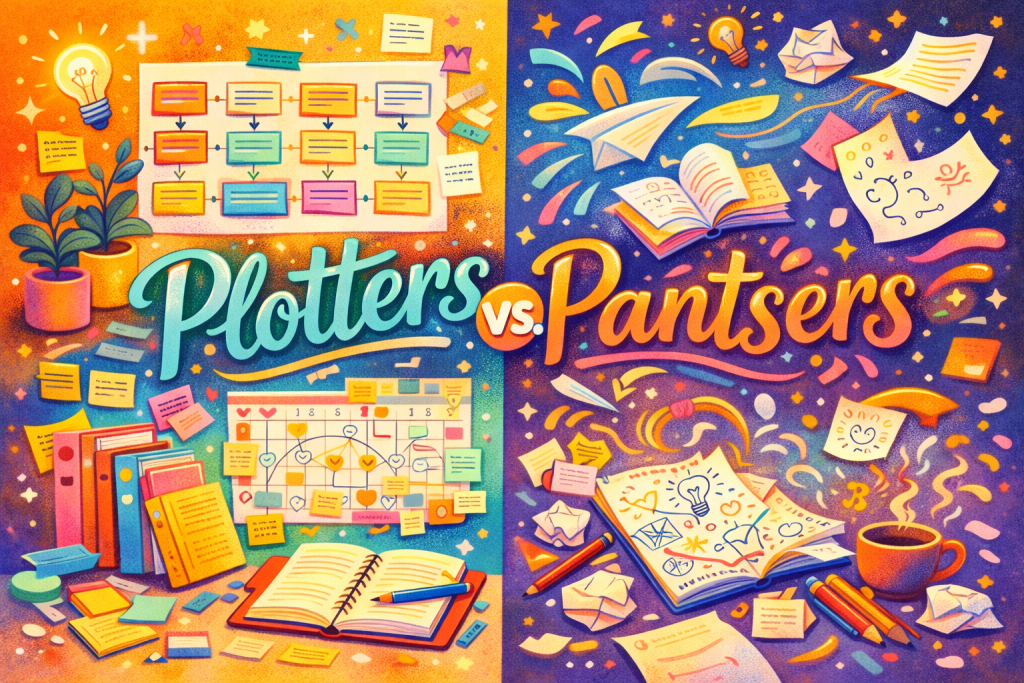
There are two kinds of writers in the world. (Or at least, that’s what the writing internet has decided.) On one side, we have the . . .