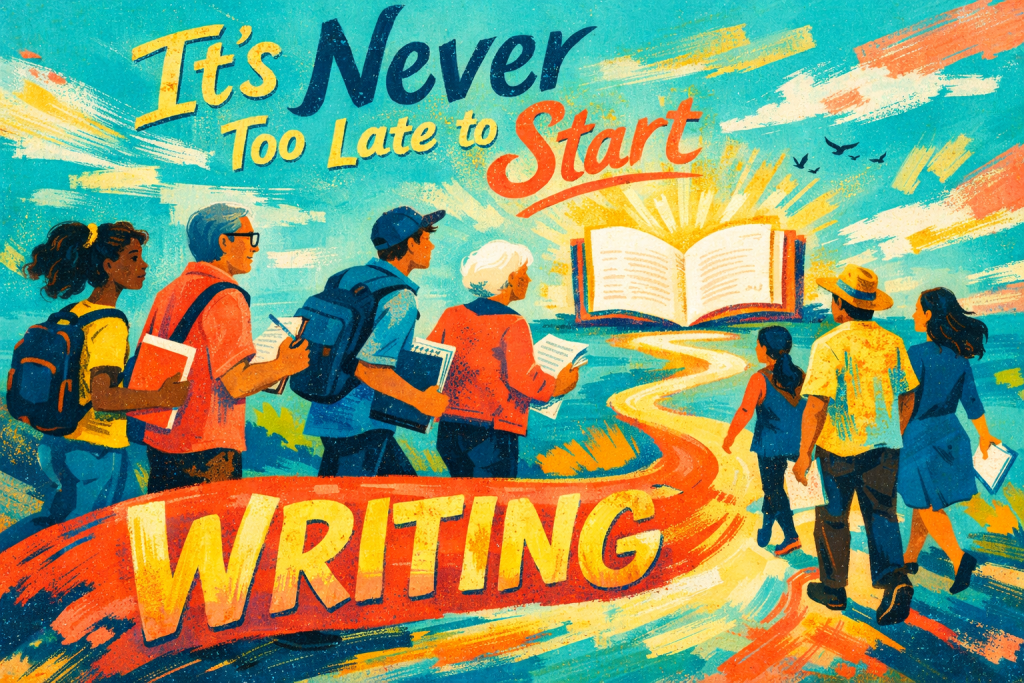
There’s a quiet, persistent fear that creeps into a lot of would-be writers’ minds. It usually arrives disguised as a sensible question, but it carries something heavier underneath.
“Am I too old to start writing now?”
Maybe you’re in your thirties and feel like you missed the boat.
Maybe you’re in your forties and wondering where the years went.
Maybe you’re in your fifties, sixties, or beyond — with a head full of stories and a lifetime of experience, but a nagging voice that says, surely it’s too late to begin.
Let me say this plainly, without sugarcoating it:
If you’re old enough to have something to say, you’re old enough to start writing.
The idea that writing belongs to the young is one of the most damaging myths in creative culture. It scares people away from the page before they’ve even written a sentence — not because they lack talent, but because they’ve been sold a very narrow image of what a “real writer” looks like.
So let’s dismantle that myth properly.
The Lie We’re Taught About “Starting Early”
We love prodigy stories.
The teenage novelist.
The poet who published at twenty-one.
The viral success who “always knew” they wanted to write.
These stories get repeated so often that they quietly become rules in people’s minds.
If I didn’t start young, I’ve missed my chance.
But here’s what those stories leave out:
Most people who start writing young don’t yet have perspective, patience, or emotional depth. They have energy — which is useful — but energy is not the same thing as insight.
Writing isn’t a sprint.
It’s a long conversation with yourself and the world.
And that conversation often gets better with age.
What Older Writers Have That Younger Writers Don’t
Starting to write later in life isn’t a disadvantage — it’s a different starting position.
And in many ways, it’s a stronger one.
1. You Have Lived Inside Consequences
You’ve seen decisions ripple outward.
You’ve watched relationships change.
You’ve experienced regret, resilience, compromise, reinvention.
That means when you write about conflict, it doesn’t feel theoretical. It feels earned.
Readers notice that.
2. You Know What Matters (And What Doesn’t)
Older writers are less likely to:
• chase trends blindly
• overwrite to impress
• mistake complexity for depth
You’re more inclined to ask, What is this actually about?
That clarity is gold.
3. You’re Less Afraid of Silence
Younger writers often panic when nothing happens on the page.
Older writers understand that pauses, restraint, and implication can be powerful.
That maturity shows up in pacing, tone, and emotional control.
4. You’re Writing Because You Want To — Not Because You “Should”
This might be the biggest advantage of all.
If you’re starting now, you’re not doing it to prove something.
You’re doing it because the urge hasn’t gone away.
That kind of motivation lasts.
“But I Don’t Have the Time I Used To”
Let’s be honest: starting later doesn’t magically grant you free afternoons and uninterrupted mornings.
You may have:
• work
• family
• responsibilities
• an older body that doesn’t love late nights
But here’s the uncomfortable truth:
Time was never the real issue. Priority was.
Most writers — at any age — build their practice in scraps of time.
Twenty minutes before bed.
A notebook on a lunch break.
A few paragraphs while the kettle boils.
Writing doesn’t require youth.
It requires returning to the page.
Over and over again.
The Fear Behind “Is It Too Late?”
When people ask whether it’s too late to start writing, they’re rarely talking about time.
They’re talking about risk.
• What if I try and I’m not good?
• What if I invest energy and nothing comes of it?
• What if I discover I should have started years ago?
That last one stings the most.
But here’s the thing:
You will feel that regret whether you write or not.
The difference is this:
Writing transforms regret into material.
Writing Isn’t About Catching Up
One of the most toxic ideas older writers carry is the sense they need to “catch up” — to younger writers, to the market, to imagined timelines.
That’s rubbish.
You are not behind.
You are starting from where you are.
There is no universal writing clock ticking above your head.
There is only:
• the story you want to tell
• the voice you’re developing now
• the next sentence
That’s it.
Publishing Late Is Not a Failure
Let’s clear something up.
Publishing at 45, 55, or 65 is not “late.”
It’s just when your work was ready.
Many celebrated authors didn’t publish their best-known work until well into adulthood — often after careers, families, and multiple reinventions.
What readers care about is not your age.
They care whether the story feels honest.
The Hidden Advantage of Starting Now
There’s a quiet confidence that often comes with age — even if it doesn’t always feel like it.
You’re less likely to:
• obsess over external validation
• panic at every rejection
• abandon a project because it’s hard
You understand that meaningful work takes time.
That patience is a superpower in writing.
What Starting to Write Later Actually Looks Like
It doesn’t look glamorous.
It looks like:
• messy first drafts
• doubt sitting beside determination
• learning craft intentionally
• letting go of perfection
• writing for yourself first
In other words — it looks exactly like starting at any age.
The difference is you’re bringing decades of emotional data with you.
If You’re Thinking of Starting Now, Do This First
Don’t begin by asking:
“Can I be a writer?”
Instead, ask:
• What stories won’t leave me alone?
• What do I understand now that I didn’t at twenty?
• What questions am I still wrestling with?
That’s where your writing begins.
Not with ambition.
With curiosity.
You’re Not Late — You’re Ready
There’s a reason the urge to write often shows up later in life.
By then, you’ve collected enough contradictions, disappointments, joys, and unanswered questions to fuel meaningful work.
Writing is not about arriving early.
It’s about arriving honest.
And if you’re reading this, wondering whether you’ve missed your chance — chances are, you’re standing right at the beginning of it.
Final Thought
You don’t need permission.
You don’t need to justify your age.
You don’t need to explain why now.
If you want to write — start.
Not because it will lead somewhere.
But because not writing has started to feel like a loss.
That’s not too late.
That’s exactly on time.
There’s a particular kind of misery that writers know well. You sit down, you open the document, and you stare at the cursor blinking back . . .
There’s a lie that gets repeated so often it’s practically tradition. Someone finds out you’re a writer, and within thirty seconds, they’ve said it: “Oh, . . .

“I’ve got a good idea… but I don’t think it’s big enough for a novel.” That sentence has quietly killed more books than lack of . . .
There’s a quiet lie that creeps into most writers early on. It sounds sensible. Strategic, even. “Write what people want.” On the surface, that’s not . . .