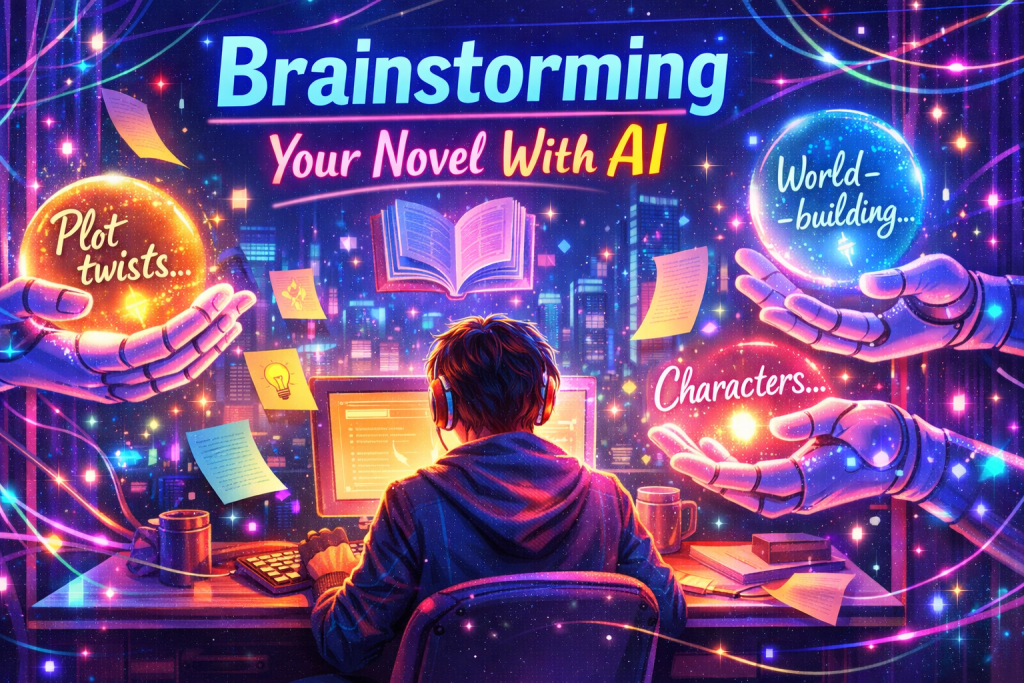
There’s a delicious, tingling moment in every novel-in-progress where the story goes from blank space to spark. It’s the whisper of a character you don’t know yet, a conflict starting to smoulder, a world waiting to exist. That part is addictive. But there’s also the other part — the heavy-brained, slightly panicked moment where you realise you don’t quite know what happens next.
For many writers, that’s where AI has begun to creep into the creative process. And whether that excites you, terrifies you, or makes you want to throw your laptop into a lake, here’s the truth:
AI is a tool. Nothing more. Nothing less.
It’s not a ghost-writer.
It’s not your replacement.
It’s not going to reach into your head and rob you of that spark that only you have.
But — and this is the part worth paying attention to — if you use it wisely, AI can be a genuinely powerful brainstorming partner.
Think of it like a co-pilot who doesn’t sleep, doesn’t judge, and never asks you to buy the next round of drinks.
Let’s talk about how to use it — safely, playfully, and without losing your creative soul in the process.
Start With Curiosity, Not Panic
Writers tend to fear two things:
- Being replaced
- Being mediocre
AI can poke at both of those fears if you let it. You see articles about artificial intelligence writing novels and suddenly you’re spiralling: What if I’m the obsolete one? What if everything I do can be done faster by a bot in a server farm somewhere?
Stop. Breathe.
There’s something AI cannot do — and that is live a human life.
It hasn’t failed. It hasn’t fallen in love and made dreadful decisions. It hasn’t sat awake at 3am fearing the future, or watched snow fall on a day when everything changes.
That’s your territory.
So use AI from a place of curiosity. As in:
What happens if I play with this and see what it gives me?
Not:
Please fix my story because I don’t know how to write.
You’re still the writer. Always.
Use AI to Break Through the Blank Page
The blank page is intimidating because it offers endless possibility — and therefore endless self-doubt.
So here’s a simple, practical way to begin brainstorming:
Step 1 — Give AI a starting point
Instead of saying:
“Give me a story idea”
Try something more grounded:
“I’m writing a mystery novel set in a rainy coastal town. My protagonist is a burnt-out journalist. Give me five unusual inciting incidents that fit this tone.”
You’ll get a handful of options. Some will be cliche. Some will be weird. One might have a spark.
And here’s the key:
You don’t accept the idea as-is. You respond to it.
Maybe the AI suggests that a body washes up on shore with your character’s business card in its pocket.
Okay — now you ask questions:
- Why that card?
- Is it a warning?
- A coincidence?
- A frame-up?
AI didn’t write the story.
It gave you a stone to skip across the water.
You decide where the ripples go.
Use AI to Explore Character Psychology
Characters are usually where my stories begin — someone walks into my head with a problem and refuses to leave. But sometimes even nagging characters can feel foggy.
AI can help you interrogate them.
Ask questions like:
“My character is a paramedic who’s terrified of the dark. What childhood experiences might explain this?”
You’ll get possibilities.
Maybe she was trapped in a lift as a child.
Maybe she witnessed a nighttime accident.
Maybe she associates darkness with silence — and silence with loss.
You don’t take the answer.
You notice which answer makes your chest tighten.
That’s your character saying, “Yes. That one.”
AI is simply the lantern you shine around until you find the doorway.
Use AI for “What If?” Chains
This is my favourite game.
You feed your story situation into AI and then do a round of escalating “What if—?” questions.
For example:
- What if the hero trusts the wrong person?
- What if the villain thinks they’re saving the world?
- What if the love interest has a secret that changes everything?
AI will throw possibilities back at you, like a writing partner hopped up on sugar and caffeine.
And once again — you curate.
You’re the filter.
You’re the voice.
You’re the soul.
AI is just the brainstorming storm cloud you stand under, catching the lightning when it falls near you.
Use AI When You Feel Stuck in the Middle
Ah, the dreaded Sagging Middle — that section where your enthusiasm collapses like a bad soufflé, and your plot begins to wander about in its slippers.
AI can help here too.
Try:
“I’m halfway through my fantasy novel. My hero has escaped the city but hasn’t yet reached the final conflict. Suggest complications that add tension and deepen the theme of loyalty vs. survival.”
Notice the specificity.
The clearer your intention — the better the ideas you receive.
And because you asked for ideas that serve your theme, you stay anchored in meaning rather than throwing in random explosions or dragons for the sake of it (though… never rule out dragons entirely).
Use AI to Understand Structure
AI is fantastic at helping you see shape in storytelling.
You can ask:
“Explain my story as a three-act structure.”
Or:
“What’s missing from my midpoint?”
Or:
“How does this connect to my character arc?”
The responses may throw light on the bones of your story — the architecture beneath the decoration.
Again — you do not accept it blindly. But you can ask:
- Does this help me see the story more clearly?
- Am I missing a revelation?
- Is the character growth too flat?
Sometimes AI simply gives language to something you already sensed but couldn’t articulate.
And that is invaluable.
Set Boundaries So AI Never Becomes the Author
This is essential.
AI is not there to write for you.
If you let it, it will start filling in paragraphs, scenes, even dialogue — and that’s when your voice starts dissolving, like sugar in tea.
So create rules, for yourself:
- AI may suggest, but it doesn’t compose.
- AI may brainstorm, but it doesn’t revise.
- AI may explain structure, but it doesn’t decide the story.
Your creative fingerprint matters. It’s the difference between a song written by a musician who has been heartbroken, and one written by a machine trained to simulate heartbreak.
The surface may look similar — but the resonance is entirely different.
Readers feel that.
Even if they don’t know why.
Protect Your Originality
One of the great dangers of AI is homogenisation — that slow drift toward sameness because everyone is pulling from the same statistical soup.
So keep doing the things AI cannot:
Go for walks.
Eavesdrop in cafés.
Travel — even if it’s just to the next town.
Watch people at bus stops.
Read widely and weirdly.
Talk to strangers.
Live.
Because AI is built from words.
But your stories are built from experience.
Bring that into the drafting room and AI becomes a spice — not the meal.
Use AI As a Cheerleader, Too
Sometimes brainstorming isn’t about plot or theme or midpoints.
Sometimes you just need to hear:
“Hey. You’re doing okay. Keep going.”
You can ask AI to help you reframe a setback, rebuild your motivation, or talk you through why your messy draft isn’t a disaster — just a first pancake.
(Of course, a trusted writing friend is even better for this. But the internet doesn’t always obey time zones.)
Use AI for mindset support — not validation.
You’re still the writer.
Your worth is not up for debate.
A Word on Ethics
Please don’t feed unpublished work that isn’t yours into AI tools.
It’s the digital equivalent of rummaging through someone’s diary and asking your virtual assistant to critique it.
Also — be transparent, especially if you’re teaching, editing, or selling writing services. If AI plays a role in your workflow, acknowledge it.
We’re all still navigating this strange, shifting landscape.
Honesty matters.
Let the Tool Stay a Tool
Here’s the paradox:
AI is both powerful and limited.
It can help you brainstorm, clarify, structure, question, and explore.
But it cannot dream for you.
It cannot live for you.
It cannot feel what you feel.
Your job is not to compete with it.
Your job is to remain human.
And if AI helps you reach deeper into the story you were already aching to tell — then use it, joyfully, unapologetically, as one tool among many.
Because the world doesn’t need more machine-made fiction.
It needs your voice —
tired, hopeful, crooked, stubborn, honest.
And the spark?
That still comes from you.
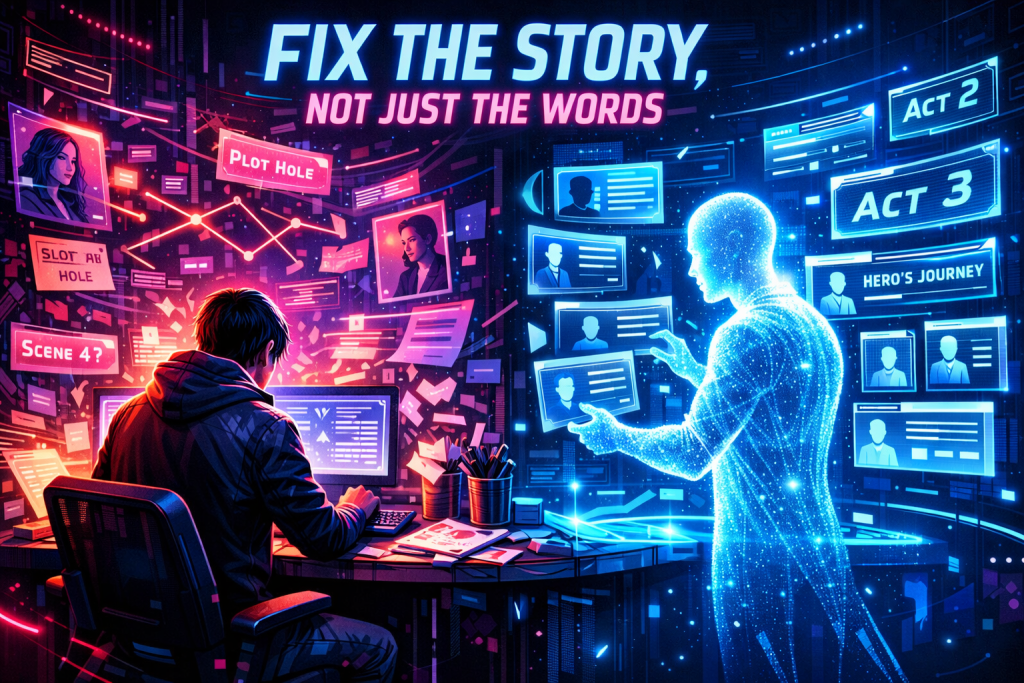
There comes a moment in every writer’s journey where confidence quietly turns into suspicion. You’ve finished your manuscript.You’ve edited it.Maybe you’ve even rewritten large chunks . . .
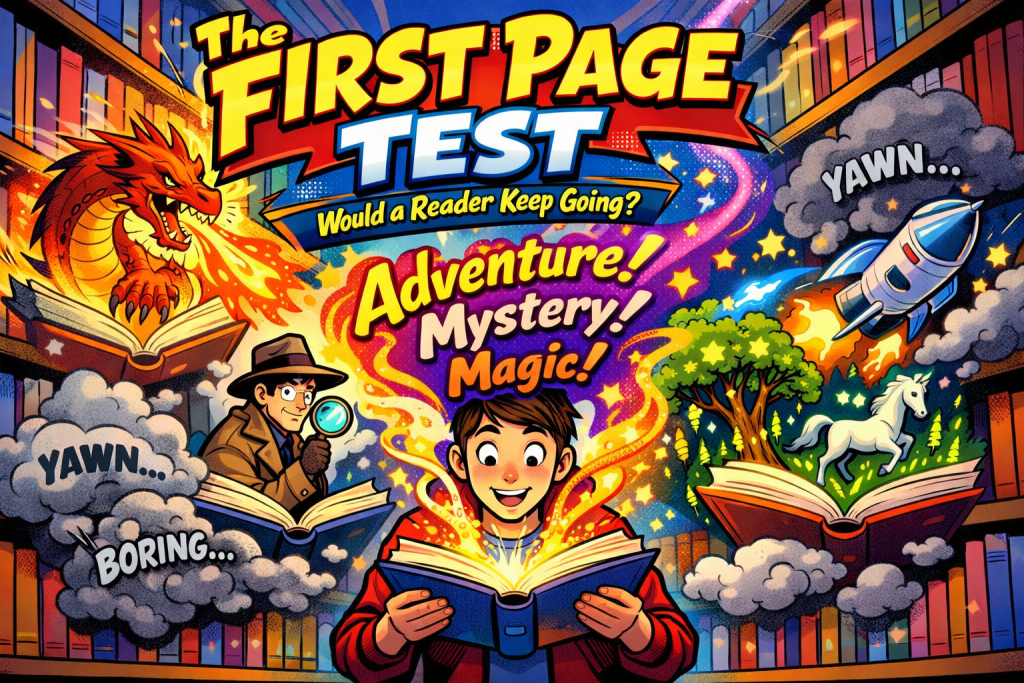
Every writer eventually faces the same uncomfortable question. If a reader opened your book and read only the first page… would they keep going? It . . .
Every writer knows the feeling. You have an idea — maybe a character, a world, or a fragment of a scene — but when you . . .
Every writer eventually meets them: the villain who should be terrifying… but somehow lands closer to awkward karaoke act than dark overlord. On paper, they’re . . .