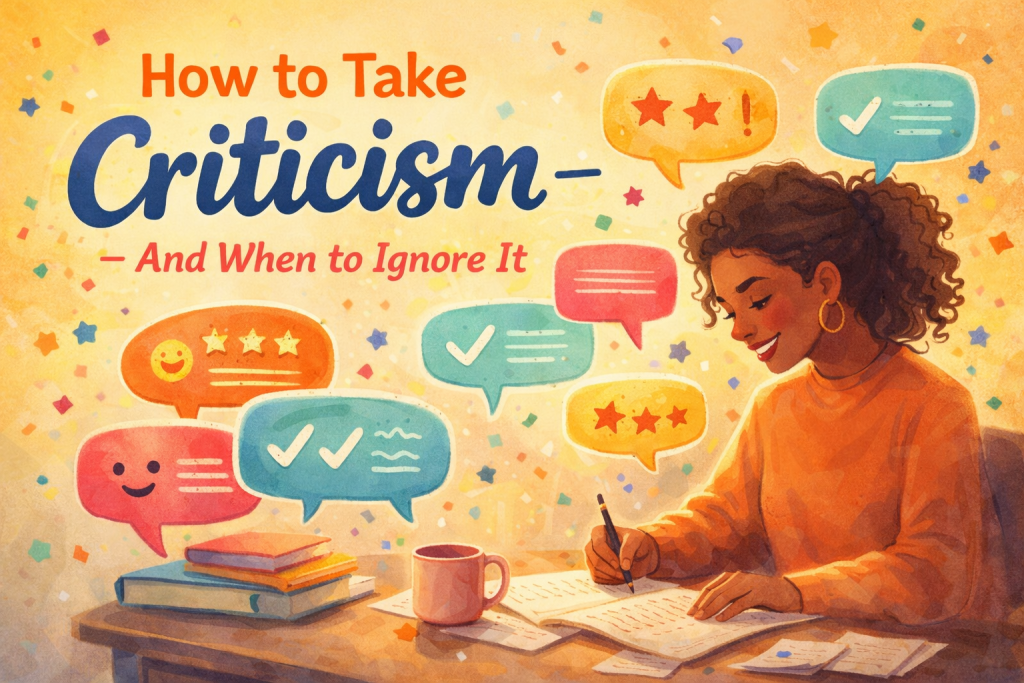
There’s a peculiar moment every writer knows. You open the email, or the message, or the comments. You know what’s inside. Feedback. Critique. Notes. You brace yourself the way you might before diving into cold water. And then you read the words that either make your heart soar… or make you wonder why you ever thought you could write in the first place.
Criticism is stitched into the fabric of being a writer. The moment you let your stories walk out into the world on their own wobbly legs, they’ll meet people — and people have opinions. Some of those opinions will be generous, thoughtful, and honest. Others will be careless, unkind, or simply wrong for you and your work. Learning to tell the difference is one of the most important craft skills you’ll ever develop.
Let’s talk about how to take criticism without crumpling — and how to know when to quietly step over it and keep going.
Why Criticism Hurts (Even When We Ask for It)
Writers don’t just make things. We make parts of ourselves visible. You might wrap that vulnerability in dragons or detectives or quiet poems, but it’s still you on the page — your voice, your choices, your heart stitched between the sentences. So when someone critiques your work, it can feel intensely personal, as if they’ve just judged you, not your story.
That’s why one offhand “this didn’t work for me” can echo louder than a dozen kind words.
It’s normal to feel stung.
It’s normal to feel defensive.
It’s even normal to fantasise about never showing your work to another human again.
But here’s the truth I’ve learned over the years: criticism isn’t your enemy. Unfiltered, unexamined criticism is. Your job is to learn how to sift it, separate signal from noise, and use what strengthens your writing — while refusing what only weakens your confidence.
Pause Before You React
The first rule of receiving criticism is this:
Don’t respond while your emotions are driving the car.
If a comment hurts, give yourself space. Close the document. Take a walk. Make tea. Rant to your cat. Let the adrenaline drain away before you decide what the note means.
I’ve had feedback that, on the first read, felt like a personal attack — only to realise days later that buried inside it was a truth I needed, one I wasn’t quite ready to face. I’ve also had feedback that sounded perfectly reasonable at first… until I recognised that implementing it would have broken the heart of the story.
Time gives you perspective. And perspective is where wisdom grows.
Ask the Right Questions
Once you’ve given yourself breathing room, come back to the feedback and ask a few key questions:
- What is the reader actually reacting to?
Sometimes the note isn’t the note. A comment about your pacing might really be about confusion over stakes. A complaint about a character might be frustration with how they’re introduced. - Is this a pattern — or a single voice?
If one person dislikes something, that’s opinion. If five people stumble in the same place, that’s a signpost. - Does this align with the story I’m trying to tell?
If the reader wants you to write a different story entirely, their advice may not belong in yours. - Is the suggestion practical and specific?
“I didn’t like it” is unhelpful. “I struggled to understand why the protagonist made this choice” gives you something to work with.
These questions turn criticism from a blunt object into a set of tools. Tools don’t hurt you. Tools help you build.
Three Types of Criticism — And What To Do With Each
Not all criticism is created equal. In fact, I find most of it falls into three categories.
1. Constructive Criticism
This is gold dust. Constructive criticism respects your work and wants to help it grow. It’s often clear, specific, and delivered with care. It might sound like:
- “I loved the atmosphere, but I lost track of the timeline in the middle.”
- “This character’s motivation wasn’t fully clear to me.”
- “The dialogue is strong, but I wanted more internal reaction in key scenes.”
You might wince reading it — but you can see the intention behind it.
What to do:
Lean in. Sit with it. Experiment. You don’t have to accept every point, but constructive criticism is often the difference between a decent piece and a compelling one.
2. Preference-Based Criticism
This type of feedback is rooted in taste. The reader doesn’t love slow-burn romances. Or bleak endings. Or experimental structure. They’re responding honestly — but their response isn’t a universal truth.
It might sound like:
- “I just don’t like first-person narration.”
- “I prefer fast-paced thrillers.”
- “I don’t enjoy fantasy.”
What to do:
Thank them (at least in your heart), harvest any useful specifics, and move on. You can’t shape your work to please people who don’t enjoy your genre or style — nor should you try.
3. Destructive or Careless Criticism
This is the garbage fire of critique. It’s vague, personal, mocking, or intended to belittle rather than build. It might look like:
- “This is terrible. You shouldn’t bother.”
- “You clearly don’t know how to write.”
- “I hate your main character. They’re stupid.”
There’s no generosity, no intention to help, and no craft insight here.
What to do:
Ignore it. Truly. Close the tab. Delete the message. Feed it to the void. Your creative life is too precious to hand over to someone who doesn’t treat it with respect.
When You Should Absolutely Listen
There are moments when criticism deserves your full attention. For example:
- Multiple readers are confused in the same place.
Something isn’t landing on the page. - The feedback highlights something you secretly suspected.
Often your gut already knows. - The reader articulates craft issues you can fix.
Pacing, clarity, character motivation, structure — these are solvable. - The critic understands your goals but shows you where execution faltered.
That’s a gift.
And yes — sometimes the criticism hurts precisely because it’s true. That doesn’t make you a bad writer. It makes you a writer in progress. Which, by the way, we all are.
When You Should Gracefully Ignore It
There are also times to smile politely and carry on writing.
Ignore criticism when:
- It demands you change the heart of your story to suit someone else’s taste.
- It’s rooted in prejudice, narrow-mindedness, or rigid expectations.
- It misunderstands your genre entirely.
- It’s vague and offers no usable insight.
- It attacks you, not the work.
You are allowed to protect your creative voice. In fact, you must.
Separating Yourself From Your Work
One of the healthiest shifts you can make is this:
Your writing is something you make. It is not who you are.
That doesn’t mean don’t care. It means hold your work firmly enough to shape it — but loosely enough that critique doesn’t feel like a verdict on your worth.
Think of it like pottery. If someone says the bowl wobbles, you don’t throw your hands up and declare, “I am a wobbly human failure.” You steady the clay. You try again. You learn with every attempt.
Writing works the same way.
How to Ask for the Right Kind of Criticism
You’ll have a better experience if you frame feedback before you ever receive it. When you send work to beta readers, critique partners, or editors, try saying:
- “I’m worried the pacing drags in the middle — let me know how it feels to you.”
- “Please focus on character motivation and clarity.”
- “I’m not ready for line edits yet — big picture thoughts are most useful.”
This gives your readers lanes to stay in, which reduces the chances of stray arrows hitting places you didn’t expect.
Choosing who you ask matters too. Gather voices who respect your genre, understand story, and believe in you enough to be honest — but kind.
Protecting Your Creative Flame
Here’s something I wish someone had told me early on: your creativity is a living thing. It needs protecting.
If certain environments leave you feeling small or brittle, limit your exposure. If social media comments drain the joy from your work, step back. If a particular person always leaves you doubting yourself, reconsider their place in your creative circle.
You don’t need to toughen up until you’re made of stone. You need to grow strong enough roots to keep writing — even when the wind blows.
Turn Criticism Into Craft Fuel
When criticism is useful, it can become rocket fuel for your writing. Try this process:
- Name the issue.
“Readers are confused about why my character runs away.” - Locate it on the page.
Where do they first experience this confusion? - Ask what’s missing.
Is the character’s fear underdeveloped? Is their backstory too thin? - Strengthen the foundation.
Add beats of thought, clearer stakes, or sharper cause-and-effect.
Criticism isn’t just “bad news.” It’s a map showing you where to dig for gold.
And Finally — Be Kind to Yourself
Writing is vulnerable work. You’re building worlds from thin air and then inviting strangers to wander through them. That takes courage. Some days you will handle criticism with grace and insight. Other days you’ll want to hide under a blanket and watch videos of dogs wearing hats.
Both days are fine.
What matters is that you return to the page. That you keep learning. That you remember the only person who can tell your stories is you.
Take what helps. Leave what harms. And write on.

There comes a moment in every writer’s journey where confidence quietly turns into suspicion. You’ve finished your manuscript.You’ve edited it.Maybe you’ve even rewritten large chunks . . .
Every writer eventually faces the same uncomfortable question. If a reader opened your book and read only the first page… would they keep going? It . . .
Every writer knows the feeling. You have an idea — maybe a character, a world, or a fragment of a scene — but when you . . .

There’s a delicious, tingling moment in every novel-in-progress where the story goes from blank space to spark. It’s the whisper of a character you don’t . . .