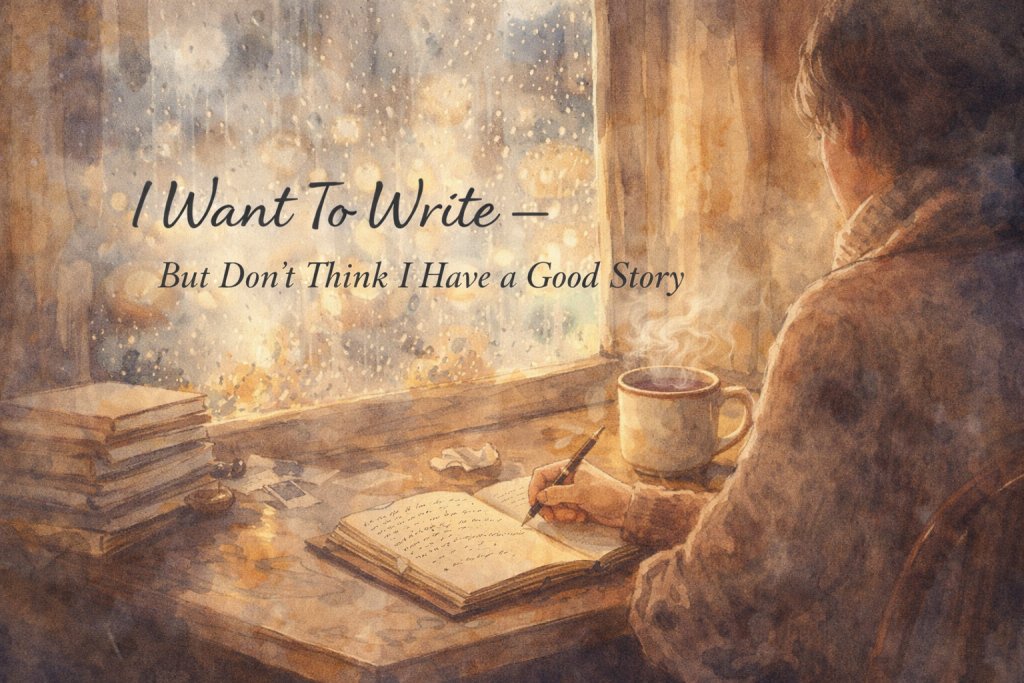
There’s a quiet ache that lives inside a lot of would-be writers. It sounds like this:
I want to write. I really do. But I don’t think I have a good story.
It doesn’t scream. It doesn’t throw tantrums. It simply sits there, whispering doubt every time you open a notebook or hover your fingers over a keyboard. And before long, that whisper becomes a truth you live by.
You tell yourself that “real writers” are struck by lightning. That they wake up already mid-story, possessed by an idea so electric it drags them out of bed at 3 a.m. You look at your life — ordinary, repetitive, beautifully boring — and think, Who would ever want to read about this?
Here’s the truth you probably haven’t heard enough:
Stories aren’t found. They are built.
And just because you don’t see your story yet doesn’t mean it isn’t there.
Let’s dig into this together.
The Myth of the Perfect Story Idea
Somewhere along the way, many of us absorbed the belief that stories must arrive fully formed. They should be brilliant from the outset. High-concept. Cinematic. The kind of idea you could pitch in one sentence and make an executive faint with excitement.
But most great stories began as something incredibly small.
A question.
A moment.
A fleeting irritation.
A face in a café that makes you wonder what they’re hiding.
I once began a novel from nothing more than the thought: What if the one person you trust most has been lying to you for years? No character. No plot. Just a splinter of curiosity under the skin that refused to leave me alone.
You don’t need a perfect idea.
You need a fragment worth exploring.
And fragments are everywhere.
Your Life Is Not Too Ordinary — It’s the Soil Your Story Grows In
“I haven’t fought dragons. I don’t live in space. I’ve never been chased through a neon city by shadowy corporations. Who wants to read about me?”
Let me tell you something comforting:
Readers don’t come to your story for events.
They come for emotion.
Falling in love for the first time. Losing someone. Being misunderstood. Being seen. Feeling powerless. Feeling unstoppable. Feeling trapped in the life you built but no longer recognize.
You’ve lived those.
We all have — but only you have lived them as you.
The way you noticed strange silence after an argument.
The particular ache of a Sunday afternoon when you were twelve.
The sound of your mother stirring tea when she didn’t know how to say what she meant.
The smell of the flat you couldn’t afford but almost rented anyway.
That is storytelling gold.
It’s not your circumstances that make your story worth telling — it’s your voice, lens, and honesty.
You Don’t Need Genius — You Need Curiosity
Good writing rarely begins with “I know exactly what this story is.”
It begins with:
- Why did that person behave like that?
- What if something familiar suddenly broke?
- What if the safest relationship in my character’s life became the most dangerous?
If you don’t feel like you have a “good story,” try this instead:
👉 Follow the questions that won’t leave you alone.
Maybe you keep thinking about the neighbour who always takes their rubbish out at 4 a.m.
Or the friend who always changes the subject when their childhood is mentioned.
Or the way grief sneaks up on you at supermarkets, of all places.
Don’t dismiss those thoughts.
Chase them.
Stories begin when curiosity latches onto something ordinary and refuses to let go.
Start With a Character — Not a Plot
Plot can be frustrating. It expects structure, momentum, logic. Characters? They just expect you to listen to them.
If you believe you don’t have a “good story,” try this:
Create a person.
Give them:
- A secret
- A longing
- A flaw that makes life harder
- A relationship that matters deeply
- A choice they don’t want to make
Now put pressure on them.
Push them out of their comfort zone. Block their easy exits. Let them lie to themselves. Let them justify terrible decisions with beautiful logic.
Sooner or later, the story will emerge from the friction.
Story is not a thing you drop onto your characters from above.
It is the shape created when your character struggles against their world.
The Fear Behind “I Don’t Have a Good Story”
Sometimes, “I don’t have a good story” is a disguise.
What we really mean is often:
- “What if I try and I’m bad at it?”
- “What if people laugh?”
- “What if I finally write and it proves what I secretly fear — that I’m not a writer at all?”
So long as the story remains unwritten, it remains perfect in your imagination. Undefined. Safe.
Writing it makes it real — flawed, human, uneven.
But perfection is not the goal of writing.
Connection is.
And readers do not connect with flawless stories.
They connect with truth, vulnerability, mess, effort, growth — all the things you’re currently trying to edit out of the process.
Story Ideas Grow When You Begin — Not Before
Here’s something I’ve learned after twenty years of fiction:
The story rarely reveals itself until I start writing it.
I’ve begun books thinking I knew what they were about, only to discover halfway through that the real story is somewhere completely different.
That’s not failure.
That’s the dance.
You cannot steer a parked car — and you can’t refine a story that doesn’t yet exist.
Write badly.
Write crooked.
Write clumsy first chapters and overwritten descriptions.
Then — slowly — shape begins to appear.
You find patterns.
Themes.
Moments that hum with quiet power.
The “good story” wasn’t missing.
It was waiting for you on the page.
Practical Ways To Find “Your” Story
Let’s ground this into something you can actually do.
1. Start a Curiosity Notebook
Every time something makes you pause — a conversation fragment, a feeling, a strange sight — write it down. Don’t judge it. Don’t demand it become a story.
You’re building compost.
Stories grow beautifully from compost.
2. Write a Scene — Not a Novel
Forget the 300-page epic for a moment. Write one scene:
- Two people disagreeing politely while wanting to scream
- Someone saying goodbye badly
- A character hiding something at breakfast
Scenes are manageable. And sometimes one scene becomes a door.
3. Ask “What If?” Until Something Clicks
“What if” is dynamite for the imagination.
What if your quietest friend is planning something catastrophic?
What if your mother’s favourite song is a message?
What if the stranger you sit next to every day knows your secret?
Don’t chase logic yet. Chase energy.
4. Let Your Flaws Speak
Some of the strongest stories come from the parts of us we wish weren’t there: jealousy, fear, pettiness, longing, restlessness.
Put them on the page.
Readers recognise themselves there — and that’s powerful.
Your Story Doesn’t Need Permission
You don’t need your story to be “big.”
You don’t need dragons or dystopian cities (unless you love dragons and dystopian cities — in which case, please include them with enthusiasm).
You need honesty.
You need curiosity.
You need the courage to begin without knowing everything.
The fear that you “don’t have a good story” is not a stop sign.
It’s simply the quiet threshold where every writer stands at the beginning — including me, including the authors you admire, including the writers who look so confident from the outside.
We all begin with uncertainty.
The only difference between writers who stay stuck and writers who grow is this:
Some of us write anyway.
So pick up the pen. Open the document. Let the first awkward sentence stumble onto the page.
Your story may not look impressive yet.
But it exists — and it’s waiting for you to bring it into the world, not as a perfect jewel, but as something living, human, and uniquely yours.
And that is more than enough.
There comes a moment in every writer’s journey where confidence quietly turns into suspicion. You’ve finished your manuscript.You’ve edited it.Maybe you’ve even rewritten large chunks . . .
Every writer eventually faces the same uncomfortable question. If a reader opened your book and read only the first page… would they keep going? It . . .
Every writer knows the feeling. You have an idea — maybe a character, a world, or a fragment of a scene — but when you . . .
There’s a delicious, tingling moment in every novel-in-progress where the story goes from blank space to spark. It’s the whisper of a character you don’t . . .