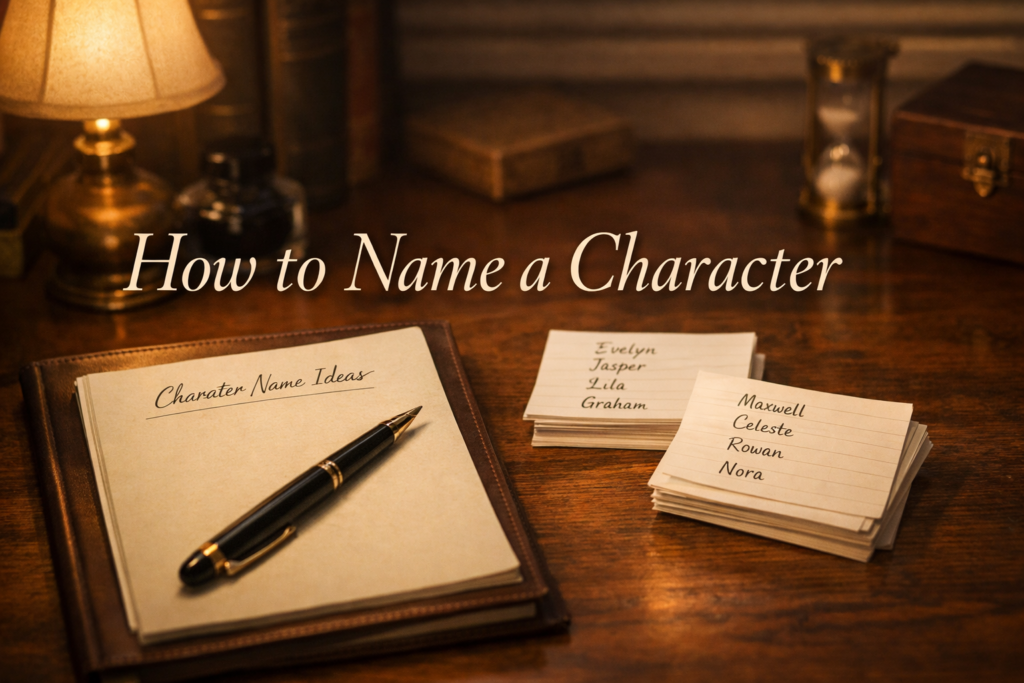
In fiction, names are far more than labels. They are tiny hooks that snag the reader’s attention, whisper meaning, hint at heritage, and sometimes (if you’re clever) foreshadow fate. A rushed or random name might leave characters floating in the story, but a well-chosen one anchors them in memory.
Over twenty years as a fiction author and teacher of writing craft, I’ve come to see naming as part art, part psychology, and part strategic storytelling. The name you give a character can signal culture, era, personality, class, thematic resonance — and sometimes mislead or delight your reader.
This article is a deep-dive guide to naming characters with intention, energy, and narrative power.
Why Names Matter More Than You Think
Some writers treat names almost as an afterthought. “I’ll think of something later,” they say, then leave placeholder “Bob” or “Girl #3” in the draft. But names carry meaning — even when readers don’t consciously notice it.
Here’s what a name can do:
1. Place Your Story in Time and Culture
Names tell the subconscious reader where and when the story occurs. “Elizabeth” and “William” feel timeless; “Blaise,” “Juniper,” or “Kael” read as contemporary or stylistic. A Rococo-era noble might be “Isabella,” while a cyberpunk hacker might be “Vex.” The name is a clue.
2. Reflect Class, Ethnicity, Personality
A name can hint at social background or cultural heritage. “Anastasia Petrova” evokes a different world than “Tess Monroe.” Without explicit exposition, your choice can communicate depth.
3. Reinforce Character Traits
Sometimes authors select names that symbolically reflect traits. A character named “Joy” might carry hope; a character named “Blake” might embody ambiguity or darkness. Use this sparingly — it should feel organic, not on-the-nose.
4. Influence Emotional Response
Some names feel soft and lyrical. Others bear sharp consonants that feel harsh. The reader’s emotional reaction can be subtly shaped by these sound qualities.
The Three Pillars of Good Character Naming
To choose names that serve your story, consider these three narrative pillars:
Pillar 1: Function
Ask yourself: What role does this character play in the narrative?
- Protagonist: A name that’s memorable, balanced, and thematically tied to your story’s emotional heart.
- Antagonist: Names with sonic weight or distinctiveness can make villains loom larger.
- Minor Characters: They still deserve authenticity — but don’t need the narrative “spotlight” that your lead demands.
Pillar 2: Context
Where and when does your story unfold?
- Historical accuracy (Geoffrey vs. Jaxon)
- Cultural resonance (Aiko, Omar, Mei-Lin, Santiago)
- Genre conventions (fantasy elven names vs gritty noir names)
Pillar 3: Sound and Readability
Language matters. Your readers will encounter these names dozens or hundreds of times — so they must roll off the tongue.
Ask:
- Is it pronounceable?
- Does it clash with other character names (Margaret vs. Martina)?
- Does it fit the narrative voice?
Practical Steps to Naming Your Characters
Now let’s walk through a practical blueprint — from first spark to final polished name.
Step 1: Understand Your Character’s Identity
Before you pick a name, know who the character is.
Answer:
- Who are they?
- What do they want?
- Where are they from?
- What family or lineage shapes them?
A name should feel like a natural extension of identity, not a constraint.
Example:
A gentle healer in a pastoral, medieval fantasy — likely a softer, melodic name. A hard-nosed detective in a crime thriller — a name with sharper sound and cadence.
Step 2: Identify Cultural and Temporal Fittingness
If your character lives in a specific culture, time, or subculture, their name should reflect that.
- Medieval Europe: Eleanor, Godwin, Beatrice
- Cyberpunk Future: Nix, Solara, Dex
- Small-Town England: Harriet, Owen, Clara
- Urban Fantasy: Names drawn from multiple heritages to reflect diversity
Research can be a friend here — but don’t just pick names because they sound cool. They must make sense in context.
Step 3: Use Sound to Communicate Mood and Character Traits
Sound symbolism is real — even if subtle.
- Hard consonants (T, K, D, G) tend to feel strong.
- Soft vowels (A, E, I) can feel lyrical or gentle.
- Repetition or rhyming elements can make names stick.
Sonic Contrast Example:
- Claire Danvers vs. Gus Thorne — different sound worlds and emotional textures.
Think of your name like music — it should resonate with the character’s emotional frequency.
Step 4: Avoid Overcrowding With Similar Names
One common pitfall: character names with the same beginning or sound.
If your protagonist is Marina, avoid two secondary characters named Mara and Miriam — the reader will trip over the similarity.
Use distinctiveness to preserve clarity in the reader’s mind.
Step 5: Keep It Readable
This is especially crucial in genre fiction like fantasy or sci-fi:
Too many hyphens, apostrophes, or invented combinations can slow the reader.
A name like Alarion Thesestra might be beautiful — but if every character’s name is six syllables, your reader needs linguistic recovery time.
Balance invented names with readability.
Naming by Narrative Strategy
There’s no single “right way” to name a character — but several narrative strategies that work well:
Strategy 1: Thematic Naming
Sometimes you want names to reflect the themes of your story.
Example for a Heroic Journey:
- Hope → name with luminous sound (Elara, Seren, Soren)
- Conflict → strong consonants (Bram, Kael, Vesper)
This is subtle — never literal. Your goal isn’t allegory, it’s resonance.
Strategy 2: Symbolic Naming
Names can carry meaning drawn from mythology, history, or language roots.
- Aria → “air/melody”
- Lucien → “light”
- Seraphine → “fiery” or “angelic”
Again, don’t overdo it. Meaning should enhance — not dictate — character.
Strategy 3: Contrast Naming
Sometimes your character’s name contrasts with their traits — to create tension.
Examples:
- A soft-spoken warrior named Silas
- A cunning politician named Beatrice
- An easy-going antagonist called Grimm
Contrast can be ironic — but it should be purposeful.
The Psychology of Recognition
Readers process names in two ways:
Conscious Recognition
They see the name and form a mental image based on familiarity.
Subconscious Resonance
They feel the name’s sound and rhythm — without intellectually analyzing it.
Great names work on both levels:
- They’re easy to remember
- They carry texture and emotion
Think of iconic character names:
Atticus, Arya, Holden, Katniss — not because they’re exotic, but because they sound like the characters themselves.
When to Name — Drafting vs. Revision
Some writers name at the very start. Others don’t name until the final revision. Both approaches work:
- Drafting first: You avoid “naming paralysis” and focus on story flow
- Revision naming: You tailor the name once character identity is fully formed
Whichever method you use, make sure the name emerges from the character, not from a random generator.
Practical Exercises to Find the Right Name
Here are exercises you can do when stuck:
Exercise 1: Write the Character’s Name in Dialogue First
Take a scene where the character introduces themselves. Let the tone of the conversation guide the name.
Does the name feel natural when spoken aloud? Does it fit the emotional moment?
Exercise 2: Build a Name Bank
Collect names from:
- History books
- Mythology
- People you’ve known
- Newspaper obituaries
- Foreign languages
Then filter that bank by:
- Pronounceability
- Narrative context
- Emotional tone
Exercise 3: Say It Out Loud Multiple Times
A name might look good on paper — but how does it sound?
Say it:
- In dialogue
- With other names
- In emotional sentences
If it trips your tongue, it will trip your reader’s.
Mistakes That Weaken Naming
Here are common missteps and how to avoid them:
🚫 Randomly Generated Names Without Context
Generators can be fun — but a randomly generated name without narrative fit is like a sticker slapped on a painting. It doesn’t belong.
🚫 Overly Complicated Names
Names with strange constructions can interrupt flow:
“X’thal’kiri” may look impressive, but every reader will pause — and sometimes that pause breaks immersion.
Keep invented names elegant and intuitive.
🚫 Too Many Similar-Sounding Names
Readers don’t have character glossaries — they have memory limits. Distinct names help them stay anchored.
🚫 Overuse of Cliché
Names like Blade, Storm, Thunder might feel bold — but overuse quickly feels gimmicky.
Instead, find authentic boldness grounded in narrative.
Naming in Series — Consistency With Evolution
If you’re writing a series, names become even more delicate:
- Don’t repeat names across main characters (no “Aria” in Book 1 and “Ari” in Book 3).
- If naming conventions change across cultures in your series world, make sure it’s intentional and explained.
Names in a series become part of brand identity — chosen well, they echo across books.
A Simple Checklist Before You Settle on a Name
Before you finalize, answer:
✔ Does this name fit the culture and era of the world?
✔ Is it pronounceable and memorable?
✔ Does it avoid clashing or echoing other major names?
✔ Does it sound appropriate in dialogue?
✔ Does it carry emotional or symbolic resonance if needed?
✔ Does it avoid cliché unless intentionally used?
If you answer yes to these, you’re on the right track.
Final Thought: Names Are the First Layer of Character Identity
A character’s name is the reader’s first handshake with them. It sets expectations. It builds tone. It carries subtle meaning long before the plot unfolds.
But names don’t exist in a vacuum. Great naming blossoms when paired with deep character work: desires, flaws, arcs, and stakes. A name can hint at identity — but your writing must reveal it.
So when you name your next character, do so with intention. Consider sound, nuance, heritage, narrative role, and emotional weight. Let the name echo the character’s soul.
Done well, it will linger in the reader’s mind — like a dream they half-remember after closing the book.

There comes a moment in every writer’s journey where confidence quietly turns into suspicion. You’ve finished your manuscript.You’ve edited it.Maybe you’ve even rewritten large chunks . . .
Every writer eventually faces the same uncomfortable question. If a reader opened your book and read only the first page… would they keep going? It . . .
Every writer knows the feeling. You have an idea — maybe a character, a world, or a fragment of a scene — but when you . . .

There’s a delicious, tingling moment in every novel-in-progress where the story goes from blank space to spark. It’s the whisper of a character you don’t . . .