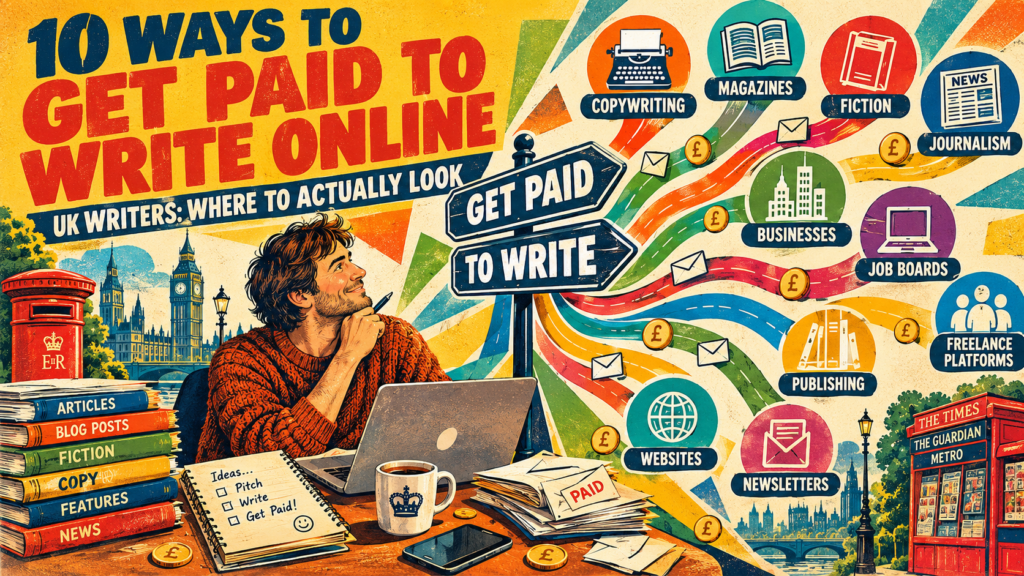
If you can write, there are more ways to make money from your words than simply trying to get a novel published.
That doesn’t mean making money from writing is easy.
It means there are more opportunities than many aspiring writers realise.
You can write website copy.
You can write blog posts.
You can write articles for magazines.
You can write advertising copy.
You can write product descriptions.
You can write newsletters.
You can write fiction.
You can write scripts.
You can write for businesses.
And you can do much of it without leaving your house.
The problem is knowing where to look.
There are hundreds of websites claiming to offer “writing jobs”, but a list of 100 websites isn’t particularly useful if half are dead, several don’t actually pay writers and the rest are competing for work that pays you three pence a word.
So let’s narrow it down.
Here are 10 genuine places and routes worth investigating if you’re a UK writer looking to get paid online.
And I’m deliberately including different types of writing.
Because if you’re serious about earning money from writing, you shouldn’t restrict yourself to one definition of what a writer does.
1. Copify
If you want to try commercial writing without immediately having to build your own client base from scratch, Copify is worth investigating.
Copify operates as a freelance copywriting platform. Writers apply, submit a CV and writing sample, and if accepted can access available assignments through its system. You choose the work that suits you rather than being tied to a regular employment arrangement. (copify.com)
The work can include different forms of commercial content, which makes it useful for someone wanting to discover whether they actually enjoy writing for businesses.
And that’s an important distinction.
Writing a novel and writing a company’s website aren’t the same job.
The skills overlap.
The objective doesn’t.
A novelist is trying to create an experience.
A copywriter is usually trying to communicate, persuade or sell.
Learning the difference can make you a much more versatile writer.
Copify says approved writers are paid after work is approved, with payment normally made by bank transfer or PayPal. (copify.com)
Best for: beginners and developing commercial writers.
Don’t expect: instant high income.
Treat it as a way to gain experience and discover what commercial writing involves.
2. Constant Content
Constant Content works differently from a conventional freelance job board.
You can create articles for its marketplace and set your own prices, or respond to custom assignments from clients.
The platform says writers can submit articles for sale and that its editors review submissions before they enter the marketplace. It also connects writers with custom client work. (constant-content.co.uk)
There’s a catch.
Constant Content keeps a percentage of the sale. Its writer-registration information currently states that writers receive 55% of the sale price, with the platform retaining 45%. International writers are paid through Wise. (constant-content.com)
So don’t look at a client’s purchase price and assume that’s what lands in your account.
Understand the economics before you commit your time.
The advantage is flexibility.
You can write about subjects you understand, build a catalogue and potentially develop relationships with repeat clients.
Best for: article writers, niche specialists and people wanting flexible commercial work.
Don’t expect: every article you write to sell immediately.
3. Creativepool
If you want to move beyond content mills and look for proper creative-sector jobs and freelance opportunities, Creativepool’s jobs directory is worth having on your radar.
It covers the wider creative industries, including writing and copywriting.
At the time of checking, Creativepool was listing writer and copywriter opportunities in the UK, including freelance and remote possibilities. Current listings included copywriting, digital content and editorial roles. (jobs.creativepool.com)
This is a different level of opportunity from writing a £20 blog post.
For example, current listings include commercial copywriting roles involving campaigns, video scripts, thought leadership, email marketing and long-form communications. (jobs.creativepool.com)
That should tell you something important.
Writing online isn’t synonymous with writing blog posts.
There is an entire commercial writing industry sitting behind websites, advertising campaigns, apps, brands and digital products.
If you’re good at adapting your writing to different purposes, there is potentially much more money there.
Best for: experienced writers, copywriters and people wanting to move into professional creative work.
4. ProCopywriters
ProCopywriters is the UK’s professional community for commercial writers.
It isn’t simply a website where you click a button and receive an article assignment.
And that’s precisely why it is worth knowing about.
ProCopywriters provides a professional network and directory for copywriters, content writers, UX writers, content strategists and content designers. It also advertises copywriting vacancies. (procopywriters.co.uk)
This is where you should start thinking differently.
Instead of asking:
“Where can I find someone who will give me a £30 article?”
ask:
“How do I become the person a company is willing to pay properly for specialist writing?”
That’s a much better long-term question.
Professional writing is not about producing as many words as possible.
It’s about producing words that solve a problem.
If you can write landing pages that convert, technical material that people understand, email campaigns that get opened or brand copy that actually sounds like the company, you’re providing a business service.
That has value.
Best for: commercial writers who want to build a proper freelance career.
5. Journalism.co.uk
If journalism interests you, Journalism.co.uk should be on your list.
Its jobs directory allows writers and journalists to search for opportunities and set up job alerts based on keywords, employment type, contract type, salary and remote working. (journalism.co.uk)
It is particularly useful because journalism offers a different route to earning from writing.
You’re not necessarily selling generic “content”.
You’re selling reporting, expertise, access, research and a story.
But don’t romanticise journalism.
The UK freelance journalism market can be financially difficult. Research reported by Journalism.co.uk in 2025 found that 73% of surveyed freelance journalists were unhappy with their earnings, while 85% had encountered offers of 20p per word or less. At the other end of the scale, some writers reported securing £1 or more per word. (journalism.co.uk)
The lesson isn’t “don’t become a journalist.”
It’s:
Know your value and learn to recognise bad rates.
Being offered work isn’t automatically a victory.
Sometimes the correct answer is no.
6. The People’s Friend
If you’re a fiction writer, don’t overlook publications that actually buy stories.
The People’s Friend is a particularly interesting example because it openly accepts unsolicited fiction from new writers. (thepeoplesfriend.co.uk)
And it publishes its payment structure.
Its current published rates state that short-story payments start at £80 and can rise to £110 after successful submissions. Serials are paid at £150 per instalment, while pocket novels and 10,000-word long reads are paid at £300. Poetry is paid at £15 per poem. (thepeoplesfriend.co.uk)
Perhaps even more importantly, it pays on acceptance rather than waiting until publication. (thepeoplesfriend.co.uk)
This is exactly the sort of opportunity aspiring fiction writers should know exists.
You don’t necessarily have to jump straight from “I’ve written my first short story” to “I need a literary agent.”
There is a market for shorter fiction.
And getting published teaches you something valuable:
How to write for a real reader rather than an imaginary one.
Best for: fiction writers, short-story writers and poets.
7. Mslexia
Mslexia is another useful UK-based publication to investigate if you’re a woman writer.
Mslexia currently says it has more than 15 paid submission opportunities in each edition, covering areas including fiction, poetry and journalism. (mslexia.co.uk)
Its submission policy states that it pays for everything it publishes, apart from some uncommissioned forum material, with fees starting at £30. (mslexia.co.uk)
Its nonfiction opportunities also show the breadth of material it considers, including journalism and personal writing. (mslexia.co.uk)
The important point here is not simply:
“Here’s another magazine that pays.”
It’s that magazines can provide a route into paid writing that isn’t traditional employment.
You develop ideas.
You pitch them.
An editor decides whether they want them.
You write to a brief.
You get paid.
That process is incredibly useful training for anyone who eventually wants to write professionally.
Best for: writers interested in journalism, essays, fiction and poetry.
8. Writers & Artists
Writers & Artists is slightly different from the other examples.
It isn’t primarily somewhere you go to grab a quick £50 writing assignment.
It is a resource for navigating the publishing industry.
Its online listings currently contain more than 5,000 publishing-industry contacts, including literary agencies and other industry organisations. (writersandartists.co.uk)
Why does that matter if you’re trying to make money writing?
Because sometimes the problem isn’t your writing.
It’s that you don’t know who buys it.
A professional writer needs to understand the market.
Who publishes this kind of work?
Who commissions it?
Who represents it?
Who edits it?
Who pays for it?
Writers & Artists can help you research that ecosystem rather than simply throwing your work into the internet and hoping someone notices.
It is particularly valuable if you’re moving towards books, publishing, children’s writing or literary work.
Best for: writers serious about turning writing into a long-term career.
9. Indeed UK
This might sound almost insultingly obvious.
It isn’t.
Indeed UK has a dedicated search for freelance copywriter roles, alongside broader content-writing opportunities. Current listings include roles such as digital content writer and writer/editor positions. (uk.indeed.com)
The mistake writers make is searching only for:
“Writer.”
Don’t.
Search for:
- Copywriter
- Content writer
- Content designer
- UX writer
- Editorial writer
- Technical writer
- Communications writer
- SEO writer
- Scriptwriter
- Bid writer
- Marketing writer
- Proofreader
- Editor
The commercial world has dozens of names for people who work with words.
If you search for only one job title, you’re deliberately making the pool smaller.
And some of the best-paid writing jobs don’t even contain the word “writer” in the job title.
10. Write Directly for Businesses
This is the one that isn’t technically a platform.
And it may be the most important one on the entire list.
Find your own clients.
Look at businesses whose websites are badly written.
Look at companies with abandoned blogs.
Look at businesses whose LinkedIn posts are dreadful.
Look at companies whose product descriptions sound like they were translated through six languages.
Look at organisations whose website hasn’t been updated since 2018.
Then approach them.
Not with:
“Hi, I’m a writer. Do you have any work?”
That’s lazy.
Instead:
“I noticed your services page doesn’t clearly explain X. I write website copy for businesses in Y sector, and I think I could help you improve it. Here’s an example of what I mean…”
Now you’re selling a solution.
That’s different.
And this is where a freelance writing career can become much more interesting.
You don’t have to wait for someone to post:
£150 — 1,000-word article — apply now.
You can create the opportunity yourself.
Don’t Ignore the Money You May Already Be Owed
There is another route to income that writers often forget.
If you’ve already had articles published in qualifying UK magazines or journals, you may be entitled to secondary remuneration through the Authors’ Licensing and Collecting Society (ALCS).
ALCS currently says eligible individual freelance writers can claim for articles published in UK journals or magazines, including online publications, subject to its rules. Claims for the previous full calendar year need to be made by the relevant deadline. (alcs.co.uk)
That’s not a replacement for getting paid by the original publication.
It’s an additional rights-based payment mechanism.
And it illustrates something important about professional writing:
Your words can have value after the initial commission.
Understanding rights is part of becoming a professional writer.
Which One Should You Try First?
That depends on what sort of writer you are.
If you’re a beginner looking for your first commercial experience, investigate platforms such as Copify and Constant Content.
If you’re already experienced, look at Creativepool and ProCopywriters.
If you want journalism, look at Journalism.co.uk.
If you write fiction, investigate publications such as The People’s Friend.
If you’re a woman writing fiction, poetry, memoir or journalism, Mslexia offers paid submission opportunities.
If you’re serious about publishing, Writers & Artists is useful for researching the industry.
And if you want a conventional job or freelance contract, don’t ignore Indeed.
But don’t try all ten at once.
That’s another common mistake.
Writers spend hours creating accounts, filling in profiles, browsing job boards and reading “how to make money writing” articles.
Then they wonder why they haven’t earned anything.
Stop researching and start pitching.
Choose two or three routes.
Create some strong samples.
Apply.
Pitch.
Follow up.
Improve.
Repeat.
Your 7-Day Action Plan
If you’ve read this article and thought, “That’s useful, but where the hell do I start?”, here’s the answer.
Don’t spend another week reading articles about making money writing.
Do this instead.
Day 1: Choose Your Writing Lane
Pick one primary route for now.
Not five.
Choose from:
- Copywriting
- Content writing
- Journalism
- Fiction
- Children’s writing
- Technical writing
- Freelance business writing
- Editing/proofreading
You can change direction later.
For now, you need focus.
Day 2: Create Three Writing Samples
You don’t need a massive portfolio.
Create three strong examples that demonstrate what you can do.
For example:
Copywriter: website homepage, sales page and email.
Content writer: blog article, how-to article and specialist piece.
Journalist: reported feature, interview piece and opinion article.
Fiction writer: short story, opening chapter and flash fiction piece.
Don’t make them average just so you can say you have three.
Make them good.
Three excellent samples are more useful than twenty pieces you don’t want anyone to read.
Day 3: Pick Three Places to Target
Choose three opportunities from the article.
For example:
- Copify
- Journalism.co.uk
- The People’s Friend
Or:
- Creativepool
- ProCopywriters
- Direct business pitching
Research their current requirements.
Read what they’re looking for.
Work out whether your writing actually fits.
Don’t send the same generic application everywhere.
Day 4: Build Your Pitch
Write a short introduction explaining:
Who you are.
What you write.
Who you write for.
What you can help with.
Where they can see your work.
Keep it short.
Nobody wants your life story.
They want to know whether you can solve their problem.
Day 5: Send Five Pitches
Not one.
Five.
Apply for suitable opportunities or contact potential clients.
If you’re pitching businesses directly, identify five companies where you can genuinely see a writing problem you could solve.
Don’t spam fifty businesses with the same message.
Send five intelligent pitches.
Day 6: Follow Up and Improve
Look at what you’ve sent.
Would you respond to it if you were the editor or client?
Is it too long?
Is it too vague?
Does it explain what you offer?
Does it demonstrate that you’ve actually looked at their publication or business?
Improve it.
If you’ve received a rejection, don’t automatically assume the writing was terrible.
Rejection is normal.
Look for patterns instead.
Day 7: Set Your Weekly Target
Now create a repeatable system.
For example:
Every week:
- 5 targeted applications or pitches
- 1 new portfolio piece
- 1 hour researching potential clients/publications
- 1 hour improving your commercial writing
- 1 hour following up existing opportunities
That’s manageable.
And more importantly, it’s measurable.
After four weeks, you’ll have sent around twenty targeted pitches.
Now you’re actually testing whether this can generate work.
That’s far more useful than reading another article promising you can earn £5,000 a month writing from your sofa.
The Goal Isn’t to Find “A Writing Job”
It’s to build a pipeline.
That’s the mindset shift.
One job comes and goes.
A pipeline means you’re always looking for the next opportunity.
Some pitches will fail.
Some will be ignored.
Some will produce small jobs.
Some may become repeat clients.
Some may lead somewhere much bigger.
That’s normal.
Don’t judge your entire writing career by one rejection.
And don’t judge it by one successful job either.
Build the habit.
Write.
Pitch.
Learn.
Improve.
Pitch again.
The Reality of Getting Paid to Write
There is no secret website where you sign up on Monday and are earning £3,000 by Friday.
If someone promises you that, be suspicious.
There are legitimate ways to make money writing online in the UK.
But they involve competition.
They involve rejection.
They involve deadlines.
They involve learning commercial writing.
They involve producing work that somebody else actually wants.
And sometimes they involve accepting that a £20 assignment isn’t worth the time it takes to complete it.
That’s part of becoming professional.
The good news is that you don’t have to wait for somebody to give you permission to call yourself a writer.
Start building the portfolio.
Write the samples.
Pitch the publication.
Apply for the job.
Approach the business.
Learn the commercial side.
And keep writing.
Because the internet isn’t short of people who say:
“I want to make money writing.”
It is short of writers who can consistently produce good work, understand what a client or editor actually needs, and deliver it when they said they would.
Be one of those writers.
That’s where the money is.
SEO Tags
Image Prompt
Social Media Post
Want to get paid to write?
You don’t necessarily need a publisher.
You don’t need a huge social-media following.
And you don’t need to wait until you’ve written a novel.
There are businesses, magazines, job boards, freelance platforms and publications actively looking for people who can write.
I’ve put together 10 ways UK writers can find paid writing work online, covering everything from copywriting and content writing to journalism, fiction, magazines and finding your own clients.
I’ve also included an important warning:
Not every “writing opportunity” is worth taking.
Some jobs pay badly. Some demand far too much for the money. And some are useful stepping stones while others are simply a waste of your time.
The trick isn’t finding any writing work.
It’s finding writing work that is worth doing.
10 Ways to Get Paid to Write Online in the UK
If you’re serious about turning your writing into an income, this is a good place to start.
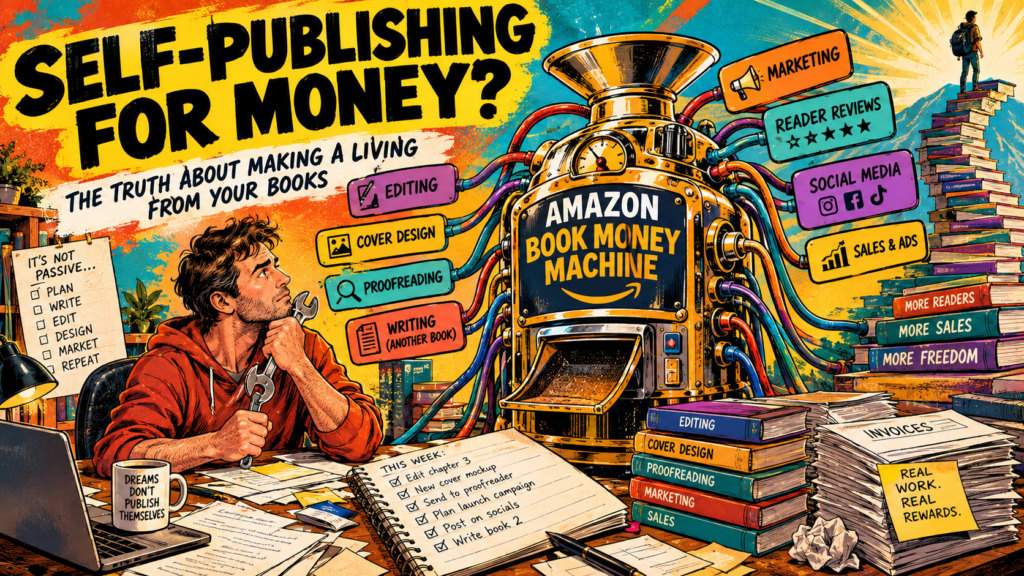
There is a very attractive idea floating around the internet. Write a book. Publish it on Amazon. People buy it while you sleep. Then write . . .

There is a particular moment every writer dreams about. You type the final sentence. You write THE END. You sit back, perhaps with a cup . . .
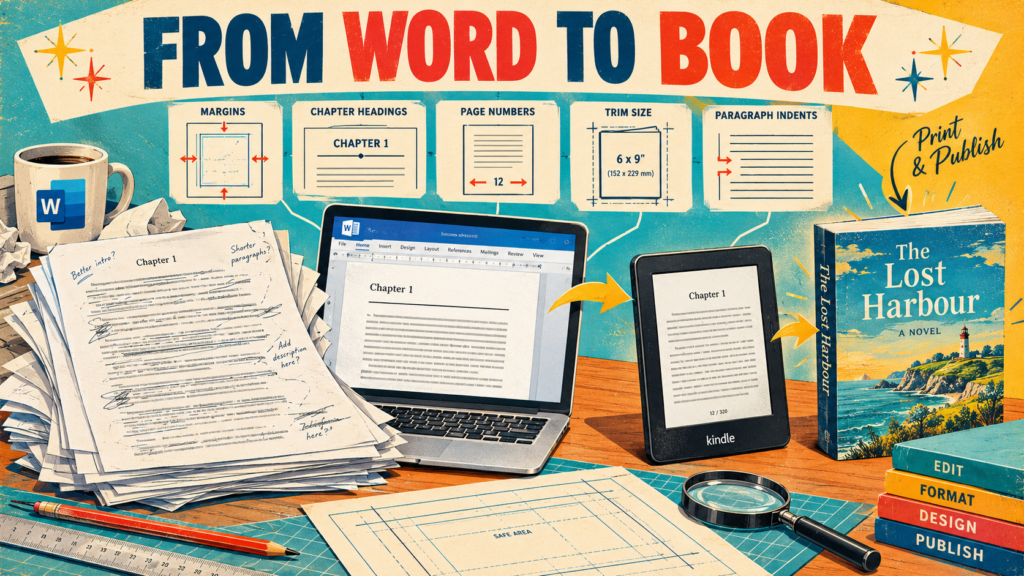
Finishing the novel is the hard part. Or at least, that’s what you tell yourself. Then you open Microsoft Word and discover that you now . . .
There’s a particular kind of misery that writers know well. You sit down, you open the document, and you stare at the cursor blinking back . . .