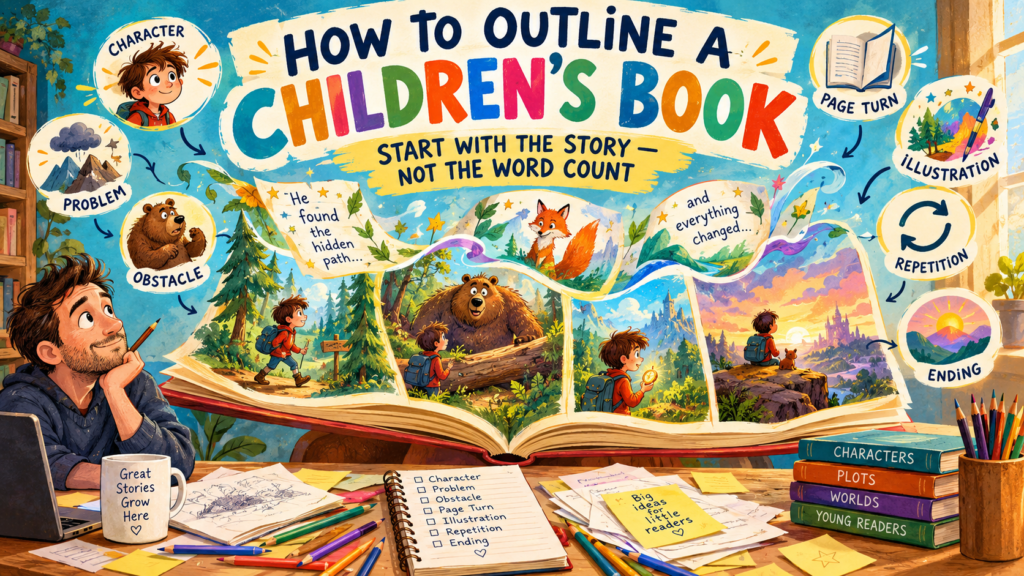
There is a dangerous assumption about children’s books.
Because they’re short, they’re easy.
You only need a few hundred words. The sentences are simple. The characters are usually funny animals or children. There are lots of pictures.
How difficult can it be?
Quite difficult, actually.
Writing for children is one of those jobs that looks easier from the outside because the finished product is often deceptively simple.
A good picture book might contain only a few hundred words.
But those few hundred words have to do an enormous amount of work.
They have to introduce a character.
Create a problem.
Make the reader care.
Move the story forward.
Create opportunities for illustrations.
Build tension.
Deliver an emotional payoff.
And finish before the child’s attention wanders off to something else.
That isn’t easy writing.
That’s compressed storytelling.
And if you want to write a children’s book, one of the best things you can do before writing the manuscript is create an outline.
Not because you need to turn a children’s story into a complicated spreadsheet.
You don’t.
You need an outline because when you only have a few hundred words to tell a story, you cannot afford many pointless ones.
First, Decide Who You’re Actually Writing For
“Children” isn’t an audience.
It’s an enormous collection of completely different audiences.
A story for a two-year-old isn’t the same thing as a story for a six-year-old.
A book for an early reader isn’t the same thing as a middle-grade novel.
The language, structure, humour, emotional complexity, illustrations and expectations are different.
This needs to be decided before you outline the story.
If you don’t know the approximate age of your reader, you don’t really know what you’re writing yet.
Ask yourself:
How old is the child who is supposed to enjoy this?
Then ask a second question that writers sometimes forget:
Who is going to read it to them?
For very young children, the adult matters too.
They are the person buying the book.
They may be the person reading it repeatedly.
They may be the person deciding whether they actually enjoy reading it for the fiftieth time.
That means a children’s book often has two audiences.
The child needs to enjoy the story.
The adult needs to enjoy reading it.
That’s quite a balancing act.
Don’t Start With a Moral
One of the easiest ways to make a children’s story dull is to begin with a lesson.
“I want to teach children about sharing.”
Fine.
But that’s not a story.
That’s a subject.
“I want to teach children that it’s okay to be afraid.”
Again, that’s a theme.
Not a story.
Stories happen when something happens to somebody.
Instead of starting with:
This book teaches children about courage.
start with:
A little girl desperately wants to enter the swimming pool, but she’s terrified of getting in.
Now you have something.
She wants something.
Something is stopping her.
There is a problem.
There is somewhere for the story to go.
The lesson can emerge naturally from what happens.
And that’s much more effective than making your character wander through twelve pages delivering a moral.
Give Your Character Something They Want
Children’s stories still need characters with desires.
They don’t have to be complicated.
A character might want:
- to make a friend
- to find their lost toy
- to prove they aren’t scared
- to win a race
- to rescue somebody
- to stay awake
- to avoid going to bed
- to find out where a mysterious noise is coming from
The important thing is that the character wants something.
Because wanting creates movement.
If your character doesn’t want anything, there is very little reason for them to do anything.
And if they don’t do anything, you haven’t got much of a story.
Give Them a Problem That Gets Worse
This is where your outline becomes useful.
Your character wants something.
Good.
Now make it difficult.
And then make it more difficult.
And then make it worse.
You don’t necessarily need a villain.
The obstacle could be fear.
It could be embarrassment.
It could be a misunderstanding.
It could be a storm.
It could be another character.
It could simply be that the character keeps making the wrong decision.
Imagine a child who wants to enter a school talent show.
At first, they are nervous.
Then they forget their words while practising.
Then their costume breaks.
Then they discover their best friend has dropped out.
Then they have to decide whether to go on stage alone.
That’s a story.
Notice what happened.
We didn’t add random events just to fill pages.
Each problem pushes the character closer to a decision.
That’s what you want from an outline.
Don’t Confuse “Something Happens” With Plot
This is particularly important when writing for children.
You can create a sequence of increasingly silly events and still not have a story.
A rabbit loses a hat.
The rabbit searches for the hat.
The rabbit meets a fox.
The fox hasn’t seen the hat.
The rabbit finds a frog.
The frog hasn’t seen it either.
Then a bird finds the hat.
Something happened.
Then something else happened.
Then something else happened.
But why should we care?
The events need to connect to the character’s problem.
Perhaps the hat belonged to the rabbit’s grandmother.
Now finding it matters.
Perhaps the rabbit believes losing it means they’re irresponsible.
Now there’s an emotional problem.
Perhaps the rabbit has to admit they lost it.
Now there is a choice.
A story isn’t a list of events.
It’s a chain of consequences.
Outline the Emotional Journey Too
This is where children’s book outlines can become much more useful than simple plot summaries.
Don’t just write:
Page 1: Lucy goes to school.
Page 2: Lucy meets a dog.
Page 3: Lucy loses her bag.
Ask:
What is Lucy feeling?
Perhaps:
Lucy feels nervous.
Then:
Lucy becomes curious.
Then:
Lucy becomes frightened.
Then:
Lucy feels helpless.
Then:
Lucy realises she can solve the problem.
Then:
Lucy feels proud.
Now you’re outlining a character journey rather than simply moving a character around a location.
That emotional progression is often what children remember.
They may not remember every event.
They remember how the story made them feel.
Think in Pages, Not Just Chapters
If you’re writing a picture book, page structure matters.
The source material discusses planning a story across spreads rather than simply writing one continuous block of text, and that is an important distinction.
A page turn can be part of the storytelling.
You can reveal something on the next page.
You can create anticipation.
You can set up a joke.
You can hide something in the illustration.
You can leave the reader wondering what happens next.
Imagine:
“Tom opened the cupboard…”
Turn the page.
The illustration reveals an enormous dragon sitting inside.
That is storytelling.
The words don’t have to tell the reader everything.
In fact, they often shouldn’t.
Let the Illustrator Tell Part of the Story
This is one of the biggest differences between writing many children’s books and writing ordinary prose.
You have another storyteller working alongside you.
The illustrator.
Don’t fight them.
If the text says:
Emily walked into the kitchen. She saw a huge green monster sitting on the table. The monster had three eyes, enormous purple ears, six orange fingers and a yellow hat.
you’ve potentially done the illustrator’s job for them.
Maybe the words only need:
Emily walked into the kitchen.
The picture can reveal the monster.
And suddenly the page has a visual joke.
The child sees something Emily hasn’t noticed yet.
That’s far more interesting.
Words and pictures should work together, not repeat each other.
Your Outline Should Leave Room for the Pictures
When you outline a children’s book, don’t think only about what the words say.
Think about what could be happening visually.
Where is the big reveal?
Where is the funniest picture?
Where is the most emotional image?
Where could the illustrator hide a visual joke?
Where can the page turn create suspense?
Where can the picture contradict the text in an amusing way?
For example:
“There was absolutely nothing unusual in the garden.”
And the illustration shows a dinosaur sitting behind the shed.
That’s funny because the words and image are doing different jobs.
The outline needs to leave room for those possibilities.
Repetition Isn’t Lazy
Adults often worry about repetition.
Children often love it.
A repeated phrase can become part of the pleasure of reading a story aloud.
Think about the experience of a child hearing the same story repeatedly.
Eventually they know what’s coming.
They join in.
They say the repeated line before the adult does.
That isn’t a flaw.
It’s participation.
If you have a phrase that becomes increasingly funny or meaningful as the story progresses, use it.
But don’t add repetition simply because someone told you children’s books need repetition.
It needs to have a purpose.
A repeated phrase can create rhythm.
It can build anticipation.
It can become a joke.
It can change meaning by the end.
That’s much more interesting than simply repeating the same sentence because repetition is supposedly “good for children.”
Don’t Make the Story Too Educational
This is another trap.
Some writers become so concerned about teaching something that the story disappears underneath the lesson.
A character doesn’t need to learn:
“It is important to share because sharing is a positive social behaviour.”
They need to experience sharing.
Perhaps two children both want the same toy.
They argue.
One gives in.
Then they discover they can play together.
The reader understands.
You don’t need to underline it.
Children aren’t stupid.
They don’t need every story to explain its own meaning.
Give them enough credit to work things out.
A Simple Children’s Book Outline
Before writing your manuscript, try creating a one-page outline.
Start with:
Main character:
Who are they?
What do they want?
What are they trying to achieve?
Why does it matter?
Why should we care?
What’s stopping them?
What is the main obstacle?
What gets worse?
How does the problem escalate?
What choice must they make?
What decision drives the climax?
What changes?
What does the character discover?
How does it end?
What is the emotional payoff?
Then break the story into the pages or spreads you expect to use.
Don’t write the entire manuscript.
Write what happens.
For example:
Spread 1: Introduce Mia and her enormous fear of dogs.
Spread 2: Mia discovers a lost puppy outside her house.
Spread 3: She tries to ignore it.
Spread 4: The puppy follows her.
Spread 5: Mia tries to hide.
Spread 6: The puppy gets into trouble.
Spread 7: Mia has to decide whether to help.
Spread 8: She approaches the puppy.
Spread 9: The puppy trusts her.
Spread 10: Mia discovers she isn’t as frightened as she thought.
Spread 11: The owner arrives.
Spread 12: Mia says goodbye — and then notices another dog nearby.
Now you have the bones of a story.
More importantly, you can see whether there actually is a story.
The Outline Should Expose Bad Ideas
This is one of the best reasons to outline.
It can save you from writing 800 words of something that doesn’t work.
Perhaps your character doesn’t actually have a problem.
Perhaps the ending is obvious.
Perhaps the middle is just a collection of random events.
Perhaps the “lesson” is much stronger than the story.
Perhaps you’ve got three characters doing the same job.
Perhaps the final page doesn’t actually resolve anything.
Discovering those problems in an outline is good.
Discovering them after you’ve written the entire manuscript is considerably more annoying.
An outline isn’t there to kill creativity.
It’s there to give you somewhere to test the idea before you spend hours writing it.
But Don’t Outline the Life Out of It
There is a point where an outline becomes counterproductive.
You don’t need a fifty-page document explaining every adjective.
You don’t need to know precisely what every character is thinking on every page.
You don’t need to decide every joke before you’ve written the first draft.
You need enough structure to know where you’re going.
Then you write.
If something better happens while you’re writing, follow it.
The outline isn’t your boss.
It’s a map.
And maps are useful precisely because you don’t have to stare at them while walking.
The Shorter the Book, the More Every Word Matters
This is the strange paradox of children’s books.
You might spend months writing something that takes five minutes to read.
That’s not because you’re doing something wrong.
It’s because compression is difficult.
Writing 100,000 words gives you room to wander.
Writing 500 words doesn’t.
Every sentence has to earn its place.
Every page has to contribute.
Every character needs a reason to exist.
Every scene needs a purpose.
Every repeated phrase needs to work.
Every page turn is an opportunity.
Every illustration can carry information.
That is why you should never look at a children’s book and think:
“I could write that in an afternoon.”
Perhaps you could.
But writing the right 500 words is much harder than writing 5,000.
The Best Children’s Books Don’t Talk Down to Children
This may be the most important thing to remember.
Children are inexperienced.
They are not stupid.
They understand fear.
They understand embarrassment.
They understand jealousy.
They understand friendship.
They understand wanting something desperately.
They understand getting things wrong.
They understand being told “no.”
They understand loneliness.
They understand humour.
They understand unfairness.
They understand much more than adults sometimes give them credit for.
Write for their emotional intelligence.
Use language they can understand.
But don’t make the story intellectually empty.
Give them something to discover.
Give them something to laugh about.
Give them something to recognise.
Give them a character whose problem feels real, even if the character happens to be a talking squirrel.
Start With the Story, Not the Word Count
If you want to write a children’s book, don’t begin by opening a blank Word document and thinking:
“I need 800 words.”
That’s the wrong starting point.
Start with:
Who is this about?
What do they want?
What’s stopping them?
What happens when they try to solve it?
What changes?
How should the child feel when the book ends?
Then think about the pages.
Then think about the pictures.
Then think about the language.
Then write.
Because the goal isn’t to produce a short book.
The goal is to produce a complete story that happens to be short.
That’s a very different challenge.
And if you get that right, the simplicity of the finished book will be deceptive.
A child might read it in five minutes.
A parent might read it in three.
But behind those few minutes should be a story that has been carefully constructed, deliberately paced and stripped of everything that doesn’t need to be there.
That’s not easy writing.
That’s knowing exactly what you want to say — and having the discipline to leave everything else out.
There is a piece of writing advice that sounds sensible, looks sensible and is, in isolation, absolutely sensible: Keep your writing clear. Put the character . . .
There is a particular moment in writing a novel that can make you question every decision you’ve made since the first chapter. You’ve been writing . . .
There comes a moment in every writer’s journey where confidence quietly turns into suspicion. You’ve finished your manuscript.You’ve edited it.Maybe you’ve even rewritten large chunks . . .
Every writer eventually faces the same uncomfortable question. If a reader opened your book and read only the first page… would they keep going? It . . .